


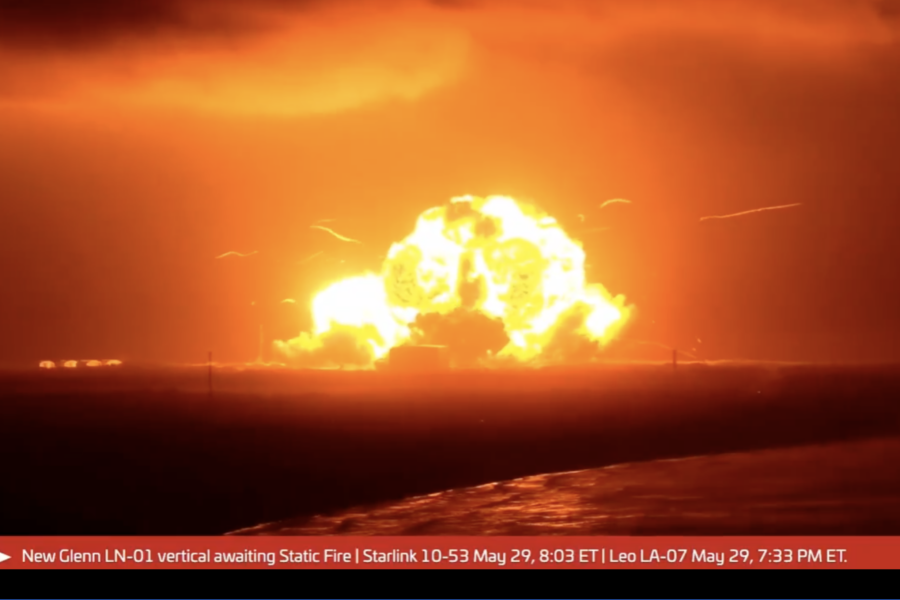
The May 28 explosion of a Blue Origin rocket at Cape Canaveral Space Force Station, Fla., is the largest the installation has seen in its history, according to the commander of the range.
Col. Brian Chatman, commander of Space Launch Delta 45, told reporters June 2 that despite the unprecedented nature of the anomaly, the base’s safety precautions before and after the incident helped contain its impact on personnel and on the broader installation.
“What that identifies is that we’ve got the right safety procedures really laid in to keep personnel safe and to keep the public safe when we go through launch operations and we have a major anomaly,” Chatman said. “We know what post-anomaly response looks like, and we tested that in real time with regards to the incident that occurred Thursday night.”
The New Glenn explosion occurred during a hotfire test in preparation for a planned June 4 launch. The company hasn’t identified the root cause, but it caused a fireball that appeared to consume a large portion of Space Launch Complex 36A, Blue Origin’s sole New Glenn launch pad. In a June 1 update, CEO Dave Limp said the damage was less extensive than initially feared, noting that the pad’s water tower, propellant farm, oxygen, and liquid hydrogen tanks “are all in good shape.”
“This is good luck because these are very long lead items,” he said, adding that he expects New Glenn to fly again before the end of the year.
Because Blue Origin’s pad is the range’s southern-most launch complex, SLD 45 was able to work through the anomaly response without impacting other operations on the range, Chatman said. In fact, a SpaceX launch flew within 12 hours of the incident and a United Launch Alliance mission lifted off the evening of May 29.
“In this instance, geography was our friend,” he said.
The SLD 45 team is still gathering data on the explosion’s impact on the area surrounding Blue Origin’s facility. Chatman said there is confirmed damage to a nearby hangar and a weather balloon release area, though equipment in the latter facility was available to support the ULA launch.
“As the Interim Safety Board team goes out and assesses the other government facilities in and around the area outside of the [Blast Danger Area], we’ll get a better feel for what that damage looks like,” he said. “We just haven’t gotten out to the facilities yet to take a look, other than those right around the edge of the BDA at this point.”
The Blast Damage Area is a safety perimeter established around the launch pad prior to launch operations. Personnel and the public are prohibited from entering that zone, and it’s set based on a number of factors, including the amount of fuel a vehicle is carrying and which direction the wind is moving. For the New Glenn hotfire test, the BDA was more than 7,000 feet in diameter.
The New Glenn anomaly comes amid a significant increase in activity at the Space Force’s Eastern Range. The installation supported 109 launches in 2025 and expects that number could grow to between 500 and 1,000 by 2036. To manage that demand, the service is making upgrades to both Cape Canaveral and its spaceport at Vandenberg Space Force Base, Calif., to make operations more efficient and safe even as that cadence increases. It’s also making room for new launch providers, with companies like Stoke, Relativity, and Blue Origin debuting rockets now and in the coming years.
Asked whether he’s concerned that the risks associated with launching less seasoned vehicles could impede operations in the years to come, Chatman said he and the Space Force’s launch enterprise will work to incorporate lessons learned from the New Glenn incident into its strategy moving forward. While it’s still early days, Chatman said the anomaly sheds light on the need to reduce the number of people traveling to and from a launch pad. It also helps make the case for more efficient traffic flow, better pad access, and improved commodity delivery.
“Looking through the lens of public safety, looking through the lens of safety of the men and women operating on Cape Canaveral—whether that’s Space Launch Delta 45 personnel or industry partner personnel, launch service providers—and then working on how we can maximize efficiency to hit that launch cadence of 1,000 launches in the 2036 time frame, are all things that we’re laying in now,” he said.