


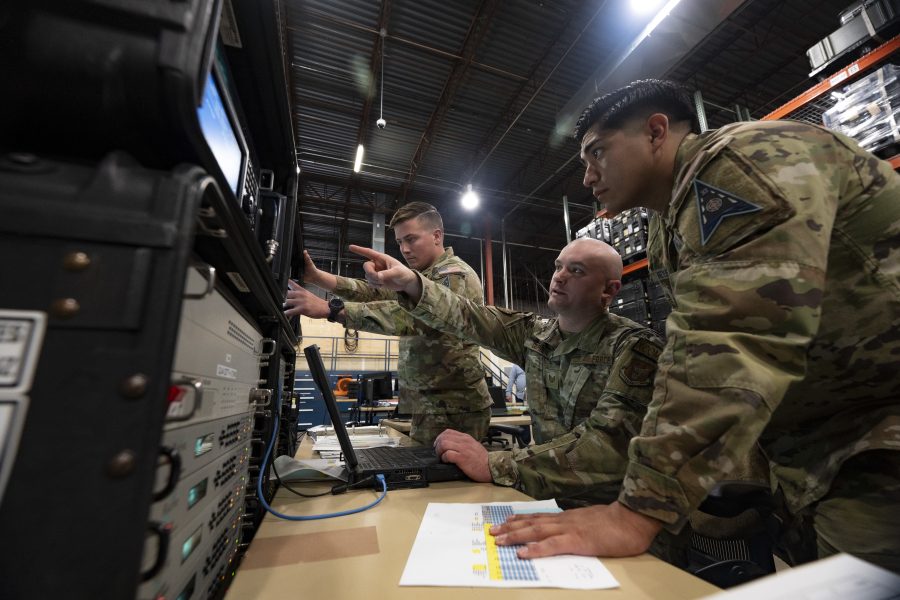
The Space Force wants to make its electronic warfare capabilities more resilient by building five new tactical EW centers in the U.S. and around the globe, the need for which was underscored by recent Iranian attacks on USSF infrastructure and assets.
“We’ve seen in Operation Epic Fury for the first time that our space capabilities have been targeted and destroyed,” Brig. Gen. Christopher Fernengel, the service’s director of plans and programs, said last week. “We expect that to happen more.”
Fernengel, speaking at the the State of Space Industrial Base conference on May 28, didn’t specify on what capabilities were destroyed. But Iran launched missiles and drones at multiple U.S. bases in the Middle East in the early days of Epic Fury, including Al Udeid Air Base, Qatar, where Space Forces Central has a growing presence.
Even beyond those strikes, Fernengel noted that adversaries are trying more and more to take out Space Force systems at home or abroad, using both kinetic and cyber weapons.
In response, Space Force leaders see a need to build up their operations center infrastructure, since those are the main way Guardians control their capabilities. Lt. Gen. Douglas A. Schiess, nominated to be the next Chief of Space Operations, said in April that “we just need to make sure that we have more resiliency in where we do operations from and and where we go with new programs.”
The 2027 budget request includes $1 billion for four new space operations centers around the country, and Fernengel hinted that there was also “significant investment” for EW centers in the request.
A Space Force spokesperson confirmed to Air & Space Forces Magazine that the service is requesting funds to build five new EW operations centers, but said the amount is classified.
Retired Space Force Col. Charles Galbreath said more EW ops centers is a critical need.
“Dispersing multiple capabilities across diverse locations provides a measure of resilience to the architecture, by decreasing the significance of a loss to any single event,” Galbreath, now the head of the Mitchell Institute for Aerospace Studies’ Spacepower Center of Excellence, wrote in an email.
There is currently just one SEWTOC, run by Mission Delta 3, established at Peterson Space Force Base, Colo., late last year. If funded, the five new centers will be placed according to the Air Force Strategic Basing process, the spokesperson said.
Manning for the centers is under continuous evaluation, the spokesperson said, and will be determined once the fiscal 2027 budget is enacted into law.
The current plan calls for a mixture of systems both in the homeland and abroad to support the U.S. military’s heavy reliance on remote capabilities, Fernengel said, speaking both of EW and space operations centers.
The EW centers can operate offensively or defensively and assist joint service across the electromagnetic spectrum by protecting satellite communications, for example, and disrupting enemy signals.
Galbreath said preserving or disrupting connectivity through EW is the “primary means” of achieving space superiority.
“The importance of providing base defense to prevent an adversary from successfully executing attacks against our EW counter communication systems cannot be overstated,” Galbreath said. “Resilience and defense must go hand in hand.”
The Gear
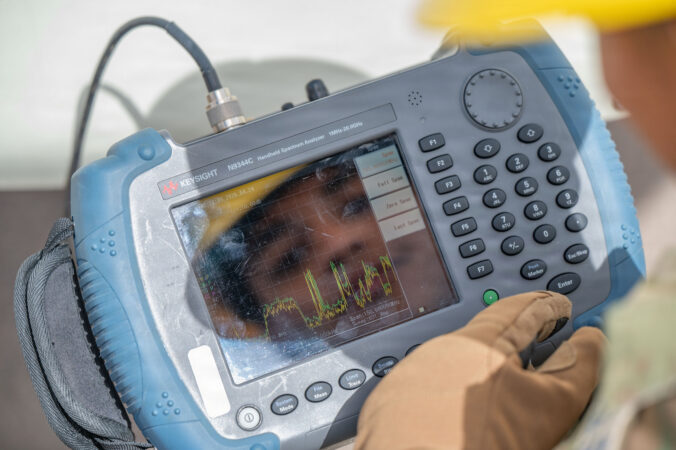
The first SEWTOC at Peterson uses a signal jamming system called Remote Modular Terminal, made by Northstrat with CACI, and Bounty Hunter, a ground-based system that protects U.S. and allied satellite communications links.
The RMT, which costs about $1.5 million each, was fielded at two separate locations and controlled by a third system for the first time in 2024 by Space Training and Readiness Command, according to a STARCOM release. At the time, the program was funded for 160 RMTs.
“These newer systems can be deployed globally with greater ease and can even be operated remotely, reducing the risk to personnel and increasing operational flexibility,” Mission Delta 3 commander Col. Angelo Fernandez said in a release.
Huntsville, Ala.-based COLSA has built and maintained Bounty Hunter since 2011, according to the company’s website.
Bounty Hunter works as a kind of “celestial detective” and has been deployed to both U.S. Central Command and U.S. Indo-Pacific Command to “detect, characterize, geolocate and report” sources of electromagnetic interference, according to a 16th Electromagnetic Warfare Squadron release.
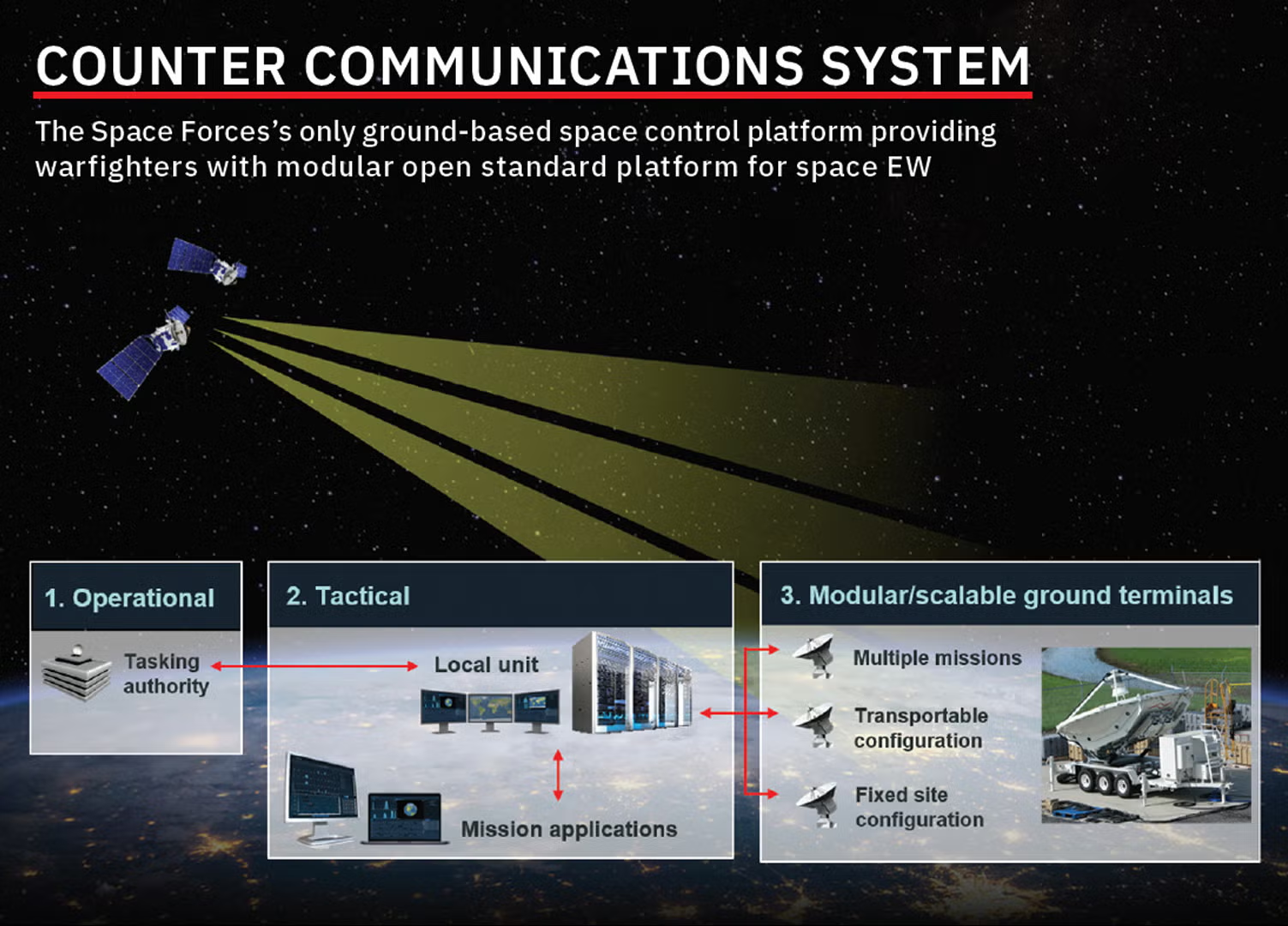
The system works with the Counter Communications System, which is soon to be replaced by Meadowlands, both built by L3Harris.
The company delivered two Meadowlands systems to Space Force in April 2025.
Planned to enter operations this year, Meadowlands is a lighter and more compact version of CCS, which allows one operator to control 300 percent more simultaneous missions from remote locations, according to a Space Systems Command release. It is also easier to assemble and operate.
Bounty Hunter has been used heavily in the 21-year-old Operation Silent Sentry, currently run by the 16th Electromagnetic Warfare Squadron and the 380th Electromagnetic Warfare Squadron, supporting remotely controlled aircraft and spectrum overwatch for in-theater naval assets in CENTCOM, according to the release.