


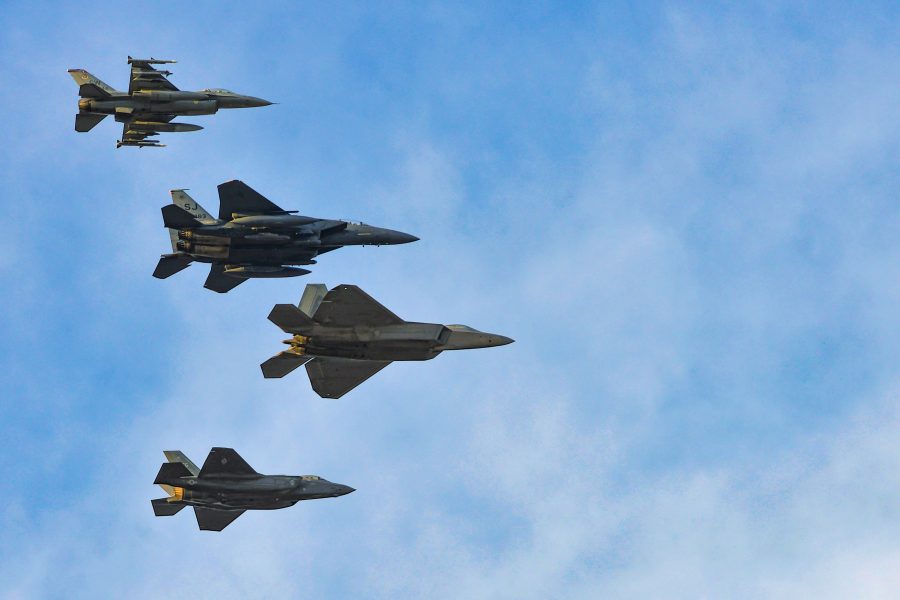
The Air Force’s primary fighter fleet dipped below the minimum allowable size under law earlier this year—and that fact should rally a “call to action” for the nation to reinvest in its airpower, a key lawmaker said June 2.
Rep. August Pfluger (R-Texas), a former F-22 pilot now serving in Congress, is sounding the alarm. “This is the moment I think that Congress needs to take action,” Pfluger said during an interview at AFA’s Mitchell Institute for Aerospace Studies. “Just that stat right there should wake up everybody. It should definitely be a call to action.”
Congress wrote into law in 2017 that the Air Force must maintain at least 1,145 fighters in its primary mission aircraft inventory (PMAI)—defined as those aircraft “assigned to meet the primary aircraft authorization to a unit for the performance of its wartime mission.”
Lawmakers gave the Pentagon a temporary exception to the requirement in 2025, but that waiver is now expired. The trade newsletter Inside Defense first reported the matter May 28, and Air & Space Forces Magazine independently confirmed that report.
The Air Force asked Congress to adopt a new measure of force size last summer, counting combat-coded total aircraft inventory instead of PMAI. The combat-coded inventory includes backup and attrition reserve aircraft, and is therefore greater than PMAI. But lawmakers declined to grant that request in the 2026 National Defense Authorization Act and a spokesman said the Air Force is trying again to get the change approved in the 2027 authorization bill.
Combat-coded TAI “is a better assessment of combat aircraft available to the warfighter,” the spokesperson said. “PMAI is a ‘funding code.’”
The difference is in how one looks at the numbers. The Air Force makes note that backup and attrition aircraft are mission-capable and therefore deployable; but critics say PMAI is more than a just “funding code,” but rather the figure used to define how many pilots, maintainers, and other personnel are needed, how many spare parts to order, and more. Arbitrarily choosing a different way to count the size of the fleet “kind of masks the Air Force’s readiness and manning crisis,” retired Lt. Gen. David A. Deptula, dean of the Mitchell Institute for Aerospace Studies, has said.
Addressing that concern to Pfluger, Deptula asked, “When is this decline in the Air Force’s force structure going to stop?”
“We still need to invest in aircraft. … Now is the moment,” Pfluger said. “I mean, this really is the moment, and I don’t want to make this political, but we’ve seen the ebbs and flows of different administrations, and no administration has gotten it exactly right. But I do think that President Trump is committed to recapitalizing our military.”
The Trump administration’s proposed $1.5 trillion defense budget includes billions of dollars to improve aircraft readiness, but the Air Force’s procurement plans call for adding just 62 new USAF fighters in 2027: 38 F-35s and 24 F-15EXs. The service has long maintained that it needs to acquire at least 72 fighters a year, but consistently has fallen short of that mark.
As one of only a few former fighter pilots and Air Force vets in Congress—and chair of the influential Republican Study Committee caucus—Pfluger is making the case for a strong defense budget.
“In Congress, this is a moment in time where we have the ability to fund airpower, and I mean joint airpower here, to fund airpower, to recapitalize airpower, and to do the right thing, so that we keep our nation safe,” he said.
The administration’s spending plan breaks the budget into two pieces, one being the conventional appropriations process and the second using a procedural mechanism known as reconciliation, by which the majority can approve funds without following the normal appropriations process or needing the minority party’s votes. Last year’s One Big Beautiful Bill Act used that process to push through a host of reforms, including $150 billion for defense. The administration wants to achieve the same success this year, seeking $1.15 trillion in the base budget and another $350 billion through reconciliation.
Pfluger is closely involved in crafting the next defense-focused reconciliation package, which he says the House will try to pass by July 23.
“I work with [Speaker of the House Mike Johnson] on a daily basis,” Pfluger said. “As the chairman of the Republican Study Committee, we’ve really been the architect of what this bill will look like.”
Now he’s got to beat the skeptics.
“A lot of people have said, ‘Well, that’s nearly impossible,’” Pfluger said. “We have the framework ready. We’ve had many conversations, and it’s going to take us continuing to work. We will meet this week multiple times on this subject, and I think that we’re going to be successful on this, and defense will be a big piece of that.”
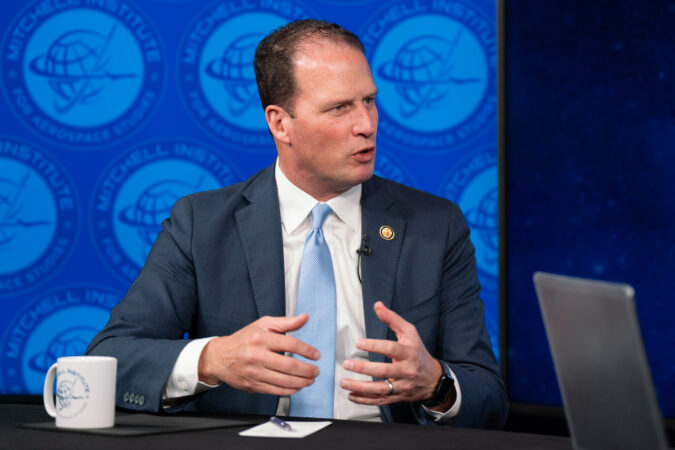
Photo by Jud McCrehin/ Air & Space Forces Association
The stakes are particularly high for the Air Force fighter fleet. The base budget seeks to fund just 24 F-35s, with the remaining 14 to be funded through reconciliation. Without that money, USAF could get just 24 of the jets for the second year in a row. Meanwhile, the Air Force continues to divest older aircraft faster than it takes in new ones.
It’s up to Congress to give the Air Force the resources it needs, Pfluger said, but the service can help its cause.
“We also need the Department of the Air Force to really stand up and sound the alarm bells right now,” Pfluger said. “I think this is a break-glass moment. I think that we are at that moment where the department can really stand up and say, ‘We’ve had enough, and here’s how we fix the problems and stop this decline, triage the situation, and get healthy.’”
If it doesn’t, the Air Force won’t get the modern jets it needs.
“Now is our time to go further and to produce these weapons,” Pfluger said. “And I’ll say, I think there was a mistake made in the 2010, 2011, 2012 timeframe. We were in a very tough war in Afghanistan, in a real war, a real threat to our way of life—but choosing to not produce weapon systems at the numbers that we had initially looked at producing, such as the F-22, I think was a mistake. Let’s learn those lessons and not make the same mistakes now so that we have that deterrent force and a capable force for the future.”