
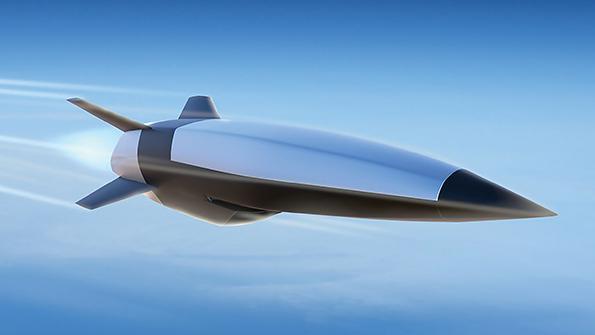
The Pentagon’s top research lab is interested in developing a hypersonic cruise missile prototype that provides “a revolutionary leap in operational performance,” as the first wave of U.S. hypersonic weapons enters production and service.
The Defense Advanced Research Projects Agency released a notice Aug. 7, informing industry of a potential new program called the Next-Generation Hypersonic Cruise Missile and seeking information and ideas on the topic.
“The goal is to design, build, and flight-test a fully integrated hypersonic cruise missile system demonstrator,” the notice states. “This demonstrator must establish the foundation for a next-generation capability that delivers a revolutionary leap in operational performance—specifically in range, cruise speed, and/or altitude. This capability must maintain technological superiority, enabling the U.S. to promptly strike advanced threats in highly contested environments.”
The notice also states that previous demonstrator programs have proven the technology behind air-breathing hypersonic weapons. But these concepts have provided only “predictable, incremental gains in isolated performance metrics” and are often expensive and complex, making them hard to transition to mass production.
Now, DARPA is hoping for a “quantum leap in overall system performance,” fueled by “high-risk, high-reward technologies,” though the notice doesn’t say what those technologies might be.
In addition to range and speed, the agency is interested in improved performance in areas like midcourse maneuverability and overall signature so that the new hypersonic missile can better evade adversaries’ integrated air and missile defenses.
DARPA previously explored hypersonic cruise missiles through its Hypersonic Air-breathing Weapon Concept in the early 2020s, developed with the Air Force and Lockheed Martin and resulting in several successful flight tests. Then the Air Force started developing the Hypersonic Attack Cruise Missile with Raytheon—the service is planning to start production on the HACM in 2027, according to budget documents.
These weapons use a “scramjet” air-breathing engine to reach hypersonic speeds, defined as above Mach 5. They’re different from other “boost-glide” weapons that use solid rocket boosters to power the vehicle to hypersonic speeds and then have the vehicle coast or “glide” to its target while being able to maneuver along the way. Air-breathing weapons are considered more efficient and can be smaller, allowing them to be carried on a greater variety of platforms.
Indeed, DARPA’s latest notice states that the agency is interested in different “classes” of next-gen hypersonic missiles, ranging all the way from weapons that can be carried internally and externally on fighters to ones that can be launched from pallets to ones that can only be launched from bombers or on the ground.
In addition to developing a new generation of weapons, DARPA wants to develop new test and evaluation technologies for hypersonic weapons—testing has been a persistent chokepoint in hypersonics development.
Current Hypersonic Weapons
The Air Force is pouring most of is resources for hypersonics into the HACM program; the service’s 2027 budget request includes around $1.01 billion for HACM, split $404 million for production and $806 million for research, development, test, and evaluation. Exactly how expensive each of these missile are—and thus how many the Air Force is buying—remains secret.
The first aircraft HACM will be fielded on is the F-15E Strike Eagle, according to budget documents, and it could be carried by fighters and bombers alike.
But the service is also still pursuing the Air-Launched Rapid Response Weapon. ARRW is a boost-glide weapon that can only be carried by bombers. Despite a series of test failures several years ago, the Air Force recently revived the program and is requesting $797 million for it in 2027: $452 million in procurement, $345 million in R&D mostly for a second “increment” of the weapon.
The Army and Navy, meanwhile, are working to field variants of the same boost-glide system called the Long-Range Hypersonic Weapon or Dark Eagle.
