
Editor’s Note: This is the third and final article in a multipart series on military training during the summer at the U.S. Air Force Academy. The first, on Basic Cadet Training, is available here. The second, on Combat Skills, is available here.
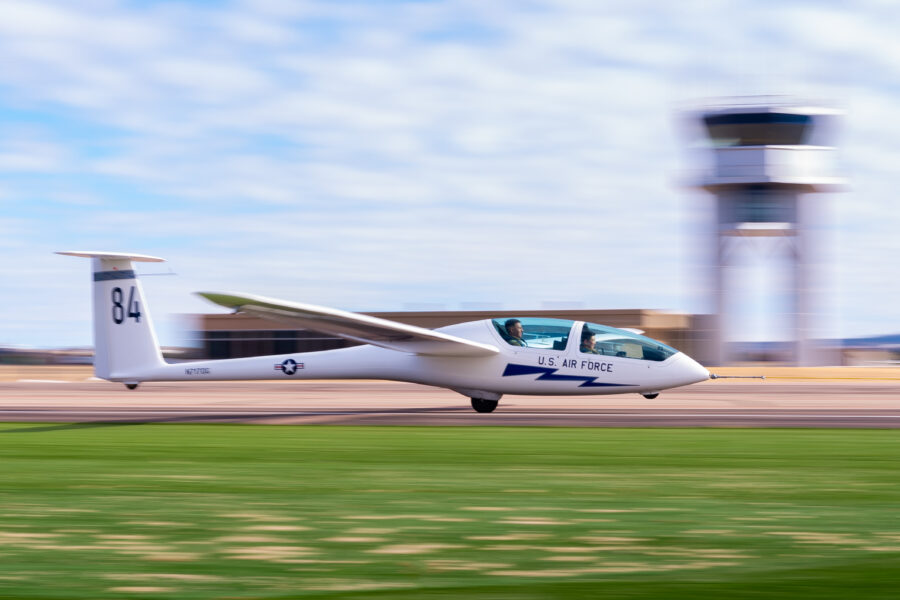
AIR FORCE ACADEMY, Colo.—It’s a warm, windy morning at one of the busiest flightlines in the U.S. Air Force, and not a single officer or jet is in sight. Instead, dozens of 18-22-year-old cadets scurry around sleek, engine-less gliders as classic pop tunes blare from a speaker.
Every few moments, a prop plane takes off with a glider careening behind, pulled with battered tow rope, or the planes land, having successfully released a sailplane.
Across the runway, in an ops building, a dozen more cadets are strapped into simulators, soaring over a virtual replica of the Colorado landscape. Nearby, more cadets mill around the step desk, where an old-school “puckboard” displays names on the day’s schedule.
The Air Force Academy operates the largest glider program in the U.S., with more than 15,000 flights every year—almost entirely led and managed by the youngest instructor pilots in the Air Force. The enterprise is poised to get even busier as USAFA leaders drive toward their ambitious objective: to get every cadet serious time in the air.
70-Year Legacy
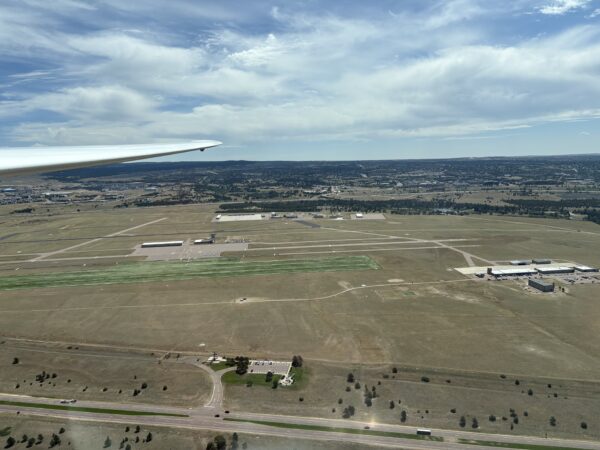
The USAFA glider program dates to the 1950s. Overseen today by the 94th Flying Training Squadron, participation levels have fluctuated over the years. There was a “Soar-for-All” program in the 1970s to give every cadet at least some time in a glider; today, about 500 to 600 members of every class—about half—take the Academy’s basic soaring class, 94th Commander Lt. Col. Curtis Holtman told Air & Space Forces Magazine during a recent visit. (The school also has a powered flight program, and as of 2018, about 70 percent of cadets participated in one or the other flying program.)
Now, once again, the academy’s is aiming to give every cadet a chance to fly.
Airmanship for All means ensuring all 4,000 or so USAFA cadets “obtain real flight experience,” said C1C Noel Migliaccio, cadet commander of the Operations Group this summer.
Some will do so in an expanded powered flight program, where cadets fly in T-53A Kadett II with a rated officer. But more will get that opportunity in one of USAFA’s 23 gliders, Migliaccio said.
Holtman said the program has evolved over time. “We in the 94th have actually kind of led … this over the last three years,” he said. “Three years ago, we were sitting right around 300ish cadets coming through. We’ve incrementally scaled that over the last two years to we’re heading into fiscal year ’27, we’ll push over 500 to 600 cadets through our basic soaring program.”
Changes to the syllabus helped. And with “access to cadet time, operating hour increases, things of that nature, then we can absolutely get to the 800 to 1,000 cadet throughput mark,” Holtman said. “If we can get to Airmanship for All through the soaring program, that is our end state objective.”
Cadet IPs
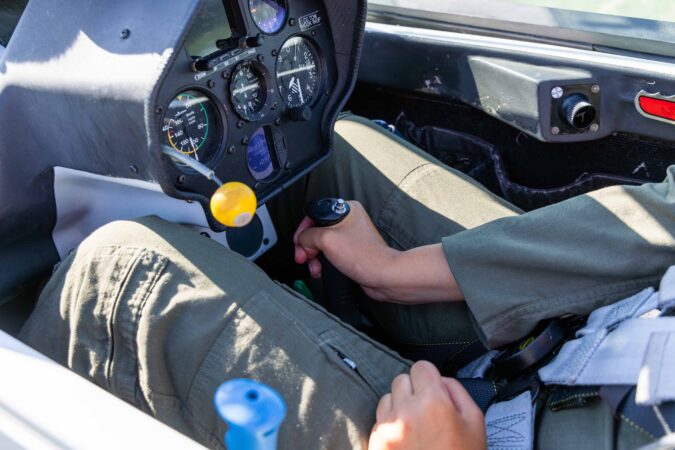
Each participating cadet gets eight flights—any less, Holtman said, and study shows cadets don’t get comfortable in the air. But some cadets get much more than those eight sorties.
After going through the basic soaring class, about 70 to 80 percent of participants apply to be instructor pilots. To be selected, they must pass an interview with a board of current cadet IPs, in which the candidate must teach the board members something to demonstrate their teaching style. The teaching topic is wide open—one cadet taught how to change a diaper, while another showed how to use a yo-yo.
Around 60 candidates are selected, after which they go through scores of flights to earn their “G” wings, then scores more as IPs. C1C James Callaghan estimates he has made more than 300 glider flights to date.
Holtman said the ranks of IPs will have to grow to achieve Airmanship for All, perhaps by an additional 10. Beyond teaching other cadets to fly, he says, IPs are also getting their first taste of life in an operational squadron. They rotate through different leadership positions throughout the year, conduct morning safety briefs, and run the step desk.
“Everything you see in this facility is what they are going to go see as soon as they go fly gray tails,” Holtman said.
The simulators cadets train on are the same immersive training devices that Air Education and Training Command uses at undergraduate pilot training, with virtual reality headsets and controls that mimic a real cockpit.
“If we can move the needle left, then we’re only preparing them better to have that high rate of fidelity transfer from what they have here to what they’ll go do in the future,” Holtman said.
Airmanship
Many academy instructor pilots have gone on to become full-fledged Air Force pilots. The halls of the 94th ops building are full of memorabilia from glider fliers who went on to become Thunderbird pilots, general officers, astronauts, and more.
The skills developed in soaring build a strong foundation for future pilots—and future officers in any career.
“I think gliders are unique in that they really do build situational awareness and energy management, which are things that we’re gonna use throughout a career, no matter what platform we end up flying on when we graduate,” Callaghan said. “Those are values that take practice to build, and my bubble for both of those have increased exponentially. And then, on top of that, being an instructor pilot and being able to talk through your flying and get someone that has never touched an airplane before to basically learn how to fly has really helped with my communication skills.”
Not that flying a glider is the same as a powered aircraft, C1C Joseph Fitzsimmons said, but flying demands “soft skill and hard skills,” and gliders give cadets a jump start on the soft skills.
“The air awareness, the airmindedness, the task management skills, all of those are baked into us now, and we will be able to carry that into whatever experience we have in the Air Force, whether it’s aviation or just leading Airmen,” Fitzsimmons said.
Indeed, while the Airmanship for All program might inspire more cadets to want to become aviators, there are only so many slots for rated career fields like pilot, air battle manager, or combat systems officer. In USAFA’s class of 2026, almost 47 percent of graduates went into non-rated career fields.
In the Air
Whether they wind up becoming pilots, intelligence analysts, force support officers, or something else, cadets who go through the soaring program get to experience flying differently than most.
“I would argue that it is the most pure form of flying. Truly, you feel every bump of air, every input of the stick, every move of your rudder, you feel everything,” said Callaghan.
With the Academy located right on the windy edge of the Rocky Mountains, handling the glider requires vigilance and many small adjustments, Callaghan said. And because the gliders are so sleek, even flying while attached to the tow plane requires focus and touch.
It’s quiet aboard the glider—no engine roar, no ear-splitting whine. But there is maneuver, and glider fliers learn how to pull Gs and perform aerobatics. Some go on to compete, representing the Air Force Academy in competitions with other schools. USAFA cadets regularly bring home national championships.
The aerobatics come at the tail end of the eight sorties in the basic program—along with sick bags just in case cadets (or visiting reporters) can’t quite stomach 5 Gs.
“You feel everything about flying and build such an intimate connection with aviation,” Gallaghan said. It’s “flying in its purest form.”
