


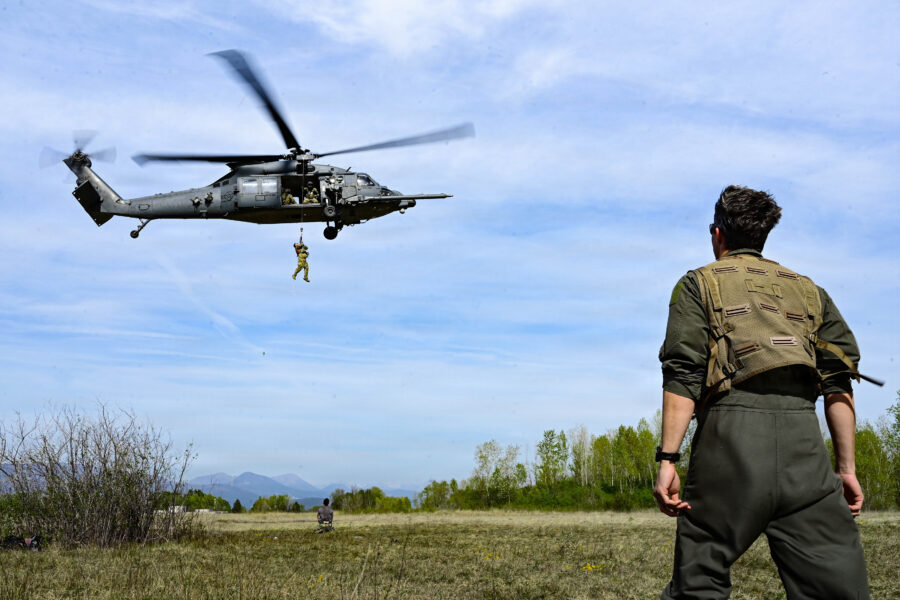
The Air Force is requesting more than $200 million in its 2027 budget for its new combat search and rescue helicopter, including for capabilities to protect against shoulder-fired rockets and transport VIPs around Washington D.C.
Both updates come as the Air Force is in the midst of redefining and reassessing the future of combat search and rescue. The HH-60W Jolly Green II, also known as the “Whiskey,” is the replacement for the HH-60G Pave Hawk, which has been flying since the 1980s.
The total 2027 budget request doesn’t include any new HH-60Ws, but it does includes $116 million in procurement and $87.9 million in research, development, test, and evaluation for the chopper.
In early April, Whiskey aircraft participated in the rescues of downed U.S. pilots in Iran during Operation Epic Fury. The Whiskeys were on the mission because an F-15E had been shot down by a shoulder-fired rocket, the same type of weapon the Air Force wants to defeat with better infrared countermeasures.
The HH-60 itself came under small arms fire during the rescue, Chairman of the Joint Chiefs of Staff Gen. Dan Caine said in a press briefing shortly following the rescue.
While the CSAR mission is the helicopter’s main purpose, part of the fleet is being retrofitted to replace the UH-1 Huey for VIP transport, known as the Air Force District of Washington mission.
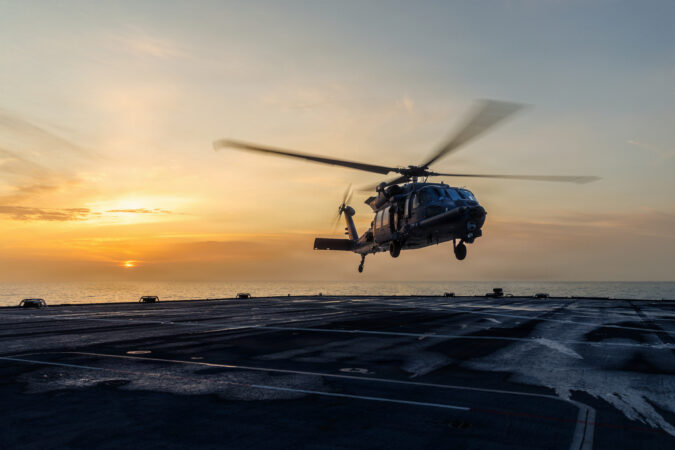
The changes are just the latest tweaks to a program that has been altered multiple times since 2022, when the HH-60W first achieved initial operational capability. The Air Force initially planned to buy 113 aircraft but trimmed that number to 85 in 2023.
Subsequent funding adds have pushed that number up to 102: 11 test aircraft, 89 production aircraft already procured, and two more left in the 2026 budget.
New Laser Jammer Needed
On April 7, the Air Force Life Cycle Management Center posted a “sources sought” notice to industry for integration of one of two different countermeasure systems onto the HH-60W: the Common Infrared Countermeasure system or the Distributed Aperture Infrared Countermeasure system.
“The absence of a capable [Advanced Infrared Countermeasures] system on this platform significantly increases the risk of infrared guided missile engagement, jeopardizing mission success, aircraft survivability, and crew safety,” the notice reads.
The Common Infrared Countermeasure system is produced by Northrop Grumman and has been flown for at least 30,000 flight hours on aircraft such as the Army’s AH-64 Apache, CH-47 Chinook, UH-60 Black Hawk, and the VH-60N, known most commonly as “Marine One,” which transports the president.
The Whiskey is a part of the Lockheed Martin/Sikorsky-made Black Hawk family.
The Distributed Aperture Infrared Countermeasure system is made by Leonardo DRS and is currently onboard the legacy Air Force HH-60 Pave Hawk, the Navy’s MH-60S Seahawk, and the Marine Corps AH-1Z Viper. The Air Force completed effectiveness testing on a version of the DAIRCM system on the Pave Hawk at Nellis Air Force Base, Nevada, in mid-2018, according to a Director of Test and Evaluation Report.
While the Pave Hawk used the DAIRCM system, the Whiskey was not equipped with the countermeasure.
Both infrared systems use a technology known as quantum cascading lasers, which generate individual colors that resemble the aircraft’s exhaust, David Snodgrass, vice president/general manager at Leonardo DRS, said in a company promotional video.
Once the system has matched the color, it blinks the beam on and off to simulate the effects a missile seeker would have on the airplane, giving it a false target and decoying the missile away from the aircraft, Snodgrass said.
VIP upgrades
The Air Force first revealed its plan to modify 26 Whiskeys for the VIP transport mission in its fiscal 2026 budget request.
The service currently uses UH-1 Hueys out of Joint Base Andrews, Md. for the job and had previously planned to purchase MH-139s for that role. An Air Force spokesman said at the time that the decision to modify Whiskeys instead was more “cost-effective” than adding the MH-139.
To convert the combat-designed aircraft into a comfortable VIP transport, the service asked vendors in an April 17 notice to industry to reconfigure the aircraft to accommodate seating for 11 passengers while preserving the search-and-rescue equipment, such as the rescue hoist, defensive weapons, and medical stations.
Changes include work on the cabin floor structure and installing or upgrading:
- Crashworthy seating subsystem
- Restrain systems
- Cabin interior configuration
- Weight and balance system
- Emergency egress system
- Oxygen system
- Electrical system
Contractors will also need to remove the following to make the “green” helicopter “blue” for civilian government service: rescue team seat, isolated personnel litter, gun system, chaff/flare buckets, and armor on doors and floors.
In its fiscal 2027 budget request, the Air Force says it plans to spend $24 million in research and development money to modify the first two of the 26 aircraft dedicated to the VIP mission next year. The service expects to award a contract by December 2026, if approved. The service is also seeking $37 million for procurement to support the first modifications, most of that going to simulators.
All told, the VIP modification process is projected to cost nearly $360 million in R&D and procurement.