


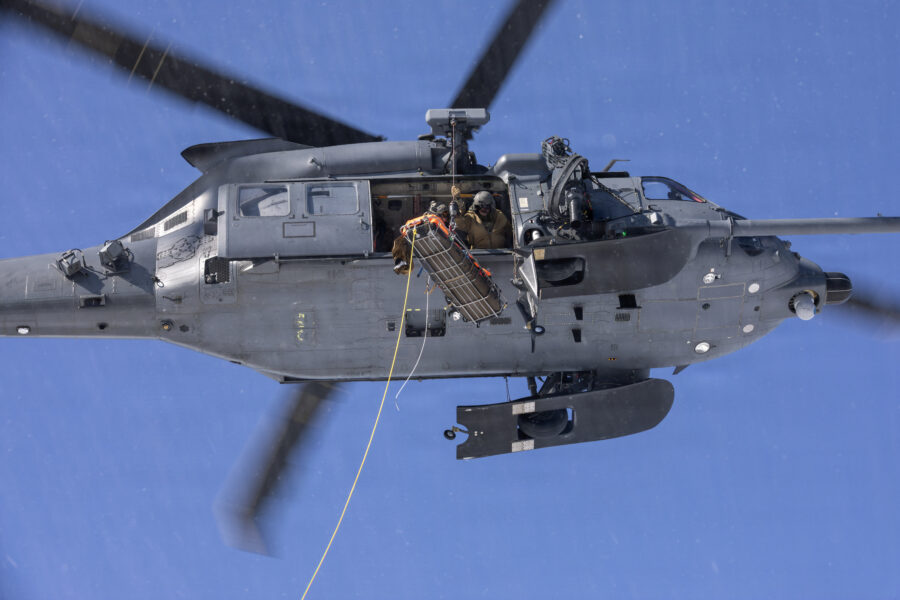
When a U.S. F-15E Strike Eagle was shot down over Iran and its pilot and weapons systems officer ejected into unfriendly territory in early April, rescue personnel immediately sprang into action. Crews focused on where the Airmen went down, listening for signals and looking for evidence that they had survived, and rescue helicopters swarmed and scanned for their possible landing sites.
When Airmen eject, the mission is clear: America leaves no warrior behind. Airmen are trained to survive, evade, resist, and escape the enemy, and everyone from ground crew to rescue personnel and commanders are committed to doing everything necessary—and possible—to bring downed Airmen home.
For two former Airmen in particular, the roughly 48 hours between the shootdown and the rescue of the second Airman brought back memories—sometimes uncomfortable—of trying to survive after being shot down in the former Yugoslavia in the 1990s. Former Air Force Capt. Scott O’Grady and retired Air Force Gen. David L. Goldfein each ejected from an F-16 during 1990s conflicts with Serbia, O’Grady in 1995, and Goldfein in 1999.
In the 27 years since then, throughout near continuous wars, no other American Airmen had found themselves in similar straits until April 2026. And during that time, attitudes, investment, and planning for future combat search and rescue has undergone periodic reassessments as Air Force planners consider the future of warfare and the challenges of rescuing downed Airmen under fire.
Rescuing DUDE 44
Within hours of the F-15’s April 3 shootdown, Air Force combat search and rescue forces mustered 21 military aircraft and dozens of Airmen, flying into Iran for a daring daylight mission to rescue the jet’s pilot, call sign DUDE 44A. Miles away, weapons systems officer DUDE 44B was unable to come out of hiding and could only watch as his crewmate caught a ride out of trouble.
Now came the hard part. Over the next day and a half, as DUDE 44B—the WSO—continued to hide, Iranian TV broadcasters announced a bounty for his capture and U.S. and Iranian operators scrambled to get to him first.
The joint force team that ultimately secured his safety, directed by the Joint Special Operations Command, included Air Force A-10 attack jets, HC-130 combat rescue airlifters, and HH-60W rescue helicopters, plus other aircraft. Resistance and other difficulties ensued. By the time the operation was done, two MC-130s and two Army MH-6 helicopters would become stranded in soft Earth and have to be destroyed and an A-10 would be struck by anti-aircraft fire and have to be ditched, though in friendly territory.
All that added up to a material loss of at least $300 million, and possibly far more. But they’d saved the life of DUDE 44B.
Reflecting on the rescue later, Chairman of the Joint Chiefs of Staff Gen. Dan Caine praised the rescuers for their tenacity, grit, and courage and said their heroism proved “yet again that the United States of America and our joint force will always place more value in humans than we ever will in hardware.”
‘It’s a Race’
When retired Gen. David Goldfein learned the F-15E had been shot down over Iran in April, he could imagine what the DUDE44 Airmen were going through. Almost exactly 27 years earlier, on May 2, 1999, Goldfein’s F-16 collided with a surface-to-air missile over Serbia. Before long, he was descending through the sky, his plane gliding to the ground beneath him and his parachute opening overhead.
“It’s a race, right?” Goldfein said. “The race is on between who gets to them first. It was the same in my situation.”
Former Air Force Capt. Scott O’Grady also knew the feeling. Recalling the recent shootdown just days after it happened, O’Grady said he looked to heaven for the Airmen’s rescue. “I prayed for them, for their safety, and for their health and their lives,” he said.
O’Grady’s F-16 was shot down 47 months to the day before Goldfein’s, on June 2, 1995, by a Soviet-made SA-6 surface-to-air missile fired by Serbian troops during the Bosnian war.
“Missile impact was very violent—it came with very little warning,” O’Grady remembered. The aircraft split in two. “I thought I was dead. But I still reached the ejection handle. I came out actually parallel with the horizon. Debris was flying all around me.”
Burning jet fuel seared his clothes and skin. His parachute opened in slow motion, the seconds feeling like minutes as he made his descent.
“I literally could see the greeting party and their troop carrier and two other vehicles matching my drift rate across the ground,” O’Grady recalls now. “I knew they weren’t just driving up the highway They were driving up to try to reach me when I landed.”
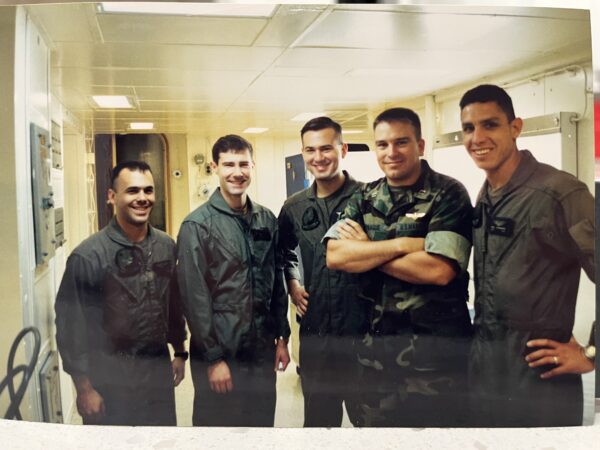
O’Grady found a hide site almost as soon as he hit the ground. “You go right to your training on what you need to do,” he said. Serb forces swarmed the area, treading within “six feet from me.” He shut off his radio so it couldn’t give him away and managed to evade capture for the next six days.
“What people don’t realize is that downed pilots or aircrew members become political pawns,” O’Grady said. As media reports the story, people back home hang on every bit of news. Capturing an American is a big win for a smaller military, and adversaries have learned over the years how to manipulate media coverage and public angst, as they seek to use captured service members to even their odds against the mighty United States.
In the 1993 Battle of Mogadishu, Army Master Sergeant Gary Gordon and Sergeant First Class Randy Shughart were killed after fast-roping down out of a helicopter to defend its surviving pilot, Chief Warrant Officer Mike Durant, against enemy gunfire. Americans watched in horror as the slain Delta Force Soldiers were dragged through the city’s streets. Durant was captured and held prisoner for 11 days. The disaster would ultimately lead to the withdrawal of American forces from Somalia just five months later.
“What kind of impact did it have when … their mutilated bodies—naked and stripped—were dragged in front of the cameras?” O’Grady asked. “That had an impact of an image in every single household in America that then had a propaganda impact on the will and the heart to stay in the fight.”
The stakes in an operation soar when an American pilot goes down, others agree. Retired Air Force Col. Brandon Losacker spent his career as an HH-60G Pave Hawk weapons officer and CSAR team member, and suggested the entire outcome of Operation Epic Fury might have tilted had the rescue missions to save the pilot and WSO DUDE failed.
“CSAR is a strategic mission,” he said. “Imagine the world that we would be in right now if our CSAR and the SOF personnel recovery missions had failed, and the Iranians had our downed crew. What would that have done to the president’s decision space? We would be in a totally different world.”
Sacred Trust
Goldfein’s rescue was a quicker and—for a while at least—somewhat quieter operation than the F-15 crew’s recovery. He was on the ground for a few hours, dodging both landmines and Serbian patrols, and recalled that Serb forces didn’t know exactly where he was until the extraction effort began.
But once they did, he said, “it got pretty exciting.” Two pararescuemen and a combat controller jumped out of an HH-60 Pave Hawk to grab Goldfein, who had emerged dirty and exhausted from his creek bed cover. As the sun rose on that early May morning, they hustled the pilot into their helicopter as “the enemy opened fire and started trying to take us out.”
This is where rescue crews’ dedication comes into play, Goldfein said. “If you’re in a helicopter in the daytime over enemy territory, you’re pretty vulnerable.”
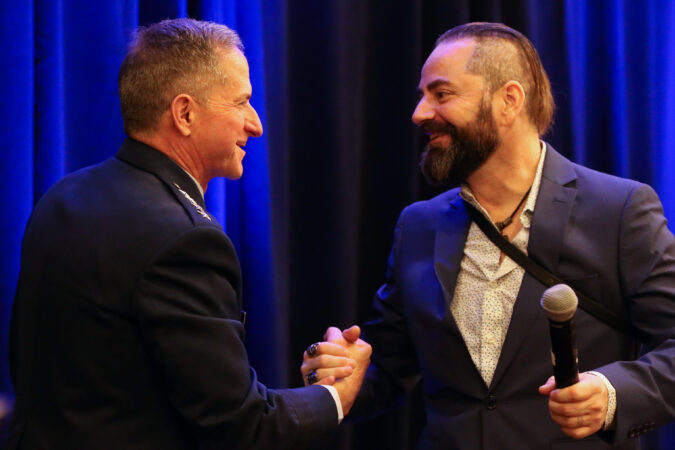
To this day, he celebrates each May 2 by sending bottles of Scotch annually to the units that helped save him. But more than that, he became close friends with his rescuers, in some cases helping them through challenges of their own, such as post-traumatic stress and substance abuse problems.
Likewise, O’Grady remains close to the 61 Marines who participated in his rescue, saying they “became my instant brothers.”
O’Grady’s six days on the ground were long and slow. His wingman hadn’t seen his parachute open and as the days ticked by, some U.S. forces began to doubt he had survived the strike.
“You have to have something that you want to live for, you have to have a belief, and you have to have trust,” O’Grady said. “For me, that belief came in my faith. What I wanted to live for was my family and to return to them, and the trust was I knew my brothers in all service branches, both men and women and most importantly, the American people, were not going to forget me. They were going to make sure I came home.”
In every case, from O’Grady’s to Goldfein’s to DUDE 44, the rescues went far beyond one service, involving the entire joint force and even CIA engagement in the case of DUDE 44.
In Iran, the CIA helped with an intricate misdirection play to throw Iranian personnel off the trail while the rescue and extraction was underway, while special operations forces held off Iranians closing in on the downed WSO on the ground. Space Force Guardians and intelligence analysts gathered data and worked to verify the emergency beacon they were tracking was in the pilot’s hands, not someone else’s.
“It’s not surprising at all to me that all of government stopped what it was doing, and applied whatever they could to the team,” Goldfein said. The rescue was a national effort.
Goldfein said it took him time to fully understand all that had gone into extracting him from the combat theater. “Until I got back and got a chance to talk to several different groups, I had no idea how many organizations across government were all focused that night on helping get me home,” Goldfein said. “It’s just who we are.”
Even now, 27 years later, Goldfein continues to discover new contributors to his rescue. “I met someone in the airport, no lie, about a month ago, who walked up to me and said ‘Are you Gen. Goldfein?’ I said, ‘Yeah, but I’ve got a new call sign, just Dave now.’ [And he said,] ‘I was the boom operator on the KC-135 during your rescue. I refueled the whole team of aircraft that was up there, for the whole night, getting you out.’”
CSAR in the Future
New technology made a difference for DUDE 44, including bespoke technology that enabled the rescue team to pick up the WSO’s beating heart from miles away. “Every rescue advances the technology, the tactics, and the procedures,” Goldfein said. “I had some firsts, in terms of technology, on mine.”
But the losses endured in the second DUDE 44 rescue could be too great if numerous pilots were down at the same time. In the Vietnam era, shootdowns were common, and rescues were comparatively frequent, though hundreds of the prisoners in North Vietnam’s notorious Hanoi Hilton prison were Airmen who weren’t able to hide long enough to evade capture.
“There’s not a commander in the world that doesn’t want combat rescue sitting on the end of the ramp waiting to go for their guys,” said retired Col. Russell Cook, former commander of the 347th Rescue Wing
But those capabilities are hard-won, O’Grady said. “There are special skill sets that are needed, and special capabilities that other units are not necessarily going to dedicate themselves to as that’s their primary mission,” he added. “These CSAR guys are willing to put it all on the line to go save someone else’s life, and that’s their joy, their mission and their purpose.”
Yet in recent years, questions have lingered about whether the U.S. would be able to pull off such rescues in a conflict against a well-defended foe such as China. In the Pacific, where distances are magnified and helicopters might lack the range and survivability to safely extract downed crewmembers, some openly questioned whether CSAR missions might still be possible.
Indeed, the Air Force moved to curtail its fleet of new HH-60W Jolly Green II combat rescue helicopters for that very reason. The service originally planned to buy 113 new HH-60Ws from Lockheed Martin’s Sikorsky division to replace its aging Pave Hawk rescue helicopters, but in 2023 cut that total to 85. Leaders argued at the time they needed to investigate unmanned, autonomous and other alternative aircraft for the rescue mission.
Congress, however, pushed back, funding the acquisition of 14 more aircraft over the following two years. Today, the fleet numbers 89 production aircraft, with two more on the way.
Even thinking about giving up that capability strains O’Grady’s comprehension. “Why would you ever want to get rid of that and give that mission to somebody that’s not focused on that being their mission, [that] don’t have the proficiency and the skill sets and the assets and the equipment and the tools necessary to get that mission successfully accomplished?” he wondered.
Goldfein, who went on to become the Air Force Chief of Staff and had firsthand experience juggling the priorities that can pit one capability against another in the fight for resources, said the future Air Force will need a variety of CSAR capabilities to match the different threat environments rescues might face.
In a highly contested rescue, such as in Iran, the Air Force may need a bigger, more robust force than it would in a less-contested place, Goldfein said. The Air Force needs to have a comparable range of options, potentially including uncrewed rescue aircraft that could swoop into an uncontested spot to pick up a waiting aviator almost like a taxi service.
Yet not all technology is helpful. Social media has enabled crowdsourced data and the sharing of photos, videos, fake imagery, along with names, locations, and more. Iranian state media leveraged American social media platforms to share photos of the wreckage and video of rescue of rescue operations in a bid to rally bounty hunters to find the Americans first.
“The question becomes, how do you roll [advancements like rapid social media information sharing] into your tactics, techniques, and procedures and your technology going forward?” Goldfein said. “There’s a lot of creative ways you can make that an advantage, while at the same time it certainly presents a challenge.”
Speed will only become a greater factor over time. At least one Airman evaded capture for three weeks in Vietnam in the 1970s, a scenario that seems hard to believe today.
“From the moment someone ejects over enemy territory, … every second counts—not every minute, every second counts,” Goldfein said. “What you want is all the tools readily available, a team that’s highly trained, a communications system that’s robust and secure. That’s not the time to start building your team, because a life depends on the team that you’ve already built.”