
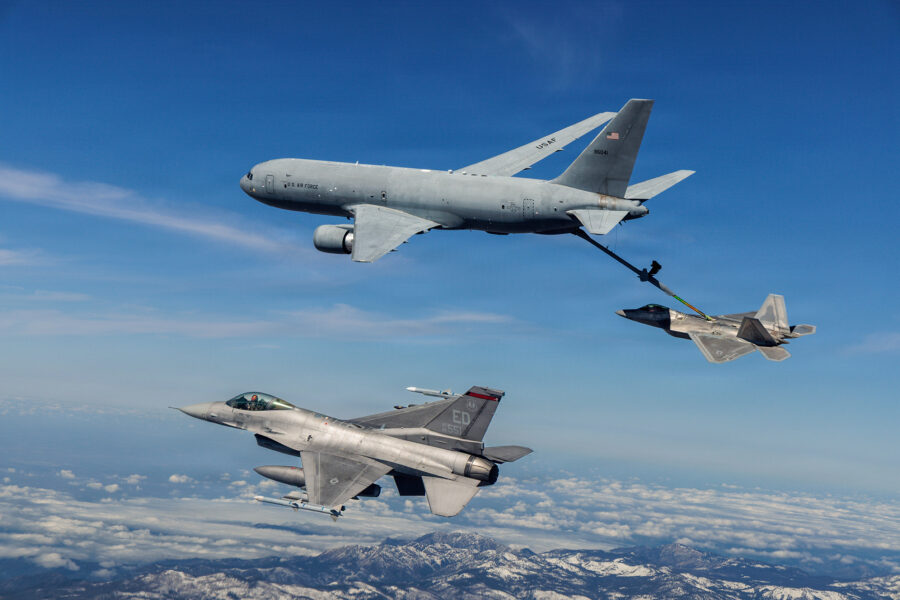
NATIONAL HARBOR, Md.—The new head of Air Mobility Command said Sept. 16 he wants to explore an unmanned option for the service’s next-generation aerial refueling system.
As the service pursues its first fleet of semi-autonomous Collaborative Combat Aircraft, Lt. Gen. Daniel Tulley said he is open to looking at emerging technologies for a future unmanned or optionally manned large aerial refueling aircraft. The service is preparing to sign a deal for 75 additional KC-46 Pegasus tankers, but it continues to search for a long-term answer to replacing its Eisenhower-era KC-135 Stratotankers, the bulk of today’s tanker fleet.
To field a next-generation tanker in the mid-2030s, the Air Force is pursuing an analysis of alternatives, looking at everything from an innovative blended wing-body aircraft to more KC-46s to a stealthy and possibly uncrewed refueling platform.
“Thinking beyond the current KC-46 buy and the program extension, whatever that next tanker looks like—our advanced tanker system—it’s got to be connected. It’s got to be able to defend itself, but it begs the question: does it need to be manned? Could it be optionally manned? It could be autonomous, or is there a family of solutions maybe that would answer that question?” Tulley, who took command of AMC in early August, told reporters at AFA’s Air, Space & Cyber conference.
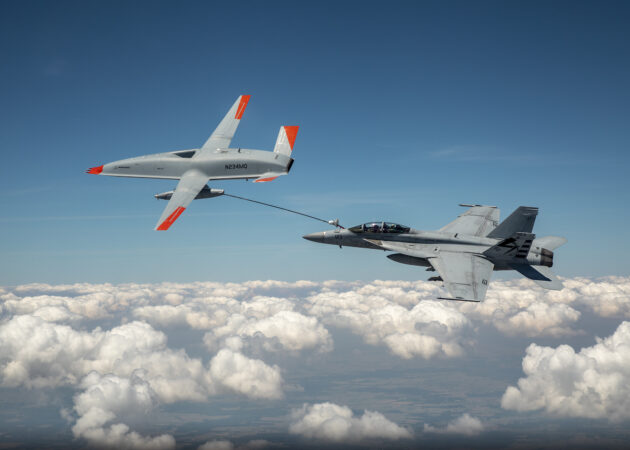
“I do not believe that it has to be a manned future air refueling solution,” Tulley said. “I think you’re seeing that with the MQ-25 and the Navy’s work,” Tulley added, referring to the Navy’s development of the uncrewed MQ-25 from Boeing, an unmanned tanker capable of transferring 14,000 pounds of fuel to aircraft like the F/A-18 Super Hornet and the F-35 at a distance of 500 miles from a carrier in highly contested airspace.
That airplane is much smaller than Air Force requirements, however; a KC-46 can carry 212,000 pounds of fuel, more than 15 times the capacity of the MQ-25.
Solving that problem is what Tulley is after. “How do we, the U.S. Air Force, bring that to bear in scope, scale, and range?” he asked. “An optionally manned or an unmanned tanker at the ranges we need to operate at is a very large aircraft.”
Currently, the Air Force is not yet “employing fully autonomous large aircraft, but the technology I would say [is] … rapidly getting there,” Tulley said.
Boeing’s large civilian airliners can take off with very little help, fly on a programed route, and land with autopilot, “but we don’t employ [aircraft] that way,” Tulley said.
The market for autonomy in large aircraft is a military market, so “establishing the requirement and then supporting the requirement with the right technology” will be key, he said.
“There are some companies out there who have offered to develop things where they can bring a carry-on kit on KC-135s and other aircraft,” he said. “But we haven’t seen them test those successfully.”
Meanwhile, the Air Force and Boeing unveiled an agreement in mid-May to resolve critical deficiencies with the Pegasus that currently stand in the way of the service signing a pending contract for 75 additional KC-46s. The service is also working to add connectivity and active defense systems on both the KC-135 and the newer KC-46.
“We are going to be recapitalizing tankers for decades, and in the interim, the same dedication to bringing on new platforms is necessary to sustain those that we have,” Maj. Gen. Gerald Donohue, deputy commander of Air Mobility Command, said during the conference. “The last KC-135 pilot has not been born.”
