
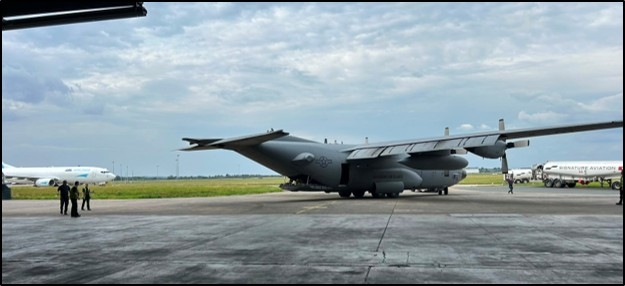
Federal prosecutors have charged an Irish man with methodically vandalizing a U.S. Air Force C-130H so extensively that the $60 million transport aircraft is effectively totaled.
The U.S. Department of Justice announced Nov. 17 that officials have indicted Daithi O’Corrain, also known as David Curran, for destroying an Air National Guard C-130H Hercules at Shannon Airport in Ireland back in April.
U.S. Attorney for New York’s Southern District Jamie McDonald and FBI Assistant Director in Charge James Barnacle Jr. alleged in the DOJ release that O’Corrain, 48, carefully planned his alleged evisceration of the plane in advance.
“This was not an act of spontaneous vandalism,” Barnacle said. “The defendant allegedly spent months researching the aircraft, acquiring tools and materials, and preparing to maximize the destruction he could inflict.”
He is charged with destruction of government property and faces up to 10 years in prison. The DOJ release notes that all the charges in the indictment are accusations at this point, and O’Corrain is presumed innocent until proven guilty.
Prosecutors allege that O’Corrain sneaked onto Shannon Airport, a major hub used by U.S. troops and equipment crossing the Atlantic Ocean, on the morning of April 11 and made his way to the parked C-130, which was on its way to another country.
O’Corrain allegedly broke the lock on the plane’s rear crew door, entered, and then barricaded himself inside using supplies he brought. His efforts included using straps, brackets and screws to seal doors shut and putting ball bearings mixed with epoxy in door tracks.
He then went to work, officials allege, by cutting the plane’s wire bundles and hydraulic lines, puncturing its air ducts, crimping—but not cutting—its liquid oxygen line, and destroying every gauge in its cockpit.
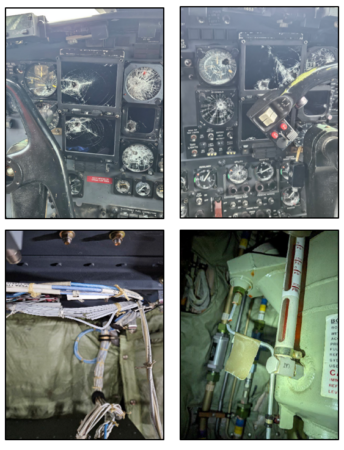
The indictment alleges O’Corrain poured multiple capsules of gallium, a highly corrosive liquid metal that quickly eats through aluminum and corrodes steel over time, onto the largely aluminum aircraft.
According to the indictment, a few hours after O’Corrain got onto the airport grounds, the C-130’s flight crew got to the plane to get ready for their flight. They saw O’Corrain through a cockpit window and called security.
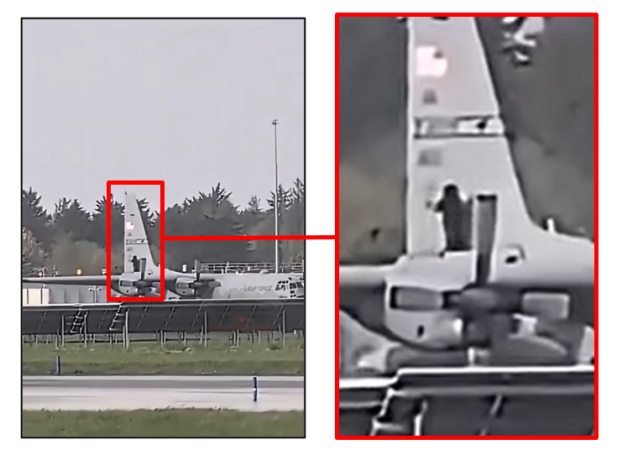
O’Corrain then allegedly climbed out of the plane’s roof hatch and inflicted more damage—striking its exterior with an axe and leaving deep gouges, and pouring unknown substances, ball bearings, and other objects into its fuel tanks, fouling them.
Irish law enforcement soon arrived and arrested O’Corrain.
The Department of Justice said investigators determined O’Corrain’s research and preparation for the alleged attack was meticulous and included online searches into the plane’s construction, coordinates and locations to breach the airport’s perimeter, and ordering gallium and other tools and equipment used. He also allegedly researched prior attacks on U.S. military aircraft at the airport and tried to contact someone who was involved in a previous attack.
Prosecutors said his decision to allegedly crimp a liquid oxygen line, but not cut it, showed how thorough his research had been.
“Had O’Corrain cut, rather than crimped, the aircraft’s liquid oxygen line, as he had its wire bundles, there would have been a high chance of a massive explosion within the aircraft,” the Justice Department’s statement said.
O’Corrain also allegedly knew the layout of the aircraft and how best to destroy its critical components, which wires and components to cut and which to avoid for safety reasons, and how to get onto the plane, according to the DOJ release.
Nevertheless, the extent of the vandalism and use of corrosive materials risked a massive explosion that could have injured or killed people nearby, including U.S. troops, the indictment alleges.
The vandalism left the plane inoperable and “effectively destroyed,” prosecutors say.
This alleged attack was far more destructive than a series of three similar incidents that took place at Shannon Airport in 2025. Three people were first arrested on May 1, 2025, after driving a van through its perimeter fence. A little more than two weeks later, on May 17, 2025, three people breached the airport’s runway and sprayed a military aircraft with paint, leaving it temporarily inoperable.
And on Nov. 22, 2025, three people in a van breached the airport’s security perimeter and drove to a restricted area where a U.S. C-40 aircraft was parked. Those people were intercepted and detained by airport security.