
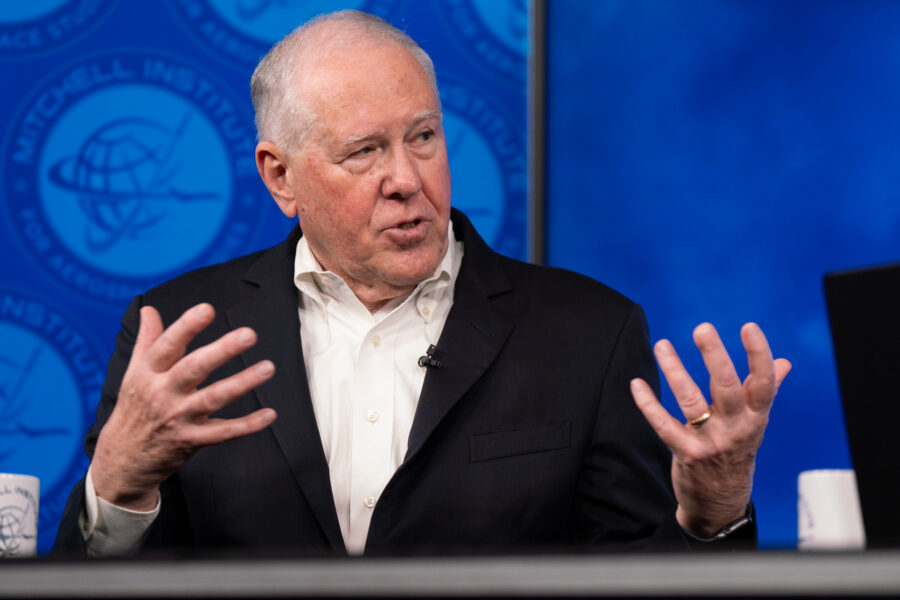
The Pentagon has revoked the security clearance of former Air Force Secretary Frank Kendall, alleging he disclosed classified information about the VC-25B Bridge “Air Force One” aircraft—a charge he pushed back on.
Chief Pentagon spokesman Sean Parnell announced the decision late Aug. 7, saying the department has revoked Kendall’s “eligibility for access to classified information and his ability to hold any sensitive position.”
Parnell’s statement did not specify the classified information Kendall, who served in President Joe Biden’s administration, is alleged to have disclosed or in which media outlet it appeared. But in a July 9 New York Times article about the new VC-25 presidential transport, Kendall was quoted as saying the rapid modification process to the Qatari-donated Boeing 747-8 meant it must lack some features typical in a VC-25.
“Time didn’t permit all the normal Air Force One modifications, so some mix of security, communications and support is missing,” Kendall said, though he did not specify what those might be. Kendall also told Air & Space Forces Magazine he was not one of the unnamed officials cited in the article claiming the aircraft specifically lacked some defensive countermeasures.
A few weeks later, when President Donald Trump announced the plane would be out of service for a month to be “maxed out” with additional modifications amid reported concerns about the state of its defensive capabilities, Kendall told Air & Space Forces Magazine it was unclear what those modifications might be, but that the timeline of one month would significantly limit how much more could be done with the plane.
“Safeguarding classified information is a non-negotiable duty. Those who violate that trust forfeit the privilege of access and any role requiring it,” Parnell wrote on social media.
Kendall, who has been a sharp critic of the Trump administration since leaving the Pentagon in January 2025, told Air & Space Forces Magazine he has had no direct communication with the government about its decision and he is planning legal action. He said he has held a security clearance for 60 years over a career that has included multiple high-level national security jobs.
“I’ve been extremely careful to not say anything that could be classified, and as far as I know I have not said anything classified. So far, no one has told me what I’m supposed to have revealed,” Kendall said.
Under executive orders governing access to classified information, there is an established process for former presidential appointees like Kendall to retain their eligibility to access classified information, a requirement for a security clearance. This allows former appointees to consult with their successors, serve on advisory boards, or continue working in the defense industry.
In recent years, however, this access has come under scrutiny. In 2018, during Trump’s first term, his administration pulled the security clearance of former CIA Director John Brennan and said it was reviewing others for officials from President Barack Obama’s administration. In 2021, Biden cut Trump’s access to classified intelligence briefings customarily given to former Presidents, and Trump did the same to Biden after returning to office in January 2025. Since then, the Trump administration has also revoked the security clearances of dozens of former intelligence officials.
Kendall has been a strident critic of Trump and Defense Secretary Pete Hegseth over the last year and a half, denouncing the administration’s firings of top military lawyers, its lethal strikes on alleged drug-smuggling boats, and its strategy in the current war with Iran. He also recently released a book, “Lethal Autonomy: The Future of Warfare, Whether We Like It or Not,” in which he argues that the manned fighter jet will ultimately become obsolete as autonomous systems become more sophisticated.
Bridge Air Force One
The “Bridge” VC-25B is a Boeing 747-8 Intercontinental, gifted by Qatar’s rulers to the United States last year. It is meant to be a stopgap between the aging VC-25As, which have been in service since George H.W. Bush’s presidency, and the new VC-25B variant, which has been beset by delays and cost overruns and is now projected to enter service in 2028.
It took less than a year for the Air Force to complete modifications on the “Bridge” aircraft, and officials have offered few specifics as to how they were able to finish the process so fast when the long-term VC-25B will take more than a decade. Air Force officials have estimated the cost of the modifications at around $400 million.
In a June statement, the Air Force said the plane is “safe, secure, and equipped with the most advanced technologies necessary to meet the requirements of the presidential mission.
“Those requirements were carefully crafted to prioritize mission over aesthetics, leaving much of the previous [Qatari] head of state interior layout minimally changed. No risk was taken in security, safety, or mission communications, but the collective team made trades on some of the less commonly used mission sets that Boeing must deliver to support the next 40 years.”
The Bridge VC-25B entered service in July and ferried Trump to Turkey for a NATO summit, but he flew on the older VC-25A model to leave the country. Multiple media outlets have reported he did so amid security concerns related to the Iran war, but Trump has denied this.
Nevertheless, the incident and Trump’s subsequent comments that the aircraft would receive further modifications, have increased scrutiny of the aircraft’s security systems.
