
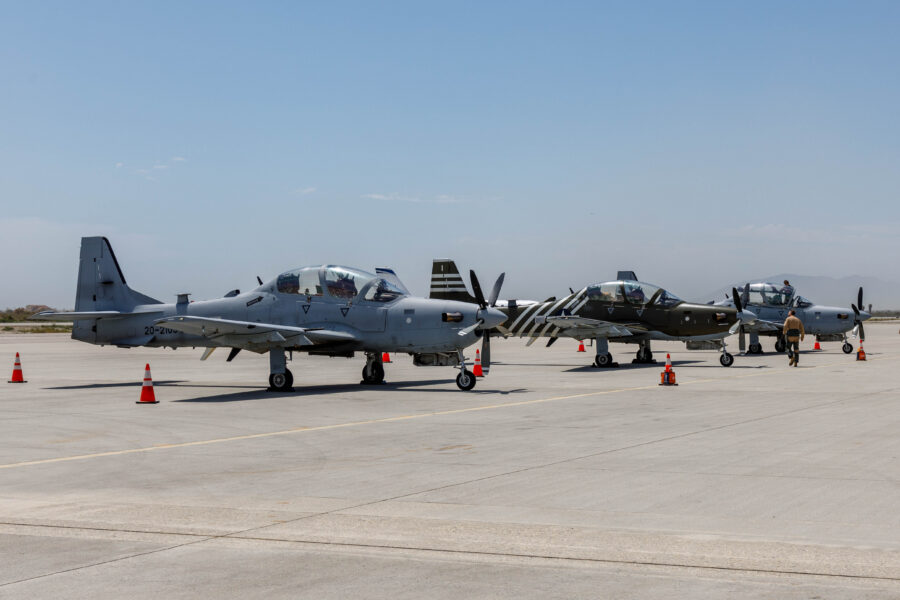
The Air Force’s trio of A-29 Super Tucano light attack aircraft are now considered officially retired and are being mothballed at Edwards Air Force Base, Calif.
A spokesperson at Edwards confirmed in a Nov. 4 email to Air & Space Forces Magazine that the Air Force no longer counts any A-29s in its active inventory.
These planes—the only three A-29s in the Air Force’s possession—were procured in the 2010s as part of a light-attack plane experiment. They were most recently flown in 2024 and 2025 at the Air Force Test Pilot School, to see if they would suit the school’s unique test mission.
In a July 2025 release, the 412th Test Wing at Edwards said the school was working to integrate the A-29 into its student flight curriculum, and first eyed it to teach student pilots how to get out of stalls and spins.
The Test Pilot School ultimately concluded the A-29 wouldn’t meet its needs, the Edwards spokesperson said in the Nov. 4 statement, and is now looking at other options for a “sustainable spin and mission systems aircraft.”
The A-29’s retirement was first reported by Aviation Week.
Those three planes were previously stored at the 309th Aerospace Maintenance and Regeneration Group at Davis-Monthan Air Force Base, Ariz.—the airplane graveyard nicknamed the Boneyard—before they were ferried to Edwards for their Test Pilot School evaluation.
Edwards said that—for now, at least—the planes will be stored and maintained at the base and not returned to the Boneyard.
The Air Force on Oct. 29 released a notice on SAM.gov saying it planned to issue Sierra Nevada Corporation a sole-source contract to provide maintenance support for the A-29s at Edwards, which it said are “fully sealed.” Sierra Nevada and Brazilian firm Embraer Defense and Security partnered to manufacture the Air Force’s handful of A-29s, as well as others that were sold to foreign allies.
While the Air Force’s planes aren’t expected to return to flight status, the notice said, the service needs on-call maintenance support to keep them safely stored and move them on the ground, if necessary. Sierra Nevada would fix and mitigate the planes’ potential oil leaks, repair or replace flat or worn-out tires, tow the planes on the ground, and maintain components such as fuel or hydraulic systems, the notice said.
The contract would be for up to three years, with one base year and two more option years.