
General Atomics, the maker of one of the Air Force’s first Collaborative Combat Aircraft, has ambitious plans for its family of semi-autonomous drones beyond the FQ-42, including a flying-wing aircraft capable of carrying out both reconnaissance and strike missions.
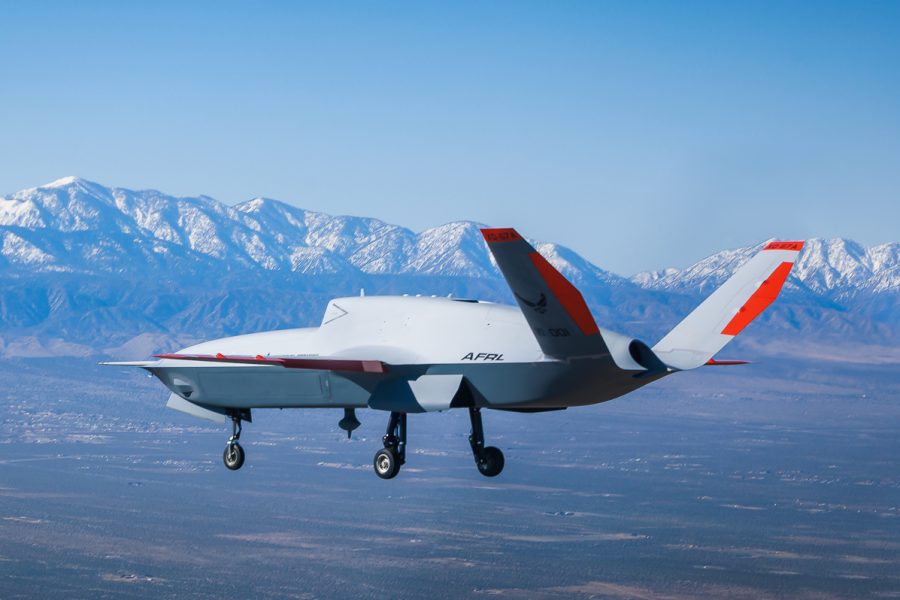
Meanwhile, the Air Force Research Laboratory announced a new program to test mission systems for autonomous aircraft, particularly those meant for reconnaissance. The lab recently flew General Atomics’ CCA prototype, the XQ-67A, as part of the program.
General Atomics spokesman C. Mark Brinkley told Air & Space Forces Magazine in an email the company is working on an uncrewed flying wing design it calls NextGen. The War Zone first reported on the NextGen aircraft.
Brinkley stressed that NextGen is “not a CCA,” but instead a “much larger … fully armed, fully outfitted, [intelligence, surveillance and reconnaissance]/strike wing” aircraft. NextGen will use a hybrid-electric propulsion system that could allow it to fly more than 60 hours without being refueled, he said, and have the potential to be flown remotely, autonomously, or semi-autonomously.
Brinkley said NextGen is planned as a “high-end capability,” and work on that program will feed into another, smaller flying wing drone that would be part of General Atomics’ Gambit series of drones.
The Gambit concept, unveiled in 2022, is envisioned as a family of modular airframes that can all fit a common “chassis” that includes a common engine, landing gear, and processors. The FQ-42 CCA is part of that series.
General Atomics refers to its future flying wing concept, which NextGen could inform, as Gambit 4.
Gambit 4 would cost less than NextGen, Brinkley said, but would also have shorter endurance and less-effective stealth capabilities.
“I don’t think people realize how deep GA-ASI’s bandwidth is, or how much we dedicate to R&D,” Brinkley said. “NextGen is coming, and the work we’re doing on that flying wing program will funnel into Gambit 4 so that when customers are ready for this, we’re not starting from scratch here either.”
General Atomics received a $99.3 million contract from AFRL in May 2025 to build a long-endurance, autonomous flying wing aircraft that could fly reconaissance and strike missions, called GHOST. That award announcement described GHOST using language similar to how General Atomics now refers to NextGen, including a references to its hybrid-electric propulsion system. Brinkley declined to comment on any potential relationship between GHOST and NextGen.
Another planned Gambit drone, called Gambit 6, would be a ground strike variant of the FQ-42. Brinkley said General Atomics is planning to hold a live-fire event with one of its own Gambit 6 aircraft in early 2027, using a ground attack munition.
“Every Gambit variant feeds expertise into the other variants by default,” Brinkley said. “So the work ongoing now for live-fire on FQ-42 Vengeance, coupled with years of internal air-to-ground launches from MQ-20 Avenger, allows us to rapidly reconfigure for Gambit 6.”
Brinkley said the FQ-42’s ability to carry weapons in its internal weapons bay will make it stealthier and more survivable than if it had to carry weapons on its wing. Other nations that are considering the CCA concept will need them to carry out air-to-ground missions, Brinkley said, making them possible customers for Gambit 6.
General Atomics is also working on another Gambit concept, similar to the FQ-42 or Gambit 6, that would be optimized for navies around the world to use on ships. This idea, called Gambit 5, would need to include the proper landing gear, equipment compatible with catapults and arresting gear, and would have to be resistant to the corrosive salt-heavy environment that comes with operating at sea, Brinkley said.
General Atomics is also developing a concept for a red air trainer drone, which could act as an adversary while training new pilots, as part of its Gambit series. Brinkley said that will be critical to teach future pilots how to fight against enemies that fly their own CCA-type drones.
“Eventually, manned aircraft will need to fight against these autonomous jets and train like they fight, but you don’t need them actually loaded with weapons,” Brinkley said. “You’ll be simulating all of that anyway. So with Gambit 3, you can alter the design without starting from scratch and probably remove some fighter components from the trainers to add overall value.”
The XQ-67, General Atomics’ first Gambit drone, is showing ways such semi-autonomous aircraft could be used in a future war. AFRL said in an Oct. 27 statement that it and the Air Force’s Experimental Operations Unit had recently flown the XQ-67 in the Nevada Test and Training Range.
AFRL was not able to immediately answer further questions about the flight, but did say it demonstrated how the XQ-67 can integrate advanced mission systems that would “work collaboratively in demanding combat environments.” Those systems include advanced sensors, mission computers, and power and thermal management hardware.
AFRL said that integrating beyond line-of-sight datalinks and “live, virtual and constructive simulations” during the flight showed how uncrewed platforms could be operated across distributed theaters.
“This proved that AFRL’s autonomous architectures, aligned with autonomy and agile mission suite government reference architectures, can reliably process and relay combat-relevant data in real-world scenarios,” Trenton White, an aerospace engineer in AFRL’s air warfare directorate, said in the release.
The flight was carried out under a project called “Demon APE,” which is short for Demonstration of ACP Performance and Effectiveness.
In a video on Demon APE, the lab said the program particularly focuses on improving battlespace awareness by linking together autonomous drones that specialize in reconnaissance, with the goal of integrating them with manned aircraft such as fighters and bombers and making them more lethal.
“By pairing AFRL’s rapid prototyping with ACC’s operational test units, the Air Force is shortening the timeline between concept and warfighter capability,” Col. Matthew Caspers, Department of the Air Force deputy technology executive officer for air, said in AFRL’s statement.
Brinkley praised AFRL’s work partnering with General Atomics on the XQ-67, and said the lab “really [has] a vision for this as a new warfighting concept for the future.”