

The Air Force’s B-52 bomber may soon be able to carry up to 20 stealthy long-range anti-ship missiles to strike moving targets at sea, a key capability in a potential fight with China.
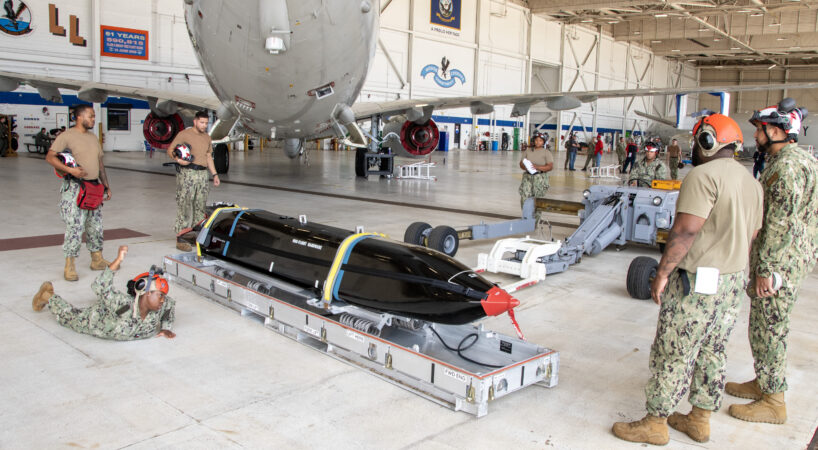
An Oct. 7 notice from Naval Air Systems Command states that the command plans to award a contract to Lockheed Martin to integrate its Long-Range Anti-Ship Missile on the B-52.
The anticipated award “is for efforts associated with LRASM integration on the B-52 aircraft platform, to include missile software updates, associated testing, test asset repair, and failure review boards,” the notice states.
The B-52 can already carry up to 20 Joint Air-to-Surface Standoff Missiles, on which the LRASM is based. The two missiles share similar dimensions.
Naval News first reported on the possibility of integrating the LRASM onto the B-52 in 2019, though the idea languished for several years. But the ability to put LRASMs on the B-52 would have massive implications in a large-scale conflict, retired Air Force Col. Mark Gunzinger, a former B-52 pilot, told Air & Space Forces Magazine.
“A handful of B-52s will be able to deliver more weapons on maritime targets and do so over much longer ranges than the Navy’s carrier-based aircraft per day,” said Gunzinger, now as the director of future concepts and capability assessments for the Mitchell Institute of Aerospace Studies.
Spokespeople for NAVAIR and Air Force Life Cycle Management Center did not immediately responded to a request for comment. Lockheed spokesperson Scott Swofford declined to provide any further details about the effort, deferring to the Pentagon, but did tout LRASM’s capabilities.
“As a precise, stealthy and survivable cruise missile, LRASM provides multiservice, multiplatform, and multimission capabilities for offensive anti-surface warfare,” Swofford said. “By leveraging Lockheed Martin’s expertise in successful cruise missile productions, LRASM brings low-risk and long-term, flexible capabilities to the warfighters’ anti-surface warfare environment that no other inventory weapon provides.”
A Necessary Tool
The Oct. 7 notice continues a push to integrate LRASM onto the bomber fleet—the Air Force revealed in June that a B-2A Spirit employed a LRASM to strike a decommissioned amphibious transport vessel during a Pacific exercise, the first time the U.S. military has acknowledged the B-2’s use of that missile.
Such a pairing is important, Gunzinger said.
“The Air Force’s bomber force will be our military’s predominant maritime strike force, considering the number of anti-ship cruise missiles they can carry per sortie and deliver over intercontinental ranges, if necessary,” Gunzinger said. “And LRASMs will give our bomber force the ability to strike moving targets at sea with unprecedented accuracy.”
The move will expand commanders’ options to strike maritime targets while launching from airbases in lower threat density areas, he said, without putting aircraft carriers at risk.
LRASM Development
- 2009: DARPA and the U.S. Navy initiate the program to develop advanced anti-ship strike capabilities.
- 2012: DARPA cancels the supersonic LRASM-B variant to focus exclusively on the subsonic, stealthy LRASM-A based on the JASSM-ER.
- 2013: Lockheed Martin completes the first successful air-launch flight test of the missile from a USAF B-1B bomber.
- 2015: The Pentagon officially designates the stealthy anti-ship missile as the AGM-158C.
- 2017: Lockheed Martin receives the first low-rate initial production contract
- 2018: The U.S. Air Force achieves Early Operational Capability with the AGM-158C on the B-1B Lancer.
- 2019: The U.S. Navy achieves Early Operational Capability integrating the missile onto F/A-18E/F Super Hornets.
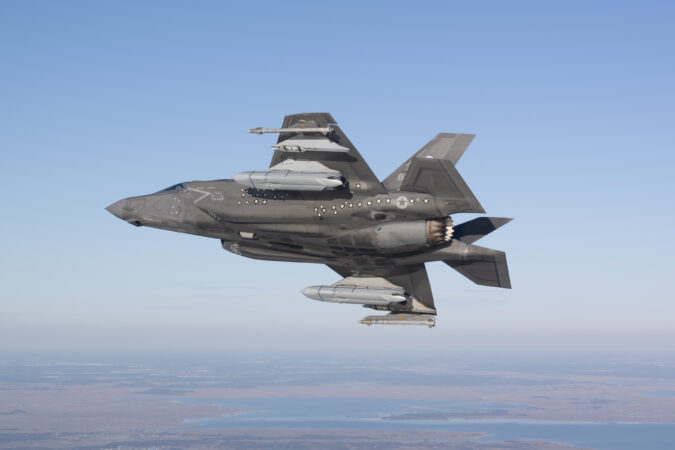
- 2024: The U.S. Navy completes four-missile salvo testing and begins flight testing the round on the F-35C
- 2025: Initial flight testing expands to the F-35B short-takeoff/vertical-landing variant.
- 2026: Lockheed Martin expands factory capacity and contract modifications to boost annual production.
Sources: Lockheed Martin, Air & Space Forces Magazine, USNI
LRASM and JASSM
Lockheed produces both the the AGM-158 JASSM and the AGM-158C LRASM. There is also the AGM-158-JASSM Extended Range variant, which can hit targets out to 500 miles.
Currently, the B-1B Lancer, B-2A Spirit, B-52H Stratofortress, F-15 variants, F-16 variants, and C-130 Hercules can carry the JASSM.
The Air Force is also integrating the JASSM onto the F-35A Lightning II and the B-21 Raider.
The LRASM’s range hovers close to the baseline JASSM variant, just beyond 200 miles.
Air & Space Forces Magazine recently reported on JASSM and LRASM production progress based on Pentagon acquisition reports released in July.
The reports noted that, as of April, the Navy and Air Force were expanding their production plans for the shared munition. Lockheed had delivered a total of 5,348 JASSMs to both services. The company’s current production capacity is 600 JASSMs a year, with short-term plans to boost that to 860 missiles annually.
That’s key, as a recent Center for a New American Security report estimates that the Air Force has ripped through a quarter of its JASSM inventory during Operation Epic Fury.
Lockheed announced a new AGM-158 JASSM-FLEX variant in September at the AFA Air, Space & Cyber conference. The new variant lets users swap out the nose and launch options for various payloads and other configuration needs, which might include an LRASM option.
“The AGM-158 FLEX airframe concept was driven by a strategic need to keep pace with rapidly evolving threats, insert emerging technologies quickly, manage obsolescence, and provide, at scale, a cost-effective missile family that can be repurposed for a wide range of missions while delivering timely, relevant capability to the warfighter,” a Lockheed Martin spokesperson told Air & Space Forces Magazine via email.
The Air Force spent $200 million in fiscal 2025 for a second-source engine for the LRASM and JASSM-ER. Lockheed plans to spend between $8 and $9 million through 2030 to boost production on existing lines.
