

One of the Air Force and Navy’s most common air-to-air missiles is falling short of a key readiness metric, and the services are ramping up stocks of a vital air-to-ground missile, according to recent Pentagon reports.
The Modernized Selected Acquisition Reports on the AIM-9 and the Joint Air-to-Surface Standoff Missile, cleared for publication in July, lay out progress and shortfalls and provide a snapshot for the health of these key munitions.
According to the reports, the AIM-9X Sidewinder Block II is facing operational availability shortages. The Warfighting Acquisition University defines operational availability as “the degree … to which one can expect a piece of equipment or weapon system to work properly when it is required.” The Air Force is at 58 percent operational availability for the latest version of the Sidewinder, and the Navy is at 78 percent—the requirement is 86 percent, the report says.
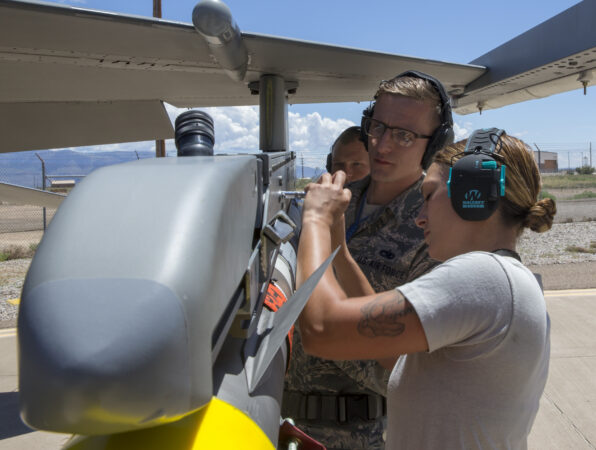
That shortage is forcing squadrons to face lower training asset availability, preventing fighter pilots from having the requisite number of Captive Air Training Missiles. Those CATMs have live seekers and guidance units that pilots use on regular training sorties to practice locking onto targets, tracking high off-boresight angles, and simulating missile shots.
When enough training pods are nonoperational, aircrews don’t have enough rounds to fly daily air-to-air tactical training with realistic seekers.
The Air Force and Navy plan to buy more than 11,000 AIM-9X Block II missiles, which are infrared-guided, short-range, supersonic air-to-air weapons.
But reliability problems with integrating a new circuit processor into the latest configuration, the AIM-9X-4, have “impacted missile reliability and halted testing.”
As a result, a software update called Operational Flight Software 10.4, meant to integrate the advanced guidance control unit and inertial measurement unit hardware upgrades, will not be fielded.
Report authors note that the follow-on software that will fix the problem won’t be ready until September 2027.
AIM-9X maker RTX declined to comment on the report.
JASSM and LRASM Work
As the two services work out the air-to-air missile problem, both are seeking to expand their plans for the Joint Air-to-Surface Standoff Missiles and its cousin, the Long-Range Anti-Ship Missile.
Another shared munition between USAF and the Navy, the JASSM is a linchpin munition with multiple variants fielded and in production.
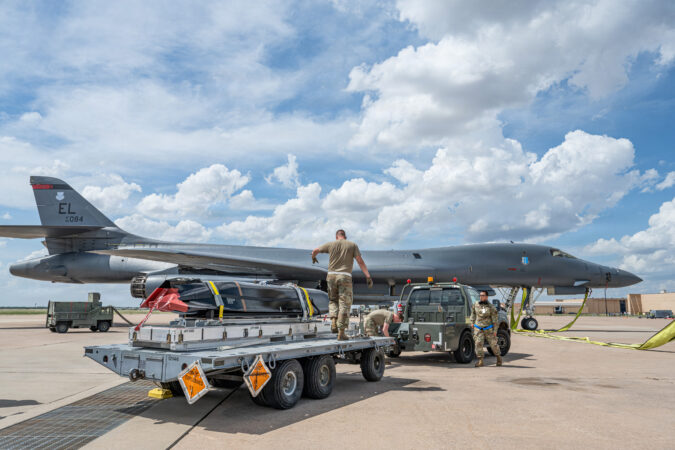
The AGM-158A JASSM is a 14-foot-long missile that strikes beyond 200 miles and has been a staple of U.S. aircraft use since 2001. The B-1B Lancer, B-2A Spirit, B-52H Stratofortress, F-15 variants, F-16 variants, and C-130 Hercules can carry it and its variants, and the F-35A Lightning II and B-21 Raider are planned to integrate it.
The AGM-158B JASSM-Extended Range can hit targets at more than twice the distance, with public reports showing ranges of more than 500 miles.
The AGM-158C LRASM has a range closer to the baseline JASSM but is equipped with radio-frequency seekers designed to strike large, moving targets such as ships.
According to the recent selected acquisition report, the joint program office between the two services had delivered 5,348 JASSM variants to the Pentagon as of April, according to the report.
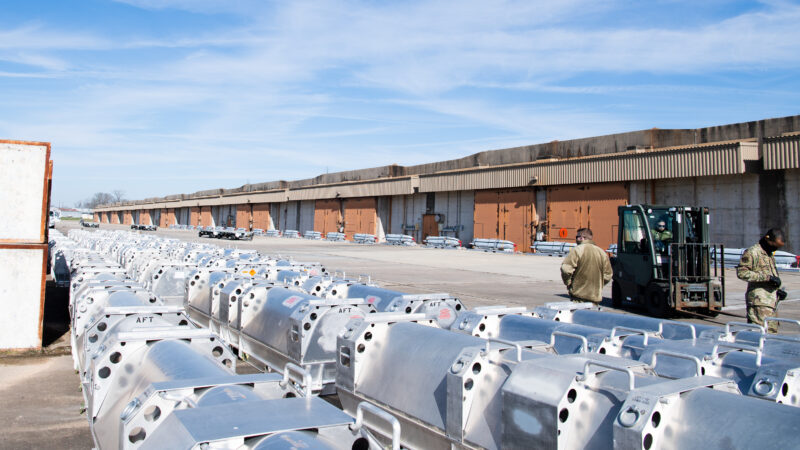
Current production capacity sits at about 600 JASSMs annually, with near-term plans to reach 860 missiles a year.
More mid-term plans call for ramping up that production to 1,280 missiles annually by fiscal year 2030 and 1,880 by fiscal 2032, according to the report.
A March $52 million contract modification to LRASM will raise the missile’s production from 240 per year to 320 per year beginning in fiscal 2029, according to the report.
Lockheed announced a new JAASM option at AFA’s Air, Space, & Cyber conference earlier this month, the AGM-158 FLEX.
The company sees FLEX, a modular, designed munition which has swappable nose and launch options, as another way to offer a variety of strike options in the JASSM form factor.
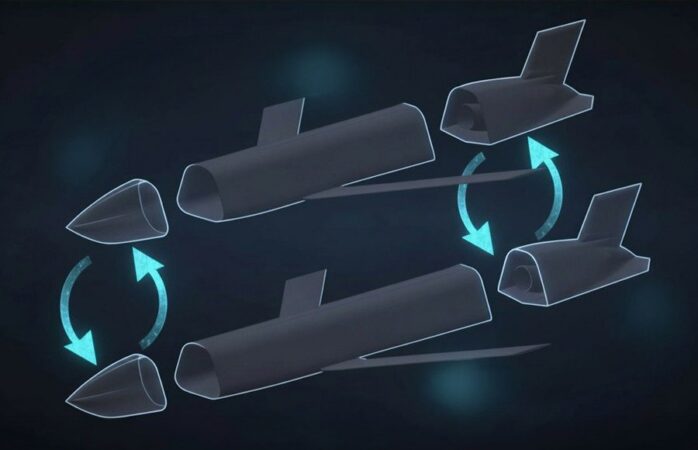
“The AGM-158 FLEX airframe concept was driven by a strategic need to keep pace with rapidly evolving threats, insert emerging technologies quickly, manage obsolescence, and provide, at scale, a cost-effective missile family that can be repurposed for a wide range of missions while delivering timely, relevant capability to the warfighter,” a Lockheed Martin spokesperson told Air & Space Forces Magazine via email.
The stockpile plus-up, however, will use current factory space via expansion efforts, the Eglin spokesperson wrote, and “will not require a new facility construction.”
Lockheed’s investment strategy includes $8 to $9 million through 2030 to meet heightened munitions demand.
“We are expanding production and building and modernizing more than 20 facilities in Arkansas, Alabama, Florida, Massachusetts, and Texas,” Lockheed spokesman Scott Swofford told Air & Space Forces Magazine in an email. “This includes upgrading existing facilities and incorporating advanced manufacturing techniques, production lines, tooling, and plant layouts to meet urgent production demand.”
Software, Paint, and Engines
Like the AIM-9X, the JASSM also faced software integration problems, specifically with its 54.0.02 flight software update. But an Eglin spokesperson said the software had received fielding approval since data for the selected acquisition report was gathered in April, and that “there are no impacts to combat readiness.”
The Air Force is also pressing to accelerate the integration of the Universal Armament Interface, a software architecture to standardize aircraft mission systems-weapons interface, but this has introduced “added software risk,” according to the report.
But the Eglin spokesperson told Air & Space Forces Magazine that the UAI program has “made no changes to the delivery schedule” of the JASSMs.
“Integration activities remain on track to deliver planned capabilities as scheduled. Software risk is being actively managed through early software-in-the-loop integration, resource prioritization, and agile contract actions,” the spokesperson said.
Separately, the report noted that in an inspection of 1,356 JASSMs, inspectors flagged 49 missiles for depot-level maintenance and overhaul, mostly due to stealth coating defects. The report says that issue won’t be resolved until 2029.
Lockheed switched from the flat gray paint scheme to a semi-gloss black coating to reduce radar and visual signatures. The new coating can absorb and deflect electromagnetic energy more easily during longer flight times used by the new, extended-range variants.
The shift began in 2021 with the Lot 19 contract award for the AGM-158B-2 variant.
The Eglin spokesperson said that both the program office and Lockheed Martin are “exploring contracting actions to increase repair capacity and return serviceable missiles to the field more efficiently.”
Beyond software updates, the Air Force also spent $200 million in fiscal 2025 to procure and mature a second-source engine for the LRASM and JASSM-ERs.
“Investing in a second engine source for the AGM-158 is essential to securing our supply chain and ramping up production of critical long-range strike weapons,” the Eglin spokesperson said. “By establishing a second production line, we eliminate manufacturing bottlenecks, drive competition, and secure deliveries of JASSM and LRASM to the warfighter.”