
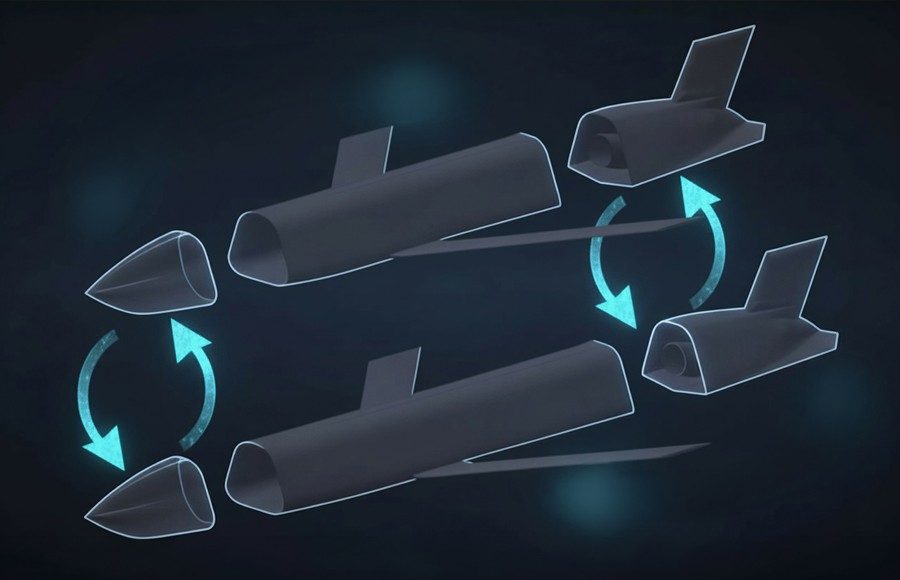
NATIONAL HARBOR, Md.—Lockheed Martin has unveiled its concept for a modular version of one of the Air Force’s main air-to-ground cruise missiles, opening up a range of possible upgrades and uses for the weapon.
Lockheed revealed the AGM-158 FLEX airframe, based on the Joint Air-to-Surface Standoff Missile, at AFA’s Air, Space & Cyber conference this week. The airframe has a removable nose cone to let users swap in different sensors and a reconfigurable tail for different launch options.
“The AGM-158 FLEX airframe concept was driven by a strategic need to keep pace with rapidly evolving threats, insert emerging technologies quickly, manage obsolescence, and provide, at scale, a cost-effective missile family that can be repurposed for a wide range of missions while delivering timely, relevant capability to the warfighter,” a Lockheed Martin spokesperson told Air & Space Forces Magazine via email.
The spokesperson did not answer questions about whether the Air Force has contracted or ordered the FLEX or what stage of development the project is in. Lockheed did say in a release that it has invested $35 million of its own money on the idea, based on what the firm called “a demand from our customers to have increased options.”
The Air Force has shown interest in modular munitions before—in January 2025, the Air Force Life Cycle Management Center published a notice to industry seeking technology to allow for its Extended Range Attack Munition project to have modular parts for its subcomponents. The ERAM is also a standoff cruise missile, which the Air Force rercently developed as a low-cost option to bolster its stockpiles.
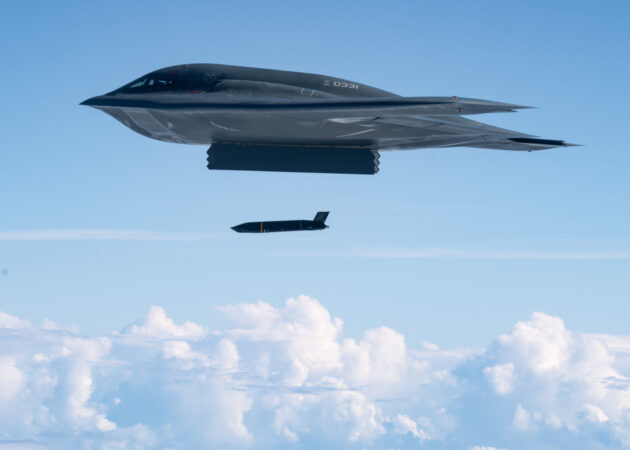
Indeed, the Air Force and the rest of the U.S. military are keen to build up their weapons stocks after using thousands to strike Iran during the ongoing conflict in the Middle East. The U.S. used 1,100 JASSMs over just the first 39 days of the conflict, according to an analysis from the Center for Strategic and International Studies in April.
Given that high usage and demand, the Air Force plans to significantly ramp up production of JASSM and its Long-Range Anti-Ship variant—and Lockheed sees FLEX as a way to further bolster the stockpile with more options.
The concept “will allow customers to quickly integrate capabilities,” Lockheed’s release states, and allow JASSM to be configured for surface, sub-surface, and ground launch options.
The air-launched version will remain compatible with all current and future JASSM and LRASM air-launched platforms.
Size options include a 206-inch extreme range option, the same size as the existing JASSM-XR, and a 168-inch extended range version, the same size as the JASSM-ER.
Both are built to give users “significantly increased standoff attack range.”
The weapon could feature in the latest iteration of a yearslong effort known as “Rapid Dragon,” which has now shifted to become “Dragon Cart,” a project to launch cruise missiles from palletized loads dropped from the ramps of transport and cargo aircraft such as the C-130 and C-17.
“As Rapid Dragon transitions into a Dragon Cart program of record, it becomes a viable deployment platform for a variety of Air Force munitions, both in inventory and in development,” the Lockheed spokesperson wrote. “While we can’t offer specific examples today, Lockheed Martin does consider all potential launch platforms in maturing munition offerings.”