
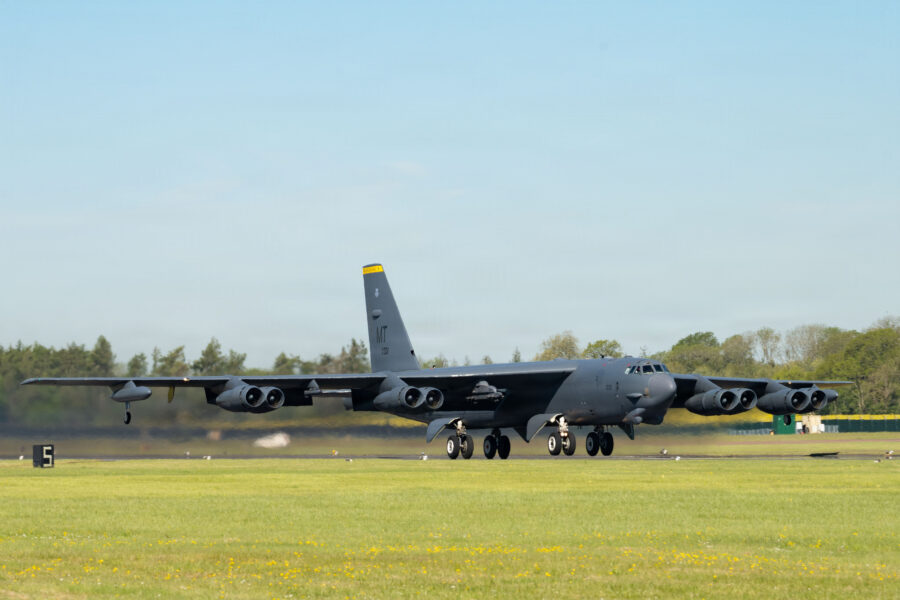
NATIONAL HARBOR, Md.—The Air Force’s program to re-engine the B-52H Stratofortress has moved from its technology maturation and risk reduction phase to engineering and manufacturing development, marking a new milestone in the sweeping overhaul of the Cold War-era bomber, a top official said Sept. 15.
William Bailey, who is performing the duties of assistant secretary of the Air Force for acquisition, technology and logistics, told reporters at AFA’s Air, Space & Cyber conference that the B-52’s Commercial Engine Replacement Program entered the EMD phase in June.
The B-52’s Radar Modernization Program, which will replace the bomber’s legacy analog AN/APQ-166 radar with an active electronically scanned array AN/APQ-188 radar, also entered low-rate initial production in August, Bailey said.
The EMD phase of a program’s acquisition process is where prototypes are developed, built, and tested to make sure they meet all the necessary requirements before the system enters production. It follows a Milestone B declaration, which is considered the point where a program formally starts.
The engine and radar replacement programs are some of the most significant upgrades in the B-52’s long history, intended to keep the 1960s-era bombers flying until at least the 2050s. When those and other modernizations are in place, the bomber will be so significantly changed the Air Force plans to redesignate it the B-52J.
Under the reengining program, the B-52’s original TF33 engines, made by Pratt & Whitney, will be replaced with Rolls-Royce-made F130 engines.
The 1960s-era TF33 engines are approaching the end of their service lives and frequently break, Air Force officials have repeatedly said. Many spare parts for the engines are no longer made, forcing the service to find new sources for those parts, make them in-house, or even “cannibalize” them from retired or otherwise non-flying B-52s.
The new Rolls-Royce engines are intended to solve those problems. Not only will they be new, with modernized subsystems like hydraulic pumps and generators that won’t need as much work, they will be derived from commercially used engines, making it much easier to find spare parts.
In an announcement released soon after Bailey’s remarks, the Air Force said the engine program’s Milestone B decision was made June 1 and established the program’s first official acquisition program baseline. CERP’s total acquisition cost was set at $20.2 billion, including the cost of research, development, test and evaluation, procurement, and military construction. The Air Force said that $2.6 billion of that $20.2 billion cost has been spent since 2018.
“The baseline reflects a realistic, data-driven service cost position that accounts for the complexity of integrating new systems on a 70-year-old airframe,” the Air Force announcement states.
The Air Force also said it has “made significant progress” to reduce the risks facing the program. Wind tunnel tests early on found inlet airflow distortion, the statement said. To fix that problem, engineers redesigned the nacelle and inlet, validated the solution through testing, and finished the critical design review with Boeing—which originally made the B-52 and is leading its modernization today—and Rolls-Royce in May 2026.
Two B-52s have been earmarked as test aircraft for the new engines and radar and recently underwent depot maintenance. They are currently flying operational missions, the Air Force said but will travel to Boeing’s facility in San Antonio, Texas, in the next few months to receive both new engines and the new radar.
The first B-52 that was used to test the new radar crashed at Edwards Air Force Base, Calif., in June, killing all eight Airmen and contractors aboard. The Air Force later said another B-52 was being modified with a new radar as a second test aircraft, but that the service always planned to have two radar test aircraft.
Bailey said at the conference that he is still awaiting more information from crash investigators, and that a final decision on how to proceed with the second radar test bomber is still in the works.
“We’re looking at that test aircraft, we had two aircraft from [the Radar Modernization Program], and what do we need to do with that second aircraft as part of the rest of that test program,” Bailey said.
The Milestone C decision authorizing low-rate initial production for the B-52’s new radar was made Aug. 21, the Air Force announcement said. The service awarded a $603 million contract to Raytheon Technologies to start building the radars, and a $163 million contract to Boeing for aircraft integration kits, with the first lot consisting of four kits. The program plans five production lots to deliver 74 kits total.
The Air Force said in its statement that the B-52 modernization program still includes work on survivable nuclear command-and-control communications, including terminals that would operate at extremely high frequencies, and conventional beyond-line-of-sight capabilities like hybrid satellite communication systems.
Part of the the engine program’s Milestone B evaluations included reviewing the B-52’s structural integrity, which remains strong, the Air Force said. The B-52’s airframe can safely support new engines, increased electrical power generation and decades more of flying operations, the Air Force announcement states.
Bailey praised the teams working on the engine and radar upgrades for getting the programs to these critical points.
“That’s the byproduct of a lot of great modeling, a lot of great ground testing, understanding what the engine is going to need to do,” Bailey said. “That [radar milestone] is also after a lot of great work getting through the integration challenges of getting that radar, and all the support equipment that radar needs, integrated into that aircraft.”
But with only 75 B-52s in the Air Force’s fleet and the Stratofortress in heavy demand for the conflict with Iran and deployments elsewhere around the globe, balancing the fleet’s testing, maintenance, and operational needs is a challenge, Bailey said.
“There’s a really great team between [Air Force Global Strike Command], operators of the aircraft, the depot out at Tinker [Air Force Base], the program office, and Edwards Air Force Base, ” Bailey said. “Those communities have to come together in a balance, because a jet needs to be downrange, but a jet also needs to be sustained.”