
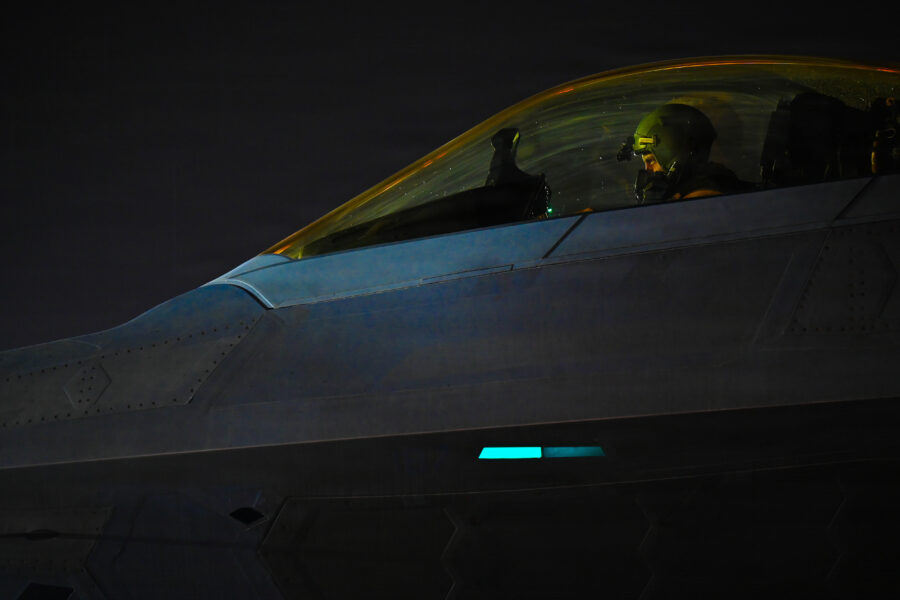
The Air Force is seeking funding to let its pilots fly more than 1.1 million hours in fiscal 2027, which would be the most in about four years.
But even if Airmen actually do fly all 1.147 million hours—which the Air Force said in budget documents would be the most it can produce—it would still be short of the 1.3 million hours the service says it truly needs.
“Although this [flying hour] funding level is below the Department [of the Air Force’s] 1.3 million-hour goal, we are aggressively addressing the challenges that limit flying hour capacity as part of a generational investment in our nation’s defense,” the Air Force wrote in budget documents. Those efforts include plans to increase pilot production to 1,500 per year, the Air Force said.
The Air Force wants its pilots to have more hours to ensure they remain sharp in their cockpits.
“Readiness is ultimately about the proficiency of our warfighters,” the Air Force said in a budget document detailing planned operation and maintenance spending. “The Flying Hour Program (FHP) is the forge that ensures American pilots remain the most capable and best-trained aviators in the world.”
In recent years, however, the service has had trouble actually executing all the flying hours in its budget due to a combination of aircraft challenges and pilot shortages.
Back in 2019, for example, the Air Force budgeted for 1.45 million flying hours but actually ended up flying closer to 1.2 million. In 2025, the Air Force budgeted for nearly 1.07 million flying hours, but when the year was finished, budget documents show pilots flew slightly more than 1.01 million hours. Active-Duty flying hours fell 10 percent short of the more than 886,000 budgeted for in 2025, while Reserve flying hours slightly exceeded budgeted amounts, and Air National Guard pilots flew 28 percent more hours than budgeted.
As a result of these shortfalls, officials have cut back on their budget requests with the goal of using every hour given. In 2024, the budgeted amount of flying hours dropped to 1.07 million hours, and at that time, service officials said that was roughly the amount that the Air Force could be realistically expected to pull off.
With the 2027 budget’s heavy emphasis on readiness, the flying hours account did get a plus-up: the Air Force is asking for $7.4 billion to fund Active-Duty flying hours, which would be a 22 percent increase from the $6.1 billion budgeted in fiscal 2026. Another $1.6 billion would cover Air National Guard hours, and $867 million would go to Air Force Reserve hours, for a total of $9.9 billion. That funding would pay for the fuel, spare parts, and consumable supplies pilots and maintenance crews need to safely and reliably fly aircraft.
That funding boost is intended to allow pilots to fly 1.147 million flying hours in 2027, about 65,000 more than are budgeted for this year. If the Air Force achieves that goal, it would be its most in a year since flying 1.149 million hours in 2022.
The Air Force said in budget documents that 300,000 hours would be used to fly the T-7A Red Hawk jet trainer. Another 229,000 hours would be for combat aircraft like the F-22 Raptor, F-35A Joint Strike Fighter, and bomber force, and 306,000 hours would go to global mobility flights.
Budget documents show the department plans to spend $174 million in mandatory reconciliation funds on F-35 flying hour requirements. That would be higher than the nearly $160 million in reconciliation funds Congress provided in 2026.
“This surge directly enhances warfighter lethality by enabling pilot production and proficiency, building a ready force,” the Air Force said in a budget report.
John Venable, a former F-16 pilot and senior resident fellow at the Mitchell Institute for Aerospace Studies, doubts the Air Force will be able to meet its goal of 1.1 million hours in 2027. The root of the problem, he said, is the service’s longstanding readiness issues that for years have caused them to struggle with keeping enough aircraft able to fly their missions.
The Guard’s pattern of exceeding its budgeted flying hours is an exception within the Air Force, one which Venable said is likely because their fighter units are often called upon for operational missions.
When pilots go year after year without being able to fly as many sorties as they need, Venable said, other duties creep into their days that start to distract units from their intended focus on flying and warfighting.
“There’s a lethargy that comes with underperformance,” Venable said.
Multiple factors have contributed to the readiness problems, Venable said, including a lack of enough maintenance personnel on the flightlines, not enough spare parts and other consumables, and not enough aircraft as aging, older planes retire and their replacements don’t come online fast enough.
This results in a system that isn’t supporting maintainers, aircrew, and other Airmen needed to generate sorties in the way they need to be ready to fight a war, Venable said.
“I’m not talking about the guy who’s turning wrenches,” Venable said. “I’m not talking about the guy who’s flying. I’m talking about the system that does not set those two people up for success.”