
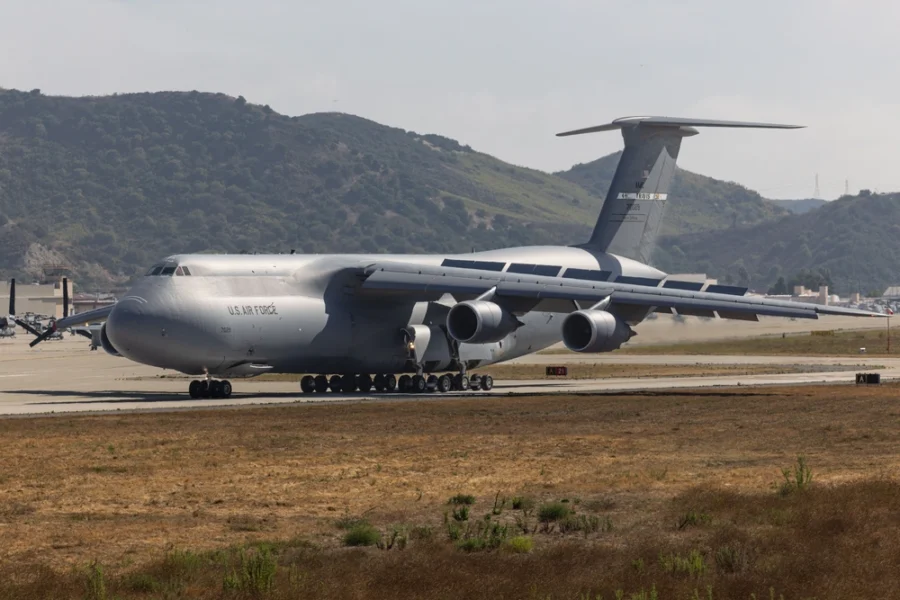
The Air Force is offering a few early hints of what it’s looking for in its next-generation replacement for the C-5 and C-17, including the ability to fly in and out of makeshift airfields on austere battlefields.
On June 12, the service released a request for information to industry as part of its market research for the Next Generation Airlifter, or NGAL, a modernized strategic cargo aircraft to replace the C-5 Galaxy and the C-17 Globemaster III.
The NGAL program is looking for an aircraft design with mature technologies that “offers significant advancements in capacity, range, efficiency, connectivity, survivability, and operational flexibility over current systems,” according to the notice from the Air Force Life Cycle Management Center’s Mobility Aircraft Directorate.
All proposed aircraft must have a wingspan of less than 223 feet to be compatible with current Air Force infrastructure such as hangers and taxiways, the solicitation states. Designs will also have to be capable of a carrying a minimum payload of 160,000 pounds over a distance of at least 2,500 nautical miles unrefueled.
That’s roughly in line with the C-17. The Globemaster, which became operation in 1995, can carry a max payload of 169,000 pounds for 2,760 miles without refueling.
The Vietnam War-era C-5 is the largest aircraft in the Air Force inventory and can carry 120,000 pounds of cargo for more than 5,500 miles but is also capable of transporting up to 285,000 pounds with refueling—that’s four Bradley Fighting Vehicles or six AH-64 Apache helicopters.
Beyond range and cargo capacity, the Air Force is particularly interested in takeoff and landing distances and whether proposed NGAL designs are capable of operating from semi-prepared or austere runways, the notice states.
Officials are also asking respondents to describe how their aircraft’s associated ground-handling concept reduces “reliance on Materiel Handling Equipment (MHE) at forward or austere locations,” and whether it enables “rapid loading/unloading, self-sufficiency, or operations where MHE availability is limited or nonexistent.”
These adaptability features could help NGAL support the service’s agile combat employment, or ACE, concept, which features small teams of Airmen setting up ad hoc airfields in remote locations that lack improved runways.
Interested firms should also describe their aircraft’s ability to perform airdrop and other aerial delivery missions. The C-17 is capable of airdropping 102 paratroopers or 18 pallets of cargo. While the C-5 is capable of airdrops, it is normally used for delivering oversized cargo to fixed airbases.
The Air Force also wants companies to detail their proposed aircraft’s defense capabilities and whether they can prevent and recover from cyberattacks. The service plans to spend more than half a billion dollars through 2031 on the Large Aircraft Survivability Systems, or LASS, program to help protect existing aerial refueling aircraft from enemy missile attacks, and such systems could be key for future cargo aircraft too.
Air Mobility Command leaders have identified NGAL as a top priority, even as they say the C-5 and C-17 will continue to fly for years, or even decades, to come. Recent plans call for the command to start fielding NGAL around 2038, and officials say they need to start preliminary work now to meet that plan.
AMC’s Deputy Commander, Lt. Gen. Rebecca J. Sonkiss, said in March that modernizing the mobility fleet—including NGAL—is “the key to readiness for the joint force.”
Sonkiss also named connectivity as a critical capability for existing mobility fleets as well as NGAL. Currently, the service is working to equip its C-5s and C-17s with the latest connectivity equipment, Sonkiss said in March, linking situational awareness to crew and aircraft survivability.
Interested companies have until June 26 to submit questions and until July 17 to submit white papers in response to the latest request for information.