


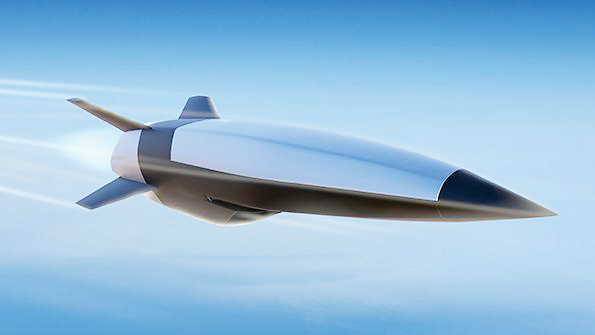
The U.S. Air Force has conducted the first flight test release of its developing hypersonic cruise missile, with that test taking place in Australia.
An Air Force spokesperson confirmed to Air & Space Forces Magazine on Oct. 6 that the Hypersonic Attack Cruise Missile flight test had occurred. The spokesperson did not specify a date.
The HACM flight test happened over a “designated Australian test range, gathering crucial data to advance the program’s objectives,” according to the spokesperson. The Woomera Test Range in the desert of southern Australia is commonly used to test missiles, aircraft, and projectiles.
The War Zone first reported on the test on Oct. 5.
“This effort is part of the Southern Cross Integrated Flight Research Experiment, a collaborative agreement built on more than 15 years of partnership between our two nations,” the spokesperson wrote in an email.
The spokesperson declined to provide further details regarding the method of test, platform used to conduct the test, flight times, durations, or speed.
RTX, the prime contractor on the missile, deferred any comments to the Air Force. Northrop Grumman, the missile’s engine-maker, did not immediately respond to a request for comment.
HACM came out of a Defense Advanced Research Projects Agency program to develop a concept for a hypersonic air-breathing weapon and traces its origins to the Boeing X-51 Wave Rider project.
In April 2020, the Air Force issued an industry call for proposals on the potential weapon. It formally established the HACM program in 2022, picking RTX for the munition and Northrop for the scramjet engine.
HACM is one of two hypersonic weapons the Air Force is pursuing, along with the larger AGM-183 Air-Launched Rapid Response Weapon, or ARRW.
The munition uses a conventional rocket booster to reach high speeds, then ditches it and engages the scramjet engine to reach and maintain speeds above Mach 5, or 3,300 miles per hour, at high altitudes.
HACM recently saw a yearlong delay because of design problems, and the Air Force cut its flight count for rapid-prototyping tests from seven to five. A 2024 GAO report said the program had a “zero margin” in its development timeline at the time, and it has since been declared behind schedule and over its original budget.
USAF is seeking about $1.2 billion to mature and field the missile in its fiscal 2027 budget proposal. It has also asked for a dedicated production line for the missile and requested $404 million for the first operational lot.
The Air Force plans to begin fielding HACM in fiscal 2027 and expects to move it to full-rate production by fiscal 2029.