


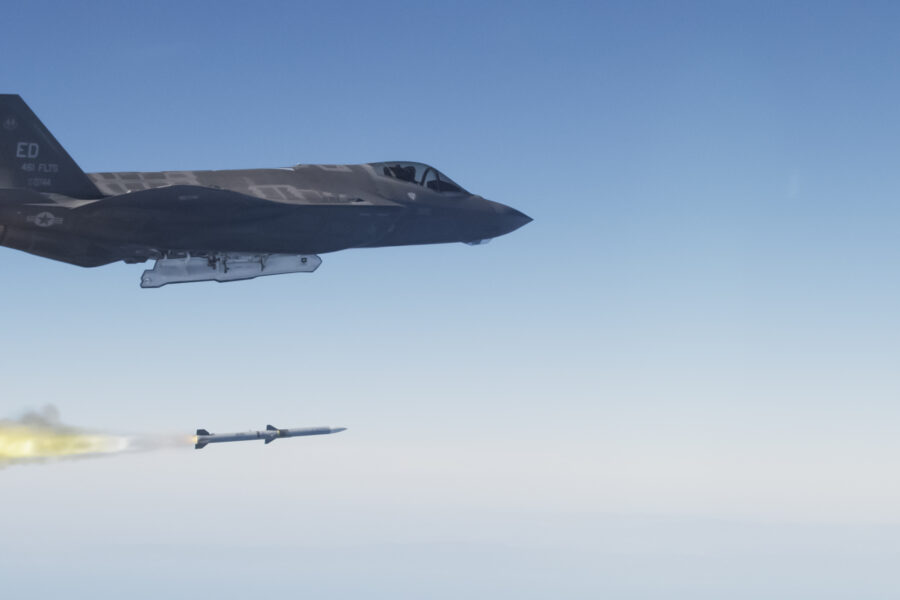
At a high-profile meeting of defense ministers in the Philippines this week, U.S. and Japan leaders finalized an agreement to establish a production facility in Japan for the AIM-120 Advanced Medium-Range Air-to-Air Missile, following a massive $20.7 billion Pentagon contract to expand production of the missile over the next seven years.
Japanese Defense Minister Shinjiro Koizumi announced the agreement in an Oct. 28 press conference after meeting with U.S. Secretary of Defense Pete Hegseth at the Association of Southeast Asian Nations Defense Ministers’ Meeting.
The agreement is the culmination of an effort that began in July 2024 under both men’s predecessors.
“We finally reached an agreement on the establishment of a final assembly and inspection facility in Japan for the AMRAAM air-to-air missile, which is essential for the F-35,” Koizumi said, according to a translation of his remarks. “This is a groundbreaking agreement that will not only ensure the acquisition of equipment needed by both Japan and the United States, but will also strengthen Japan’s defense industry base.”
In a readout of the two leaders’ meeting, the Pentagon did not mention the AMRAAM facility but said Hegseth “welcomed Japan’s efforts to strengthen its defense industrial capacity, and both leaders committed to continue close coordination on critical munitions production.”
The location for the facility has not yet been announced.
The approval process took more than two years in part because Japan has severe constitutional restrictions on exporting lethal weapons or even coproducing offensive weaponry with allies, which date back to its peace-focused foreign policy following its devastating losses in World War II.
The AMRAAM also contains classified guidance systems and intellectual property that require key safeguards to prevent leaks of crucial information about the weapon.
U.S. and Japanese officials have said the agreement will diversify the AMRAAM industrial base and build regional stockpiles for both the U.S. and its allies at a time when President Donald Trump, and Hegseth and his leadership team at the Pentagon have urged allies to invest more in their own defenses.
AMRAAM has long been the U.S. military’s main dogfighting weapon—the first missiles were delivered in 1988. The latest variant is the AIM-120D, which features GPS guidance and improved range, lethality, and jam-resistance over its predecessors.
All legacy fighters, as well as fifth-generation fighters such as the F-22 Raptor and F-35 Lightning II, can carry the AMRAAM.
In late September, the Pentagon and contractor RTX announced a five-year production contract for AMRAAM with two additional option years valued at up to $20.7 billion. The two sides had previously agreed to a framework agreement in February for AMRAAM and other key munitions.
While the contract award—officially published by the Air Force on Oct. 23—does not specify quantities of missiles, the February framework agreement calls for RTX to increase production “to at least 1,900” per year.
Both the length and size of the new contract are far greater than previous deals. Those usually covered a single year, and demand could whipsaw depending on budgetary pressures or service priorities.
As recently as fiscal 2022, the Air Force budget request called for buying just 186 AMRAAMs and the Navy requested none. Those totals wound up changing through reprogramming requests and congressional adds, but generally speaking, procurement stayed at or below 400 missiles between the services from fiscal 2017 to 2022.
AMRAAM Procurement
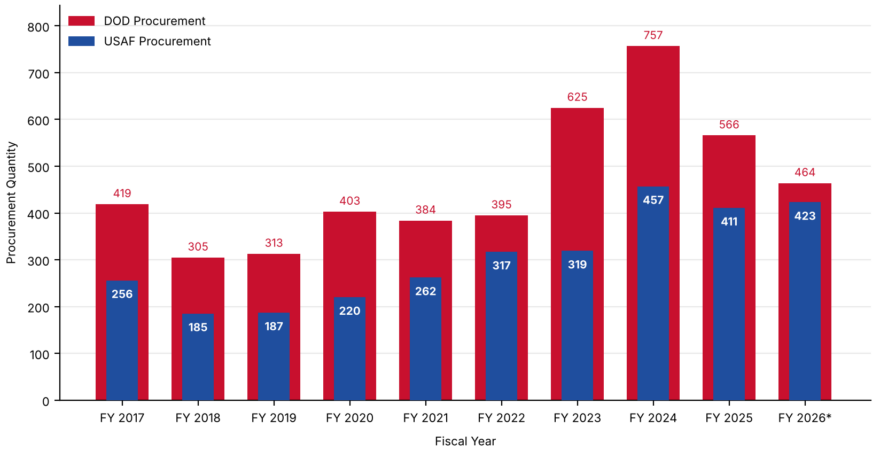
Source: Department of Defense Program Acquisition Cost by Weapon System reports. 2026 totals not finalized.
This new award expands the Pentagon’s multiyear procurement authorities, covering Lots 41-47. Those lots include fifth-generation technology in AIM-120D-3 variants, such as modernized processors and software-defined measures for the electronic warfare threat.
The deal is part of a broader effort by President Donald Trump’s administration to secure multiyear deals for munitions and aircraft, aiming to break the stop-and-start funding cycles of the past few decades.
The contract also increases output to other countries, with foreign military sales to 16 international partners for additional procurement pipelines included.
“We are accelerating output to record levels to deliver this critical capability for the U.S. services and more than 40 allied nations,” an RTX spokesman told Air & Space Forces Magazine in an email.
“We have invested heavily over the past several years to expand capacity, modernize manufacturing, and strengthen our supply chain,” the spokesman wrote. “RTX proactively sourced $80 million in test equipment before any award. These investments will ramp annual production over the coming years to at least 1,900 AMRAAM missiles.”
The company is currently delivering previously contracted AMRAAMs, but the new multiyear contract helps avoid delivery interruptions, the spokesman wrote.
AMRAAM production has faced bottlenecks from a variety of issues, including subcontractor component supply chain problems and solid rocket motor production lag times.
“Like many advanced defense systems, AMRAAM relies on complex components that have long lead times,” the spokesman wrote. “Through sustained investment, supplier partnerships, and efforts such as new U.S. rocket motor production lines coming online in 2027, we are building faster than ever before.”