
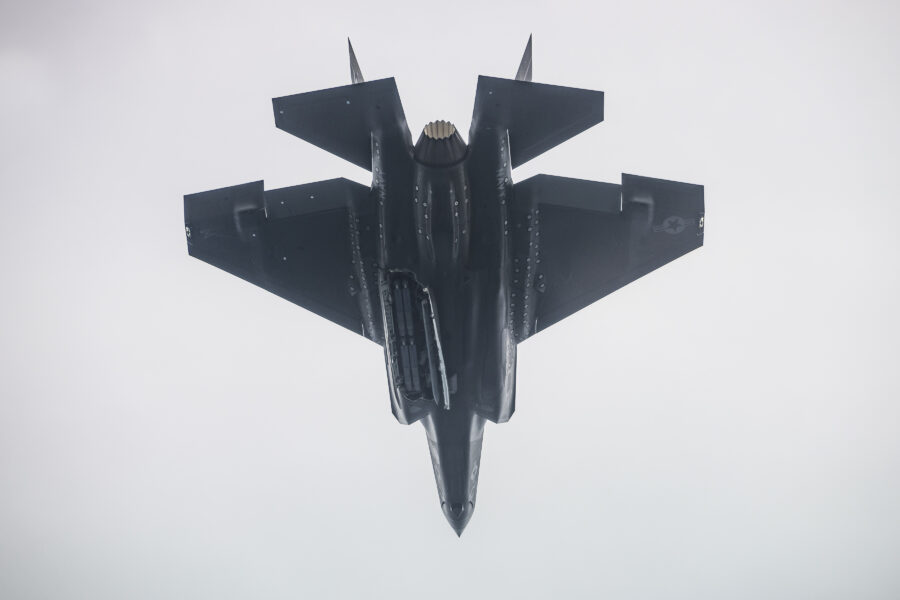
The Marine Corps recently conducted its first-ever “ripple” release of eight Small Diameter Bomb IIs from an F-35B, a key early step in proving out the capability for all F-35 variants.
A “ripple release” refers to munitions all being released in one pass instead of multiple go-arounds. Marine aviators from the Marine Operational Test and Evaluation Squadron 1 at Yuma Proving Ground, Ariz., conducted the test Sept. 15, retired Air Force Maj. Gen. Jon Norman, Raytheon’s vice president for air and space systems, told Air & Space Forces Magazine.
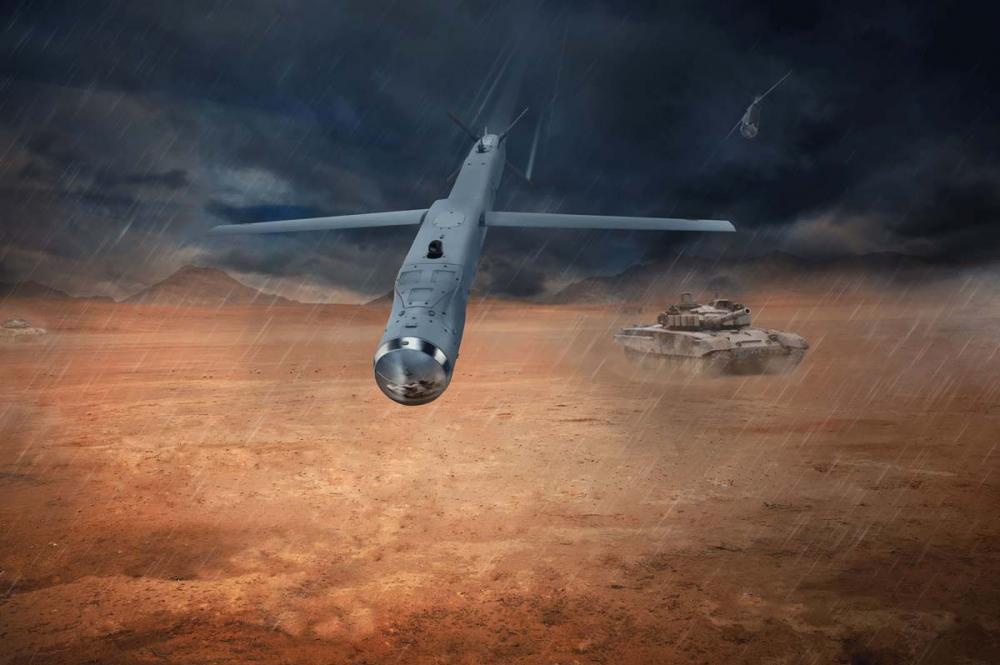
SDB II, also called “StormBreaker,” is a 250-pound, low-yield, precision-guided munition that can hit moving targets in all weather conditions at ranges of at least 46 miles. It is a joint effort between the Air Force and Department of the Navy and is built by RTX’s Raytheon.
While software and other issues have delayed fielding StormBreaker on the F-35, the “ripple” capability could be critical to the Lockheed Martin-made stealthy fighter down the line, Norman argued.
“From a pilot perspective, it’s nice because you’re not sitting there exposing yourself when you have eight targets to address,” he said.
It also eliminates the need to do hands-on weaponeering for each bomb.
“You address the entire target set, so it’s less workload in the cockpit, and you’re able to achieve an effect that I think the pilots are really going to appreciate,” Norman said.
The networked missiles can also be confined to a defined kill box to ensure they strike only a specific area on the battlefield.
“We’re able to set boundaries,” Norman said. “So, you give it a kill box, and it’ll exclude everything outside of that and only hit within that kill box.”
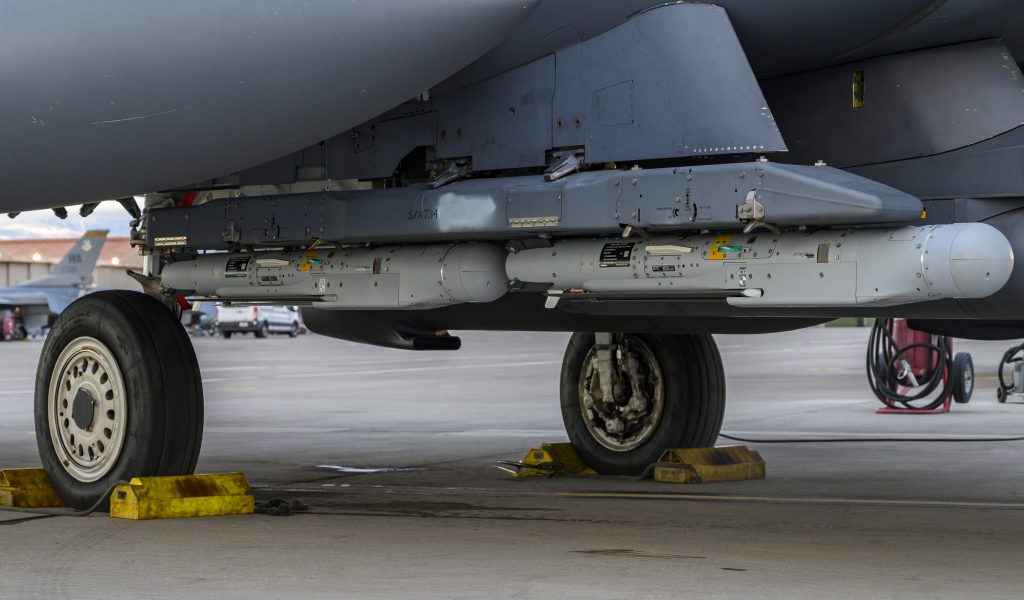
That’s a key upgrade for the StormBreaker compared to what the bomb is replacing—cluster munitions. SDB II was developed to give pilots an option to replace legacy-era cluster munitions following the 2008 DOD policy directive, which set a 2019 deadline to stop using the area-saturation weapons that had high failure rates and could produce swaths of unexploded ordnance on battlefields.
So, a pilot could spot a boat swarm, quickly set the parameters, and then launch eight 250-pound missiles to destroy the mini-fleet in one pass, Norman said.
“Through automated target recognition software that’s built into it, we can hit prioritized threats,” Norman said. “So, if one fails or one gets shot down, then they just reorder the prioritization.”
F-35 Tests
Low-rate initial production on the StormBreaker started in 2015, and the Air Force cleared the bomb to go on its “objective” aircraft, the F-15E, in 2020. But the service hopes to integrate the munition onto many more platforms, including the F-35A. The Navy, meanwhile, cleared the SDB II to go on its F/A-18E/F this February, though its objective aircraft remains the F-35B and C.
But while the F-15 and F/A-18 carry the StormBreaker externally, the F-35 uses its internal weapons bays to maintain stealthiness, offering a new wrinkle to the ripple release process. The F-35B has the smallest internal capacity of the variants, to accommodate the fan that enables vertical landings.
The next ripple release test is planned for this quarter over a small range in Texas, Norman said.
“We’ll take those results then to the Air Force and to the Navy and the Marines and say, “we’ve demonstrated this capability, is this something you’re interested in?’” Norman told Air & Space Forces Magazine.
Future tests could include striking moving targets at sea with multiple munitions, Norman said—a particularly relevant capability, given reports of swarming boat attacks by the Iranian military in the Strait of Hormuz.
As Raytheon works on refining the “ripple eight” capability for operational use, the F-35 fleet is awaiting rolling software patches to fully incorporate the StormBreaker into its arsenal.
A July report from the Government Accountability Office noted that “SDB II initial capability on the F-35 is delayed 2 years, and program officials said that it might be delayed 2 more years due to F-35 software development issues.”
The F-35 fleet has undergone its third technology refresh, or TR-3, which upgraded the L3Harris core processor, replaced the aircraft’s memory storage unit, and installed multicore processors. But while a “truncated” version of TR-3 was completed in 2025, the fleet is still getting software patches to continue upgrades.
“Development on TR-3 was completed in 2025,” Lockheed Martin spokesperson Mireya Villarreal told Air & Space Forces Magazine in an email. “We continue to build on this baseline through the Block 4 modernization program, which implements upgrades including additional weapons, electronic warfare capabilities and improved sensor technology to ensure the warfighter can defeat any threat.”
StormBreaker’s Future
in addition to the ripple release test, Norman said Raytheon is working to extend the StormBreaker’s 46-mile range by exploring engine efficiencies and design work on the bomb’s body.
“We don’t want to constrain pilots,” Norman said. “We want to give them their full operating envelope to be able to release this.”
At the program’s inception, the Pentagon planned to acquire 21,160 StormBreakers, but that figure has now risen to 31,800, according to the GAO report
“Last year we produced and delivered 1,500 StormBreakers. This year we’re increasing that,” Norman said. He could not provide specific numbers for this year’s deliveries.
“But it’s a significant increase, and we have capacity in the factory to increase more,” he said.