


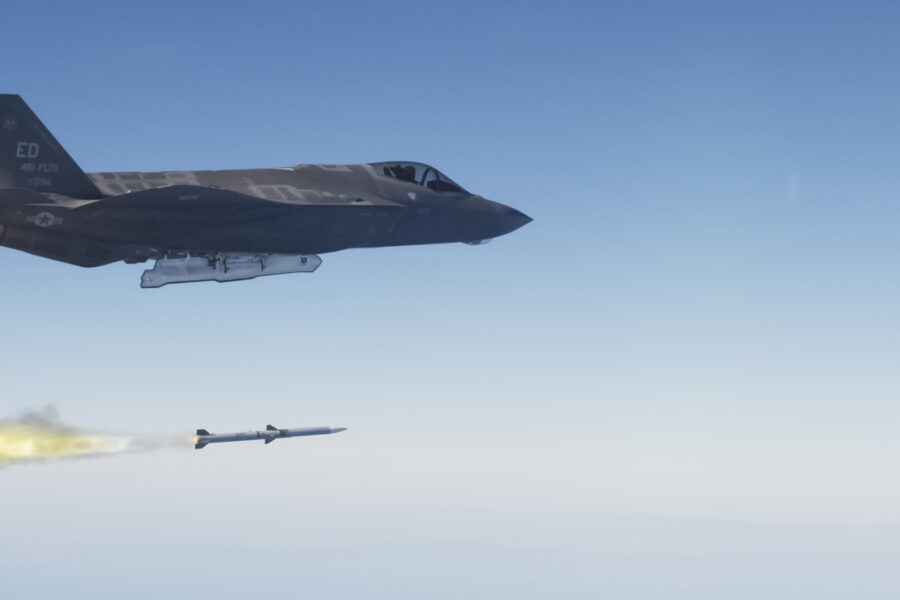
The Pentagon on Sept. 28 announced a contract potentially worth $20.7 billion for RTX to build Advanced Medium-Range Air-to-Air Missiles used by Navy and Air Force aircraft and for ground-based interceptors.
The announcement of the Sept. 25 award noted that the contract is for five years, with two optional years, and is meant to ramp up production of the munition, used for air-to-air combat and missile defense.
The Pentagon release highlights both roles of the AIM-120 AMRAAM as “a proven air-to-air capability” and a “critical air defense capability for U.S. and allied forces.”
In its own release, RTX said the money would “accelerate production of AMRAAM missiles to record-setting levels” but did not specify the quantities.
However, RTX’s Raytheon division previously announced in February it had reached “framework” agreements to boost annual production of the AMRAAM to at least 1,900 missiles annually, along with increased production of the Tomahawk, SM-3 Block IB, SM-3 Block IIA, and SM-6 missiles, all of which are Raytheon products.
The latest contract award does not make clear whether the $20.7 billion is funding for the framework agreement or a separate deal. Neither the Pentagon nor RTX immediately responded to a request for comment.
The Air Force’s fiscal 2026 spending plan included $680 million for 423 AMRAAMs, split between regular appropriations and reconciliation funding.
Munitions Options
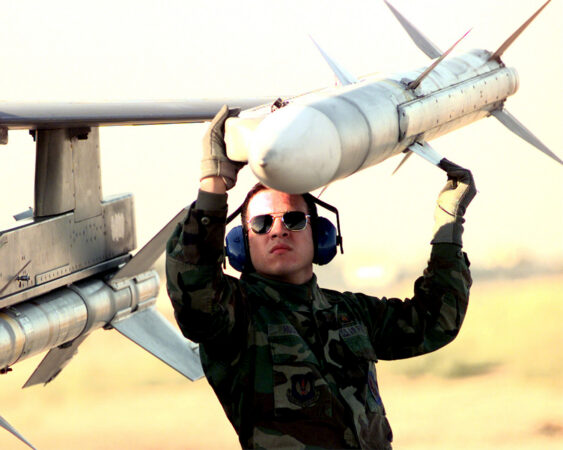
The new $20.7 billion contract aims to supply the USAF, Navy, and potentially foreign military sales, according to the release.
The AIM-120 is a radar-guided, supersonic missile. According to RTX, 11 currently operational platforms across 40 nations use it, including:
- F-15 Eagle / F-15E Strike Eagle / F-15EX Eagle II
- F-16 Fighting Falcon
- F/A-18 Hornet & F/A-18E/F Super Hornet
- F-22A Raptor
- F-35 Lightning II
- AV-8B Harrier II
- Eurofighter Typhoon
- JAS 39 Gripen
- FA-50 / T-50 Golden Eagle
- NASAMS (National Advanced Surface-to-Air Missile System)
- SL-AMRAAM / CLAWS Ground Launchers
There are three variants: the “B” model, which offers reprogrammable aspects not on the initial AMRAAM; the “C” model, which has smaller control surfaces so the F-22 and F-35 can carry it and high-angle off-boresight launch capability; and the “D” model with GPS-assisted guidance, improved range, updated data links, and jam resistance.
The latest version, with System Improvement Program update III, was fielded in March 2024.
The Pentagon plans SIP IV and SIP V upgrades, which will increase the munition’s computing power to four times its current level and expand its engagement envelope.
USAF has announced plans to use the AMRAAM alongside its still-under-development AIM-260 Joint Air Tactical Missile.
Air & Space Forces Magazine reported on Sept. 17 that Lockheed Martin announced a deal to expand JATM production through a separate multiyear agreement. Beyond production, the Air Force also faces operational availability problems with another air-to-air missile, the AIM-9X Sidewinder, as Air & Space Forces Magazine recently reported.
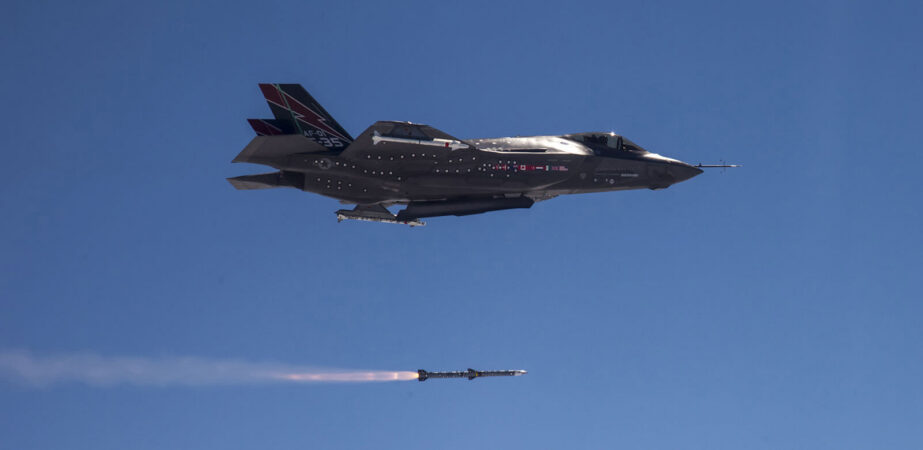
Both the AIM-9X and AIM-120 are key for tactical aircraft operations. The Sidewinder is a within-visual-range, dogfighting missile, while the 12.7-foot-long AMRAAM is a “fire-and-forget” missile used for beyond-visual-range interception.
The 9.8-foot-long AIM-9X uses imaging infrared focal plane array seeking technology, while the AMRAAM uses active radar and conducts mid-course updates for terminal strikes. The Sidewinder can strike targets up to 22 miles away, while the AMRAAM can travel more than 100 miles.
President Donald Trump’s administration has been vocal and adamant about increasing munitions stockpiles for everything from interceptors to air-to-air and air-to-ground missiles.
Separately from the AMRAAM and JATM work, the Air Force is ramping up production under its Family of Affordable Mass Missiles program, which saw a July announcement naming Anduril, CoAspire and Zone Five Technologies as builders of thousands of cruise missiles for air-to-ground engagements.
The companies are expected to produce as many as 5,300 missiles annually starting in 2028 and reach nearly 8,000 missiles a year by 2032.
Many Uses
Not only is the AMRAAM used for air-to-air combat, it is also part of the National Advanced Surface-to-Air Missile System, a midrange air defense system built jointly by Raytheon and Kongsberg Defense & Aerospace.
NASAMS reached operational capability in 1994 and was then deployed by the Royal Norwegian Air Force, according to a 2022 Congressional Research Service report. It can engage 72 targets in both active and passive modes using active-seeker missiles such as the AMRAAM. It has three launchers, each carrying six missiles.
The system uses an AN/MPQ-64 Sentinel Radar, a Fire Distribution Center, and the AMRAAM. The missiles have about a 25-mile range, according to the CRS report.
In 2022, President Joe Biden announced an $820 million aid package to Ukraine, which included funding for two NASAMS. That was followed by six more systems committed later that year and a finalized $1.3 billion contract with Raytheon to build a total of a dozen NASAMs for Ukraine.
Later, the State Department approved an FMS sale of one additional NASAMS to Ukraine in 2023 for $285 million.
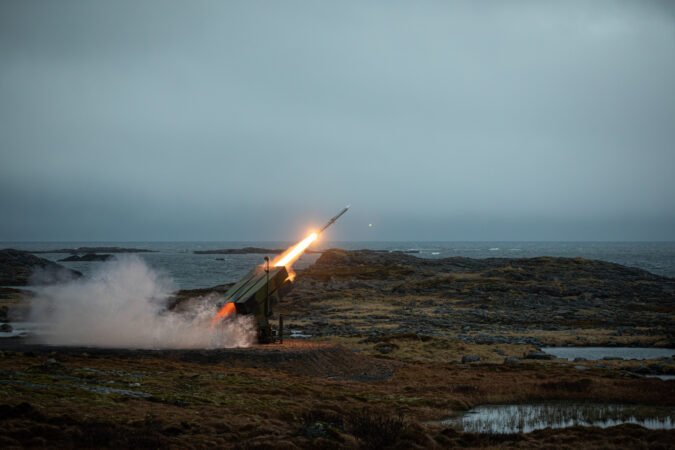
Ukrainian President Volodymyr Zelensky has said that his nation has more than 10 NASAMS in operation.
In 2024, Air & Space Forces Magazine reported that Japan would begin to co-produce AMRAAMs.
Mitsubishi Heavy Industries is the missile manufacturer under a license agreement. However, as of April 2026, the company was still in discussions “regarding the scope of Japan’s participation in the AIM-120 AMRAAM” program, according to a company release. Separately, the Pacific nation signed a deal in 2023 to acquire 120 AMRAAMs for its own stockpile.