


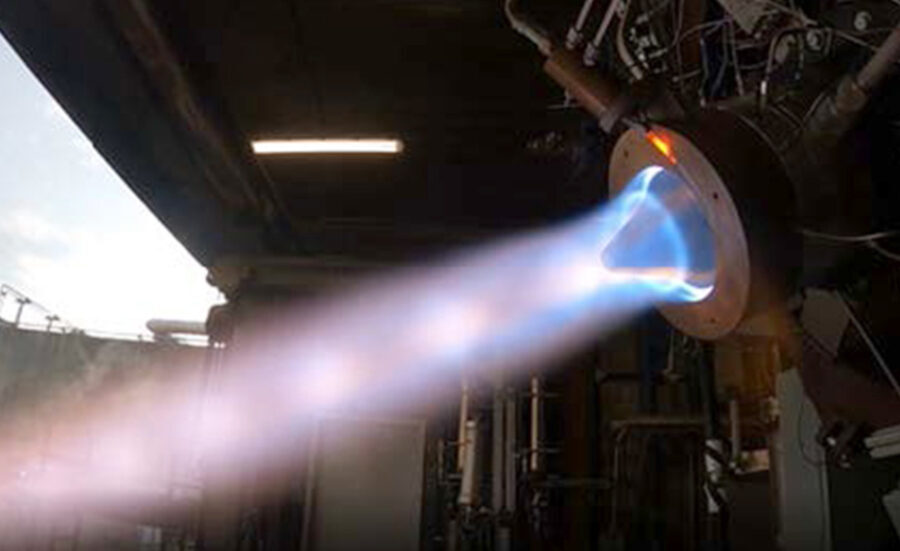
The Air Force Research Laboratory wants industry to advance concepts for affordable hypersonic munition engines to prototype demonstrations within three to four years.
AFRL released a request for information early this month, seeking white papers on technical requirements by Nov. 16. The notice is one of the first updates in months on its push for affordable rocket engines for hypersonic munitions.
The Hermes Rocket Lab effort began in 2020 under AFRL’s Rocket Propulsion Division with a Broad Agency Announcement seeking novel concepts and research and development proposals to accelerate rocket engine technology.
The latest white paper notice focuses on a specific kind of tech called rotating detonation rocket engine combined-cycle, or RDRE-CC.
RDRE-CC systems use continuous detonation waves rather than deflagration, the combustion process used in conventional engines. The approach produces higher pressures and improves efficiency and thrust-to-weight ratio. The technology could increase range, speed, and payload while reducing rocket engine production costs.
According to the lab’s notice, RDRE tech is at the proof of concept stage—in government parlance, at technology readiness level 3 of 9. AFRL wants industry to demonstrate a prototype in an “operationally relevant environment” within three to four years—the step associated with technology readiness level 6.
Specifically, AFRL wants the prototype demonstration to be a “ground-launched, sounding-rocket-boosted flight demonstration to validate the system’s operational viability for future High-Speed Affordable Mass Munitions.”
The Rocket Propulsion Division at Edwards Air Force Base, Calif., began HAMM market research in August and explored rocket-based combined-cycle technologies. That work led to the current RDRE-CC white paper notice.
HAMM covers both high-supersonic and hypersonic speeds, with its most ambitious efforts targeting the hypersonic range.
An AFRL spokesperson declined to answer specific questions on the latest notice from Air & Space Forces Magazine.
“AFRL continues to monitor opportunities and information obtained through Request for Information (RFIs) and may release further details at the appropriate time,” spokesperson Aleah Castrejon wrote in an email.
Industry Efforts
The Air Force is already developing hypersonic munitions like the Air-Launched Rapid Response Weapon and the Hypersonic Attack Cruise Missile. Both those use scramjet and boost-glide systems that are more expensive to produce.
Other approaches include pulse detonation engines, oblique detonation wave engines, and advanced supersonic combustion engines. But critics have noted challenges with each: Pulse detonation engines are more complex and costly to build; oblique detonation engines are harder to start and face challenges at lower speeds; and advanced supersonic combustion engines often need external boosters. Ramjets may also offer lower thrust-to-weight ratios than RDRE-CC technology could achieve.
Companies are already developing RDRE-CC in various modes.
GE Aerospace uses Turbine-Based Combined Cycle, combining a standard turbofan with a rotating detonation dual-mode ramjet.
In 2023, GE laboratory tests validated continuous rotating detonation in supersonic airflow, a potential foundation for transitioning to Mach 5+ speeds.
The company teamed up with Lockheed Martin this year to demo a liquid-fueled rotating detonation ramjet for high-speed and hypersonic standoff missile use.
RTX, which includes Raytheon and Pratt & Whitney, uses an air-breathing, high-pressure combustion engine with rotating detonation combustors.
The company began continuous-detonation research in 2011 and was later selected by the Defense Advanced Research Projects Agency for its Gambit effort, which sought to develop a rotating detonation engine.
Venus Aerospace uses a compact RDRE and rocket-based combined-cycle system dubbed the Venus Detonation Ramjet, which combines RDRE with a Ramjet to attempt to reach Mach 6 speeds without separate propulsion systems.
In 2023, the company achieved long-duration, hot-fire tests of storable, liquid-propellant RDREs and ran drone-scale model flight tests for subsonic and low-supersonic stability.
In 2024-2025, Venus demonstrated the VDR2 on test stands with DARPA.
Aerojet Rocketdyne, part of L3Harris, works with pressure-gain combustion and RDRE tech to build both air-breathing and rocket applications. The company has conducted more than 500 static test firings in a variety of RDR and RDE configurations using multiple propellant combinations. They previously worked with AFRL and the Department of Energy on pressure-gain combustion modeling and other testing.
IN Space, LLC focuses on injector designs, ignition systems, 3D manufacturing tech, and hot-fire testing to build high-thrust RDRE.
In 2021, they worked with AFRL to test a 22kN-thrust RDRE using liquid oxygen and gaseous methane at Purdue University, Ind. Over the following two years, they worked with NASA to test 3D-printed RDRE combustors.