


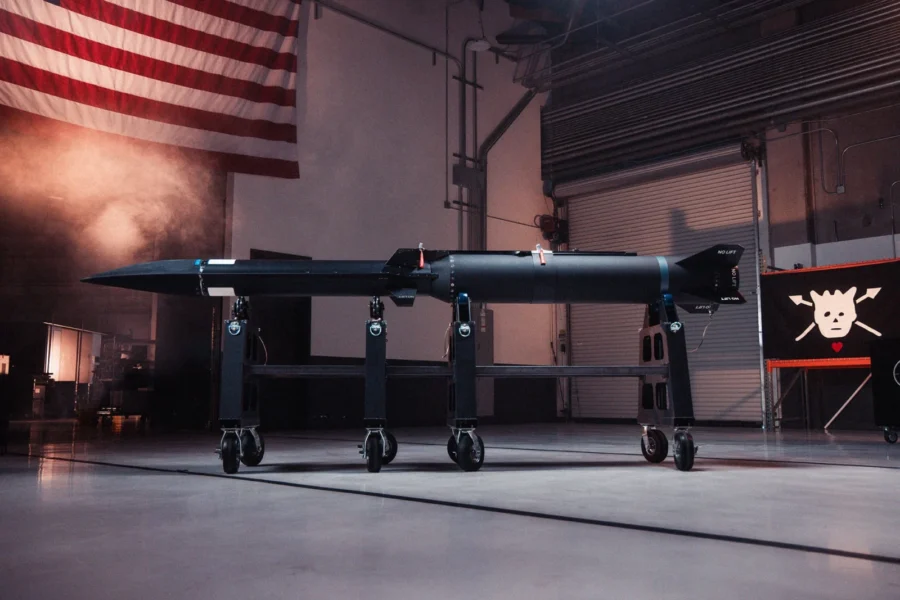
The Air Force has awarded Castelion, a venture capital-backed defense startup founded in 2022, a contract to integrate its hypersonic Blackbeard missile onto the F-16 Fighting Falcon.
The announcement, which came from the company via social media on Oct. 26, marks a major advancement in the Air Force’s work on hypersonic munitions.
Neither the Air Force Research Laboratory, which awarded the contract, nor Castelion immediately responded to a request for comment.
The same day, the service awarded a $694 million contract to Lockheed Martin, a longtime defense prime, to begin production of the hypersonic Air-Launched Rapid Response Weapon, Air & Space Forces Magazine reported.
The Blackbeard missile has drawn strong interest across the Pentagon, with the Navy pushing to field the rocket-powered, boost-glide strike weapon with a nearly 500-mile strike range on the sea service’s F/A-18 Super Hornet.
Navy Development
The Navy’s Air Test and Evaluation Squadron 23 used the Super Hornet to conduct carriage and separation tests of Blackbeard on Sept. 18 at Naval Air Station Patuxent River, Md., which validated the weapon’s compatibility and flightworthiness on the aircraft.
The service selected Blackbeard as the winner in its Multimission Affordable Capacity Effector program, which shifted it to a program of record under framework contract orders of up to $200 million.
The company won a $105 million contract to integrate the missile on the F/A-18 Super Hornet in April.
The MACE initiative sought an affordable hypersonic missile about the size of an AIM-120 AMRAAM air-to-air missile.
In June, the service awarded the company its first production contract, worth $23.4 million, for 50 early operational capability pre-production prototype Blackbeard missiles.
Subsequent delivery orders from the Navy aim to speed up Blackbeard pre-production prototypes to EOC status and field the low-cost hypersonic weapon.
USAF Spending and Development
For its part, the Air Force has spent nearly $21 million to date on Blackbeard research and development, and AFRL added $16.4 million in a September contract modification for the missile.
Those dollars cover development through June 2028 under current spending and contractual agreements.
The USAF contract modification also pursues compatibility with the F-35A.
While the F-35 is the services’ main fifth-generation tactical fighter, the F-16, like the Navy’s workhorse Super Hornet, are workhorse fourth-gen fighters that can carry more munitions without worrying about compromising stealthy characteristics.
The Air Force has more than 600 F-16s in the fleet and recently moved forward with plans to upgrade the decades-old software system for those crucial aircraft, Air & Space Forces Magazine previously reported.

The Big Picture
The Air Force now has a three-pronged approach to hypersonic munitions.
These include Castelion’s Blackbeard, an air-to-air missile; the Lockheed Martin AGM-183A ARRW, a strategic strike-focused, exquisite, long-range hypersonic missile; and the Raytheon/Northrop Grumman Hypersonic Attack Cruise Missile, a cruise missile option to strike ground or maritime targets.
ARRW successfully completed booster and All-Up-Round tests and is poised to add terminal seeker and data-link integration for moving-target tracking in its Increment 2 tests. The strategic strike missile is envisioned for the B-52 Stratofortress and B-1B Lancer.
The AHM-4A HACM is built for internal or external carriage and geared for both fighter and bomber use to add high-volume magazine depth to the fleet. The missile achieved milestone flight tests over an undisclosed Australian range in late September, Air & Space Forces Magazine reported. Initial operational delivery of HACMs is slated for 2027.
Additionally, AFRL recently posted a request for white papers on developing a more advanced hypersonic rocket engine for its current and future munitions dubbed the Rotating Detonation Rocket Engine.
If successful, the more affordable, mass-produced engine could extend ranges, increase speed, and up the payload for future hypersonic, Air & Space Forces Magazine reported.