


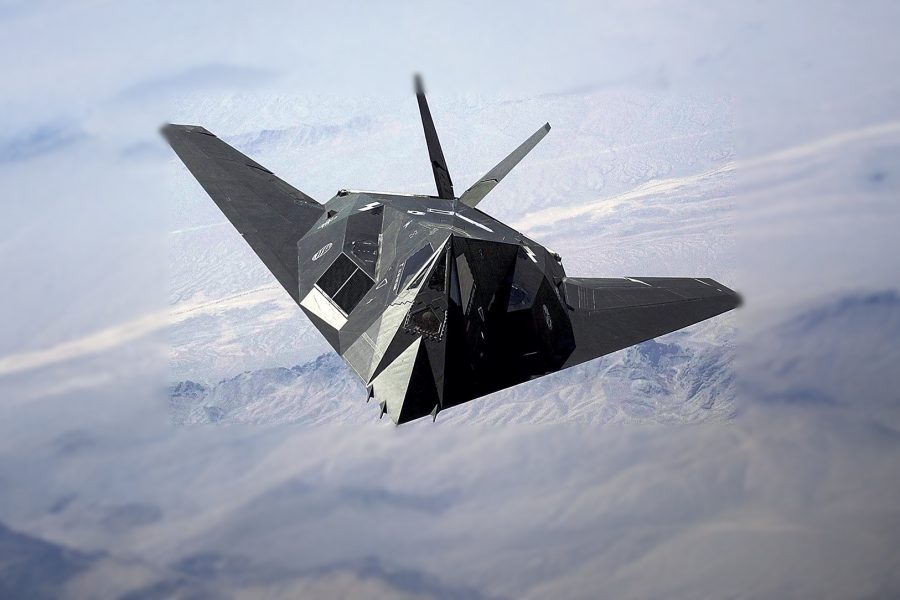
NATIONAL HARBOR, Md.—The Air Force F-117A Nighthawk—America’s first stealth fighter—will soon go on display among other iconic aircraft at the Smithsonian Institution’s National Air and Space Museum’s Udvar-Hazy Center outside Washington, D.C.
Shrouded in extreme secrecy while under development in the late 1970s and early ’80s, the F-117 stunned the world when it flew unobserved into heavily defended Iraqi airspace on Jan. 17, 1991, in the opening salvo of Operation Desert Storm.
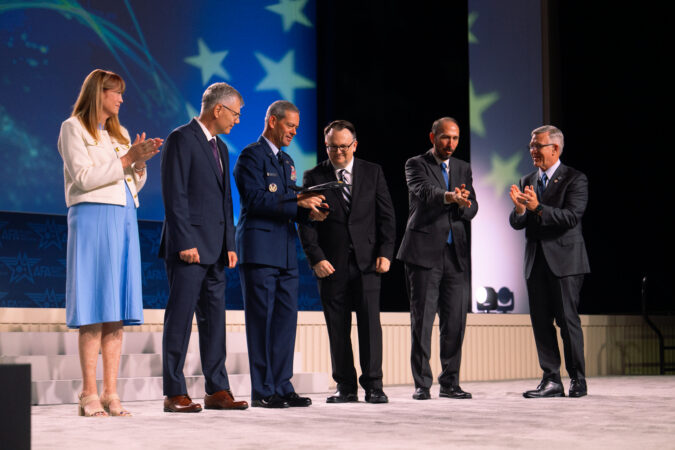
Now more than three decades later, an F-117A airframe—nicknamed the “Overachiever” for being the only Nighthawk to fly combat missions in all four major conflicts of its era—will become a permanent exhibit at the museum in late October, Jeremy Kinney, assistant director of the museum’s research, collections and curatorial affairs office, said Sept. 14 during AFA’s Air, Space, and Cyber conference.
The F-117 has “earned its place in the national collection,” Kinney said. “It revolutionized modern airspace and military technology.”
Aircraft maker Lockheed Martin, which developed the airplane, is restoring the aircraft to its final operational appearance, Kinney said.
In early October, an aircrew from the 512th Airlift Wing from Dover Air Force Base, Del., will transport the restored F-117 on an Air Force Reserve C-5M Super Galaxy transport to the museum’s Stephen F. Udvar-Hazy Center in Chantilly, Va.
Soon after, the aircraft will go on display joining other aircraft, including Lockheed’s SR-71 Blackbird, the Boeing B-29 Superfortress bomber nicknamed “Enola Gay,” which dropped the first atomic bomb on Hiroshima, Japan in August 1945, and the Space Shuttle Discovery.
Kinney thanked the teamwork that went into saving the airplane, saying it “is only possible through the support and collaboration of partners” including the Air & Space Forces Association and Lockheed Martin, in addition to the U.S. Air Force.
The F-117 was developed in response to improved air defenses and offensive counter-air systems developed by the Soviet Union. Losses by U.S. Air Forces in December 1972 and by Israel in the 1973 Yom Kippur War, triggered U.S. weapons developers and the Air Force to collaborate on radar-evading technology. The F-117 proved the concept, paving the way for modern stealth aircraft including the B-2 bomber, F-22 Raptor, F-35 Lightning II, and future B-21 and F-47 aircraft.