


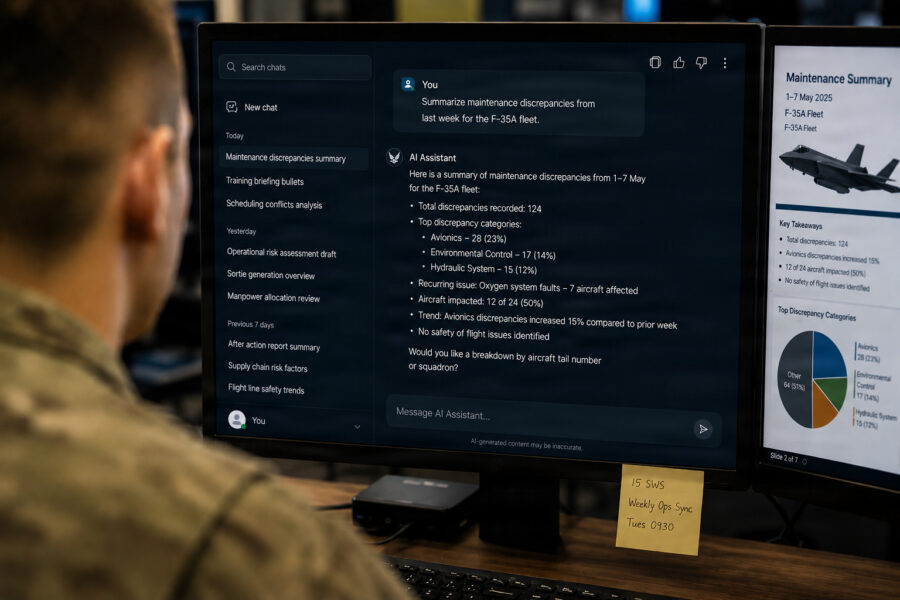
Air Force and Space Force leaders are calling for Airmen and Guardians to enthusiastically embrace artificial intelligence and apply emerging tools to their work. In September, Chief Master Sergeant of the Air Force David Wolfe even went so far as to say those who don’t embrace AI “will end up in someone else’s rearview mirror.”
Secretary of the Air Force Troy Meink opened AFA’s annual Air, Space, and Cyber Conference Sept. 14 with the comments of a true believer, saying the department is “putting more than 300 AI tools into the hands of our people.”
“I use them every day,” Meink said. “This includes tools that streamline work for nearly 150,000 Airmen, and for our Guardians, data fusion tools that turn millions of data points into actual information.” He praised the maturing self-driving technology available in his personal automobile, and hinted that he was hard pressed to find a more complex problem for AI to solve than driving in downtown Washington D.C.
In June, following a “Corona” meeting of Air Force’s top three- and four-stars generals, Air Force Chief of Staff Gen. Kenneth Wilsbach announced forthcoming guidance for AI.
New Chief of Space Operations, Gen. Douglas A. Schiess noted even before he became Chief in September that his service was “not doing enough” to leverage AI. He stressed scaling AI across the force as a route to ensuring decision advantage.
Yet despite leadership’s exhortations to embrace AI for automating burdensome admin tasks and accelerate decision-making, some experts see risk. “DOD’s approach to AI has been very interesting,” said Leah Siskind, an AI research fellow at the Foundation for Defense of Democracy in October. “They’ve taken a lot of bold moves in kind of lowering the hurdles in procurement for AI tools… I think it was a really great approach. That being said, I think the intense cultural pressure coming from the top down, of use AI and we’re, you know, putting out AI slop posts that say, ‘We’re an AI-first workforce’ is a lot because leading technical transformation in government, it’s often largely a cultural process. You have to get people to trust the tools that they’re using, and you have to get them comfortable with this.”
But without a structured approach to vetting what AI tools Airmen are using for what tasks, risks abound. “My biggest concern with the kind of pace we’re adopting AI is it’s actually going to expedite bad processes,” Siskind said.
Keeping a Close Watch
Retired USAF Lt. Gen. William Bender, former Air Force CIO, told Air & Space Forces Magazine he thinks the Department of the Air Force has good intentions, but he questions their ability to manage AI use at an enterprise level.
“Two things can be true at once: we’re measuring it, we’re watching it, and setting objectives and … it’s completely out of control,” Bender said.
Bender, who advises Kosmoy, a company that builds enterprise AI infrastructure and governance platforms, said that institutions should have governance controls in place before they push widespread use of AI tools. With any new technology, users may be inclined to find and adopt their own solutions rather than wait for the institution to certify specific solutions.
The result is what IT professionals call “shadow IT,” which are IT processes that the IT leaders can’t track or protect. He’d like to see the department adopt an enterprise tool to manage and track AI usage.
“Otherwise, it’s a formula for disaster if you don’t really know how it’s being managed,” Bender said.
Shadow IT or shadow AI use poses more than just risk. It carries costs that disappear in operational budgets but add up across the enterprise. “The Air Force has so much IT that was never headquartered-sanctioned, and yet it’s still costing the Air Force,” he said. “So, it’s one of the biggest problems in managing a finite IT budget, because you don’t know where most of it is. And there’s heavy reliance on some of the shadow stuff that was never sanctioned in the first place.” While Bender sees value in bottom-up innovation where Airmen use AI tools to solve real operational problems, the management challenge is to provide a top-down approach to control and protect data and networks.
“I would be looking for efficiencies and productivity by enabling AI to automate and drive an enablement of changed business practices and workflows inside of a constrained environment,” Bender said.
Both Bender and George Dougherty, a retired Air Force colonel and the author of “Beast in the Machine: How Robotics and AI Will Transform Warfare and the Future of Human Conflict,” see risk in unbounded use of the tools.
Army Acting CIO Gabe Chiulli announced in May “unlimited” AI access for Sage AI, a Defense Department platform for accessing various AI tools like OpenAI’s ChatGPT and Google’s Gemini. But usage far outstripped the budget. By mid-June, the Army had burned through its 100 million-token allotment for the year.
Constraints can be helpful to make people thing about efficient and effective use of resources.
DAF Chief Information Officer Ashely Devoto told Air & Space Forces Magazine in October that the department is already working on this.
For example, she said, running basic cybersecurity vulnerability checks might not require the top-of-the-line AI model, and instead could be accomplished with existing, non-AI tools.
“Start with your baseline scanner so that you’re not burning all the tokens identifying what a vulnerability scanner could have already identified,” Devoto said. “We’re trying to be thoughtful about the usage of these models that are going to get expensive very quickly.”
The department is working through usage questions for using AI tools and calculating compute requirements as DAF looks at how AI use will fit into its mid- and long-term budget planning.
Using Gemini, Grok, or ChatGPT for every search is “kind of like driving your Bentley everywhere,” Dougherty said. “If you were just going to go to the 7-Eleven and get a Slurpee, it doesn’t really make sense to take the Bentley there if you’ve got your Honda Civic.”

Usage and Tracking
The Department of the Air Force embraced DOD’s GenAI.mil platform earlier this year for unclassified and sensitive back-office tasks, such as budget planning. The platform provides access to Google Gemini, OpenAI’s ChatGPT, and xAI’s Grok.
To date, more than half the 3.3 million uniformed and civilian DOD personnel with access have used the platform, according to the Pentagon.
DAF Chief Data and Artificial Intelligence Officer Susan Davenport is responsible for AI strategy, policy, governance, oversight, and acceleration of AI capabilities within the department.
The department tracks “relevant use cases and capabilities” through a central inventory dubbed CLARA, an Air Force spokesperson told Air & Space Forces Magazine.
“These use cases are at different stages of maturity, ranging from evaluation and pilot efforts to more established operational applications,” the spokesperson said. “Access and use depend on mission need, security requirements, applicable approvals, and the sponsoring organization.”
The department’s goal is “pervasive, enterprise-wide adoption, supported by the DAF AI Strategy and the DAF AI Hiring & Talent Development Plan, which establishes the DAF as an AI-first force and mandates baseline AI literacy for all personnel.”
Wolfe, USAF’s top enlisted Airman, is doing his part to lead the charge. He established an AI Action Team, a widespread confederation of about 165 Airmen and Air Force civilians who meet virtually to identify “promising grassroots” AI projects for potential enterprise-level “visibility, support and adoption” for the broader Air Force, a lead member of the CMSAF’s AI Action Team told Air & Space Forces Magazine in an email response.
Wolfe’s staff did not disclose the names of any of the action team members. But speaking to Airmen at the conference in September, he invited them to bring their ideas and challenges to him and promised to connect them with task force members to help.
Among the more than 50 projects the team has brought to Wolfe’s attention so far are AI training for the 300-, 500-, and 700-level Air Force Foundation Course, beta testing for emerging DOD AI products, and building AI tools to streamline headquarters processes, the lead member wrote.
CMSAF and the team measure the utility of the tools by evaluating “project delivery, adoption, time and cost savings, process improvement, and the ability to scale successful solutions across the force,” the member wrote.
While Davenport’s CDAO office tracks the use cases and capabilities, responsibility for managing the development, authorization, and delivery of AI tools resides with the mission owners, the spokesperson wrote.
“A use case’s inclusion in the enterprise inventory does not itself constitute authorization for Department-wide use,” the spokesperson wrote.
The CDAO and DAF Data and AI Council provide oversight.
DAF evaluates whether AI tools being used for various missions support those mission outcomes via its AI Strategy.
Learning and Risks
Even when Airmen or Guardians use AI for routine office tasks or promotion board reviews, Bender said, unintentional risks remain.
Users could expose private information unwittingly through an errant prompt, he said. Or a user may ask the AI tool to perform a task, but the prompt may be interpreted differently than intended.
“Exposure to the internet is exposure to the world,” Bender said. “That also opens up-doors into your own networks that would otherwise have been potentially constrained.”
Air Force Maj. Megan Hainline, chief of air superiority programs in the International Affairs Weapons Division on the Air Staff and a visiting fellow at the Foundation for Defense of Democracy, said in a panel discussion in October that AI adoption will ultimately come Airman by Airman and unit by unit.
“There’s a lot of resources out there, but actually trickling that into the unit level and having somebody walk you through it” takes time, she said. People are busy, and may not be inclined to adopt tasks without a push, Hainline added: “It’s hard to take a step back and get to learn about these new technologies until it is kind of forced upon you.”
She advocates for squadron-level units to designate unit experts who can take the lead, updating and advising colleagues on tools specific to their jobs and duties and courses or videos for training.
“Give them a foothold, because it is overwhelming,” she said. “If you’re like, ‘I want to learn about AI,’ you have no idea where to start.”