
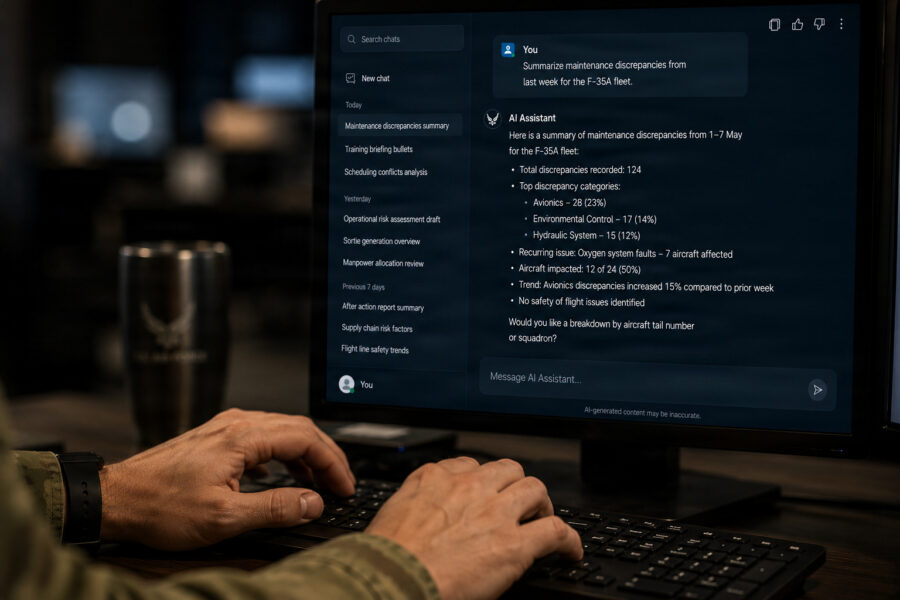
The Department of the Air Force is launching a new artificial intelligence strategy across 15 mission areas, including everything from intelligence to human resources to nuclear operations, using a blueprint recently outlined by the department’s chief data and AI officer.
Each of the 15 domains will be overseen by either a general-grade officer or senior civilian executive who will track governance and data access for the powerful new AI tools the department is embedding across the force.
Chief Data and AI Officer Susan Davenport raised the curtain on this new effort at the GovCIO AI Summit on Nov. 6 in Tysons, Va., and stressed that the new approach would bridge the pilot-to-production gap that often stalls new tech adoption across the U.S. military.
“I always say [Super Intelligence] is an organizational design decision and return on investment is measured by the outcomes we were able to achieve—in other words, did we shorten the kill chain, or return time back to the commander, or did we create decision advantage?” Davenport said, using the government’s new preferred term for AI.
To get better outcomes, the CDAO said the department has to redesign how it uses data and AI before it can be digitized.
The DAF CDAO “has operationalized” data and AI strategies through a series of quarterly showcases in which the domain heads present progress reports to the chief, a department spokesperson told Air & Space Forces Magazine in an email.
“During the showcase events, gaps, overlaps, risk, and areas for collaboration are highlighted and mitigated,” the spokesperson wrote.
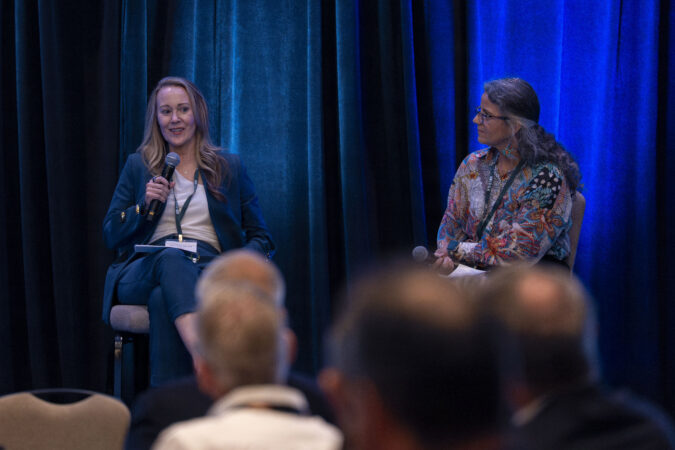
“The data strategy is focused on decentralized data management and treating data as a product,” Davenport said. “The AI strategy is focused on accelerating SI across every facet of the Department of the Air Force.”
Davenport’s job title has two responsibilities—AI and data. In her remarks, she delineated the department’s approach to both and how they feed each other.
The key features for data are protecting and accessing the data and streamlining the process.
The old process, which included a centralized data team tagging, cleansing, and copying data, created an immense bottleneck to get the information out to the force, she said.
“There was no way to understand the authoritative source. And then, as you can imagine, we couldn’t build a team large enough to, you know, act at speed and scale,” she said.
That approach has changed.
“Our data strategy focuses on decentralized data management, and what that means is we’re leaving the data where it is, right, where it’s produced, and we’re leaving the data in the capable hands of the people who produce it,” Davenport said.
Next Steps
The department would not provide a copy of the new AI blueprint when Air & Space Forces Magazine requested it. It is not a classified document, the spokesperson said, but it is categorized as controlled unclassified information.
More details may come in the new year.
“The plan outlines mission outcomes for each domain, and the Domain Principals are responsible for highlighting their roadmap to achieving them. In the next showcase in [early 2027], research and development organizations like Air Force Research Laboratory will be present to highlight pilots and prototypes that can be adopted by the domain principal to fill a gap,” the spokesperson wrote in an email.
The “Super Intelligence” integration effort follows several AI initiatives the department has launched over the past year and builds on comments made by Air Force Special Operations Command head Lt. Gen. Michael Conely to Congress in May.
“Our intelligence professionals have fundamentally transformed how we turn raw data into actionable intelligence. An AFSOC-developed intel platform has become a central hub for full-motion video processing across multiple services,” Conley said. “By pairing [AI]-augmented workflows with trained humans, this system drastically accelerates targeting cycles—collapsing the time from detection to engagement from hours to seconds—increasing lethality and survivability.”
Education
Davenport highlighted leveled efforts to educate the force on AI. The department’s talent management plan seeks to inject AI literacy training at the 100-, 200-, and 300-level. The first level is for every Airman and Guardian, the second for building organizational workflows, and the 300-level for AI developers.
She encouraged personnel to reinvent ways to accomplish their duties and tasks with the new tools.
“Now is the time for you to reimagine how that looks and improve that process, not just incrementally, but, you know, exponentially,” Davenport said. “I want people to remember that [AI] is an incredible gift, and don’t pave a cow path, right? Really use your imagination to reimagine that mission.”
Air Education and Training Command head Lt. Gen. Clark J. Quinn signed a directive on Aug. 17 for the command’s own blueprint on how to integrate not only AI into education but how to educate troops on using AI in their work.
The goal of the new push is to cut average training time by up to 20 percent in targeted technical specialties, AETC spokesman Daniel Hawkins told Air & Space Forces Magazine in September.
By augmenting coursework with AI, Hawkins said, the material can be adjusted to work at the Airman’s pace.
Initial prototypes will focus on highly technical skill sets with complex manuals or heavy digital simulation components, he said.
In April, the DAF also announced an aggressive effort to recruit, train, and retain top-tier AI professionals.