


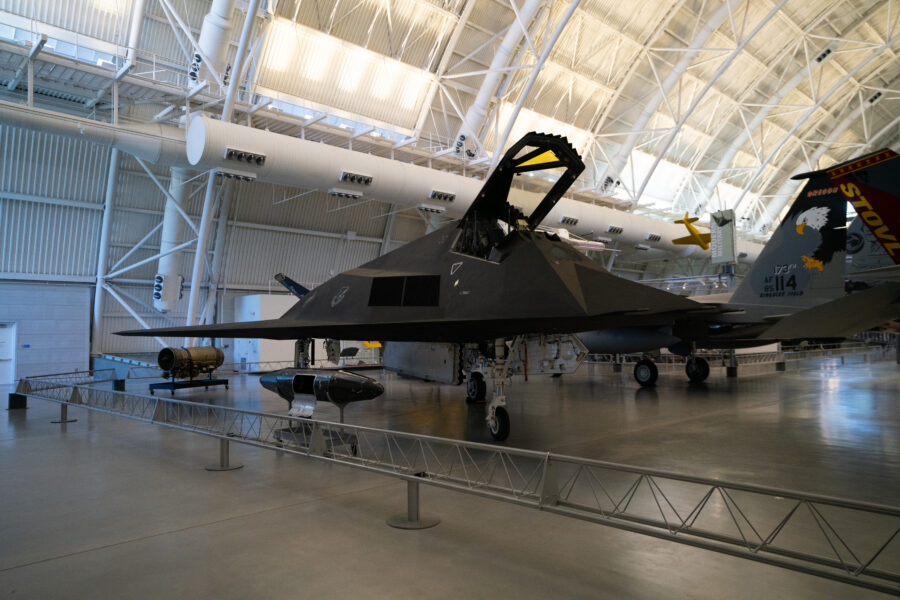
A historic Lockheed F-117 Nighthawk is now on permanent display at the National Air and Space Museum’s Stephen F. Udvar-Hazy Center. The exhibit debuted Oct. 21, showcasing the first operational stealth aircraft at one of the most visited aircraft museums in the world.
The F-117 joining the collection at Udvar-Hazy Center in Chantilly, Va., is unique: Dubbed “Overachiever,” tail number 85-0818 is the only F-117 to have flown combat missions in all four of the major conflicts from when the F-117 was active: 1989’s Operation Just Cause in Panama; 1991’s Operation Desert Storm in Iraq; 1999’s Operation Allied Force in Kosovo; and 2003’s Operation Iraqi Freedom in Iraq..
The F-117 Nighthawk was the first operational aircraft designed to evade radar with its unique shape and materials and was a triumph of technical ingenuity and skill at a time before computer-aided design. The aircraft proved how reducing an aircraft’s radar cross-section could provide a decisive advantage in combat.
Michael Hankins, the museum’s curator of modern military aviation, said today’s F-35 stealth fighter builds on the foundation set by the F-117. Beyond the “jaw drop moment” he expects visitors to experience when they see its sharp, angular features, he hopes the display teaches them to appreciate the visionary designers and groundbreaking pilots and maintainers who took the F-117 into battle and kept the jets running.
Jeff Corbets, a program manager at Lockheed Martin’s Skunk Works, oversaw the Overachiever’s restoration, which included removing parts of the plane that remain classified secrets to this day. He said he hopes the jet will connect future generations to the story of stealth.
“This was the aircraft that ushered in the era of [stealth],” he said, noting that the F-22, F-35, B-2, and B-21 followed. “All of them now are kind of based on the legacy of this airplane.”
Skunk Works engineers developed the sharply faceted jets’ shape to minimize its appearance on radar screens. Subsequent stealth aircraft have used curves to achieve the same effect, but in the 1970s when the F-117 was developed, the computer power to calculate those curves was not yet available. Air Force tests calculated the radar signature as being on par with a marble.
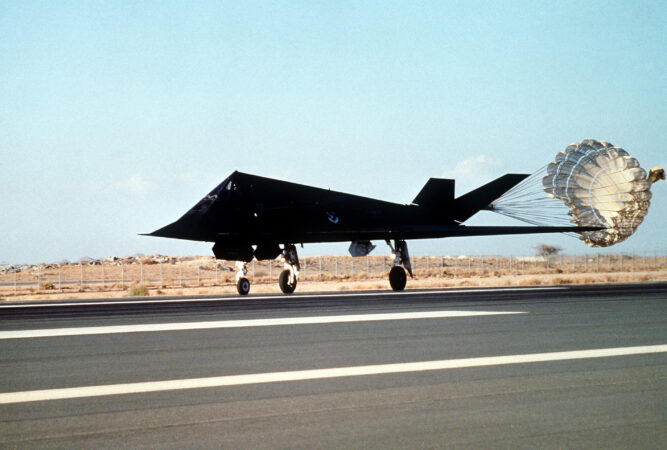
The Nighthawk went into service in the early 1980s and wasn’t officially acknowledged until 1988. Although it debuted operationally in Panama in 1989, that operation was not deemed a success. Rather, it was the role the Nighthawk played in 1991’s Operation Desert Storm that demonstrated its value: an ability to fly undetected, without jammers or other escorts, into contested enemy territory and deliver ordnance at will.
“The F-117 was the centerpiece of the success that we experienced during the Desert Storm air campaign,” said Lt. Gen. David A. Deptula, USAF (Ret.), dean of the Mitchell Institute for Aerospace Studies and principal attack planner for the campaign. “It was the linchpin of our success.”
Deptula said the combination of stealth jets and precision munitions enabled planners to strike more targets in the first 24 hours than would have been possible with standard force packages of conventional aircraft.
“We’re pretty sure that this one [the Overachiever], on the first night of Desert Storm, took out a main communication center in Baghdad,” Hankins said. He cautioned that details are hard to come by because much of the jet’s history remains classified. It will likely take years for information to be cleared for public release.
F-117s remain in rare but limited use in training and other activities. The Overachiever is among several F-117s to become museum pieces, but the first to join the Smithsonian collection. The Air Force, working with Lockheed and Smithsonian officials, spent years orchestrating the transfer, which was officially announced at AFA’s 2026 Air, Space & Cyber Conference in September.
Lockheed donated the hours to restore and demilitarize classified elements of the aircraft, including removing its original stealth coatings. The work was completed over about eight months, after which the jet’s wings were removed so that it could be loaded onto a C-5M Super Galaxy cargo aircraft for the flight to Washington.
Now, hundreds of thousands of people will get to see the “Overachiever” and learn about the origins of stealth. The Udvar-Hazy Center is open every day except Christmas from 10 a.m. to 5:30 p.m. Admission is free, but parking costs $15.