


NATIONAL HARBOR, Md.—Flying and fixing aircraft remains the Air Force’s reason for being, but protecting air bases from attack is becoming an essential component that makes those possible. Following attacks on air bases across the Middle East during Operation Epic Fury, point defense was among the hottest topics on tap at AFA’s 2026 Air, Space and Cyber conference in September.
The Iranian attacks, such as the March 27 air raid on Prince Sultan Air Base, Saudi Arabia that damaged multiple refueling aircraft and an E-3 Sentry AWACS command and control plane, did not deliver crippling blows. But they did cause injuries, disrupt operations, and destroy some aircraft.
The damage was great enough to convince Air Force leaders to prioritize air base defense—or point defense, as they are calling it—and invest in new weapons and a new career field to man them.
Air Force Secretary Troy E. Meink and Chief of Staff Gen. Kenneth S. Wilsbach announced new initiatives at the conference, aimed at improving oversight of point defense acquisitions amid the recent explosion of growth in the counter-drone industry as it responds to increasing Pentagon demand.
Wilsbach pledged that point defense will no longer be treated as a “side hustle” but as a “core function of air and space power.”
The Air Force began ramping up its point defense strategy in late 2023 after unidentified drones were seen flying repeatedly over Langley Air Force Base, Va. Soon the service, along with the rest of the U.S. military, was racing to catch up with the rapidly evolving drone warfare threats and tactics emerging from the war in Ukraine. Then in June 2025, Operation Spider Web, a bold Ukrainian drone attack on strategic bomber bases deep inside Russia, showed Air Force leaders just how vulnerable the service’s own air bases were to this new threat.
But it took the hard lessons from a shooting war with Iran to elevate point defense to a new level of importance at the service’s semiannual Corona summit in June and make it a key focus at this year’s AFA event, said retired Air Force Lt. Gen. David Deptula, dean of the Mitchell Institute for Aerospace Studies.
“The reason why it was announced at AFA is because a decision had been made at the previous Corona to make point defense a mission function of the Air Force,” Deptula said. The conference “was the first opportunity to really make a big splash.”
During the conference, several Air Force generals said that the service’s increased emphasis on point defense is needed after watching Iranian drone and missile attacks strike air bases during Epic Fury.
Air Combat Command Boss Gen. Adrian L. Spain said Epic Fury “laid bare some of those things that have been in front of us for a while, and it just reminded us that we have to get after some of these things.”
“Our bases are under attack; we have to continue to generate air power in spite of that,” Spain said. “We have to be able to be resilient under attack, and we have to be able to sustain the force under those kinds of pressures to win.”
The Air Force’s chief modernization officer, Lt. Gen. Christopher J. Niemi, said the service identified more than a year ago that it would have to “increasingly protect our assets at air bases with investments in point defense but that accelerated … because of some of the experiences that we had over there.”
Prior to Epic Fury, the Air Force appeared to be banking on its agile combat employment strategy to disperse forces from large bases to ad hoc air bases in order to complicate targeting for adversaries and fight through attacks. The service evacuated Al Udeid Air Base, Qatar, before the Feb. 28 launch of Epic Fury, moving aircraft and most personnel to other locations both in the region and back in the United States.
When Iranian forces attacked Al Udeid, destroying the Combined Air Operations Center, or CAOC, there, the facility was empty—the first time it hadn’t participated in air combat operations since the 1990s. Instead, Epic Fury’s air operations were commanded fromShaw Air Force Base, S.C.
“ACE was really birthed out of necessity, [because] I cannot protect these forces any longer,” Spain said. “But if I could perfectly protect all my forces at a location, I would not move. There’s no reason to move. I’m only creating turbulence for myself if I do that.” That turbulence extends to every part of an air operation, he said: “I have a logistics problem I’ve got to worry about. I’ve got a fuel problem I’ve got to worry about. I have a [command and control] problem I have to worry about when I move around more.”
Spain said Iran’s proven ability to threaten a base means the Air Force is returning to “a time well before 9/11, where we were preparing to fight a peer adversary in an existential way. We see what that looks like through the experience of [Epic Fury].”
Air base defense has long been a complex problem for Air Force leaders. Ostensibly, the Army is responsible for protecting air bases from missile attacks, dating back to the 1948 Key West Agreement on roles and missions of the armed forces. That’s why the Patriot ballistic missile defense system is an Army weapon system. But with the rise of low-cost attack drones such as the Iranian Shahed, the scale and scope of threats has grown while the Army’s capacity to defend far-flung bases has not kept pace. In April 2025, the Air Force published new doctrine on “Point Defense of Air Bases,” assuming a more active role for Airmen in defending their air bases.
The lack of hardened shelters at most forward bases contributes to the Air Force’s vulnerability. Investment in such structures and other passive defenses has often ranked low among budget priorities, compared to aircraft and major research initiatives.
Deptula maintains that the Air Force has long been underfunded and that vulnerabilities are the result of calculated risk and budget choices.
“How come hardened aircraft shelters weren’t in place at Prince Sultan Air Base? How come the command-and-control facility at Al Udeid—that the joint force air component commander has been operating from since 2001—wasn’t built underground?” Deptula said. “The answer is money, because it costs more money. The United States military took the risk, understanding that there were threats out there, they were willing to take the risk and not to spend the money to build hardened aircraft shelters, to build underground facilities.”
Now that “the threat has shown itself to be highly capable,” he added, “resources are going to have to be allocated to increase our ability to defend our bases.”
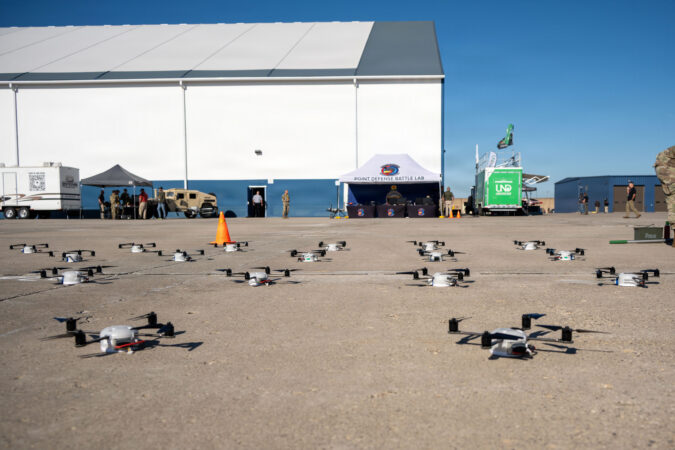
Air Mobility Command Boss Lt. Gen. Daniel H. Tulley said he was encouraged by Wilsbach’s decision to establish a new career field to develop point defense specialists. Wilsbach said the Air Force will start designating Airmen with the new specialty within two years. The Air Force announced it was standing up the new career field in late June after the Corona meeting. As a short-term fix, USAF has established point defense flights, specialized units of roughly 20 Airmen each, trained to rapidly deploy to hotspots and defend air bases against drone attacks.
Tulley saw how unprotected Al Udeid was when he commanded the 379th Air Expeditionary Wing there from 2019 to 2021.
“When I was at Al Udeid, this problem was widely recognized,” Tulley said. “The Air Force has been going after it, but I think our sense of urgency has dramatically increased—which it needs to. We’ve all seen what Operation Spiderweb did in Russia. How do we prevent the same sort of thing, and maintain the sense of urgency?”
The Air Staff and Point Defense Task Force, working with the Pentagon’s Joint Interagency Task Force 401, or JIATF 401, is making headway to identify technologies and field new weapons to counter the drone threat. But it will take years for the service to build up an adequate point defense capability.
“Would I like to get there a lot faster? Yes, but I think we’re getting there,” Tulley said. “I’d like to look back in two years and say, ‘We’re done,’ but I don’t know if we’ll quite be there yet.”
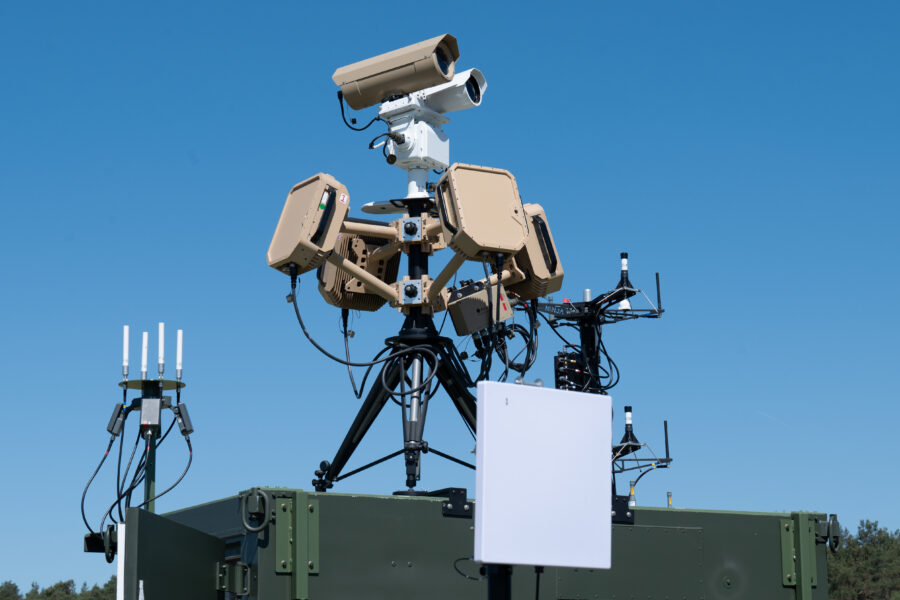
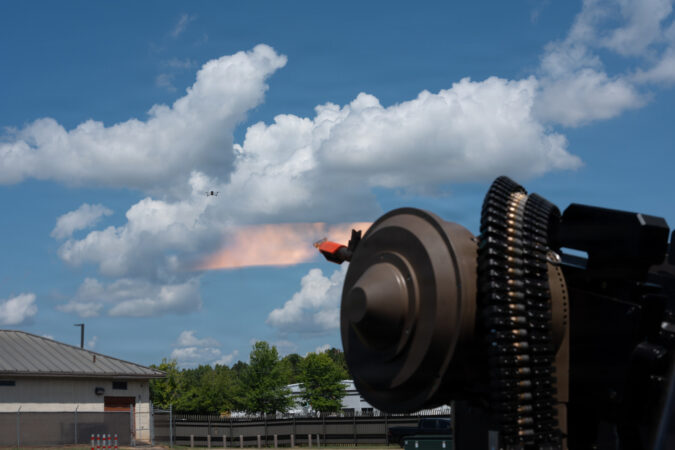
The Air Force relies primarily on the Small Unmanned Air Defense Systems, or SUADS, for countering drones. The system is capable of identifying and tracking enemy missiles or drones of multiple sizes, and downing incoming drones with an electronic warfare weapon. To stop missiles, it uses both electronic warfare and kinetic effectors. It can also interface with commercial counter-drone systems and other air defense systems, depending on the needs of a commander.
It’s available in two variants, one for fixed air bases and one that can be deployed on a pallet for rapid response missions. The Air Force has requested more than $1.5 billion for SUADS in the fiscal 2027 budget, with most of the funding allocated for the system’s missile defense components, according to budget documents.
What remains unclear is how much money is being spent on additional counter-drone systems for the Air Force, which are being acquired with the assistance of JIATF 401. Those buys are difficult to track since they are not listed in the budget request. Both Air Force and JIATF 401 officials declined to provide funding details.
During the conference, leaders said the Air Force is working on initiatives to gain more oversight over the acquisition process to more efficiently manage its counter-drone acquisitions.
Globally, the market is expanding rapidly, The current global counter-drone market is valued at roughly $9 billion and is projected to reach about $30 billion by 2031.
JIATF-401 Director Army Brig. Gen. Matthew Ross cited that figure in a talk with industry members Sept. 15. The U.S. portion of the counter-drone market is currently valued at roughly $2.5 billion and is expected to grow to roughly $8.6 billion by 2030, according to MarketsandMarkets.com a business intelligence firm.
“What that means is that demand is going up really quickly,” said Ross adding that his agency is acquiring “additional arrows to put into the quiver of our warfighters,” but “our supplies just aren’t there yet.”
Meink said the service is also looking at establishing a senior portfolio acquisition executive, or PAE, to manage the point defense enterprise. PAEs are a new construct, introduced during recent Pentagon acquisition reforms to get more authority into the hands of fewer leaders in order to maximize acquisition success. The idea is to combine several programs within a single mission area and give PAEs authority to move funds between programs and adjust requirements based on evolving needs. The Department of the Air Force currently has 26 PAEs—17 in the Air Force, nine in the Space Force.
Currently, the Air Force PAE for Electronic Systems oversees counter-drone acquisition efforts and the service’s PAE for Intelligence, Surveillance, Reconnaissance & Special Operations Forces manages offensive drone acquisitions, said Lea Kirkwood, the Air Force PAE for Electronic Systems.
U.S. Air National Guard photo by Airman 1st Class Andre Bordlee
The Pentagon recently stood up the new Direct Reporting Portfolio Manager for Unmanned Systems, or DRPM UxS, with the goal of accelerating the development, procurement, and fielding at scale of autonomous capabilities.
“There’s a lot of considerations across mission areas,” Kirkwood said, adding that the Department of the Air Force is “looking at how do we need to look at our structure to say ‘how can we best support the [Pentagon], the DRPM UxS, and then also within the DAF, both from the offensive and the defensive perspective’—you know, what’s the best way to get after this?”
The Air Force is also creating a “point defense weapon system,” Wilsbach said during his speech. The new system will be designed to formally manage multiple counter-drone systems that range from sensors, radars, and command and control architecture to kinetic and nonkinetic effectors for disabling or destroying incoming drones.
“The point defense weapon system is a way for us to consolidate these capabilities under a single umbrella,” Michael Sheehy, director of future operations under the Air Force deputy chief of staff for operations said during the JIATF 401 industry meeting.
The Air Force is currently writing a program action directive for the weapon system. “That way it’s not this ad hoc approach to this, where it is buying some, trying some pieces of parts and then kind of making up who’s operating the system. … The other thing that it does is it creates a single point for funding within the Air Force,” Sheehy added. “Now I have a program element code for this weapon system, and as funding’s coming in, it’s going to that as opposed to kind of going all over the place.”
Sheehy noted that there was a “vast difference” in the amount of counter-drone innovations on the show floor at the AFA conference this year compared to prior shows.
“There’s a lot of counter-UAS capability that is being developed out there, and … we need to have a more enterprise level approach to doing this,” he said. The Air Force “owes it to our wing commanders to provide that kit, provide that training, provide that organization that is professionalized to get after this really difficult problem.”