
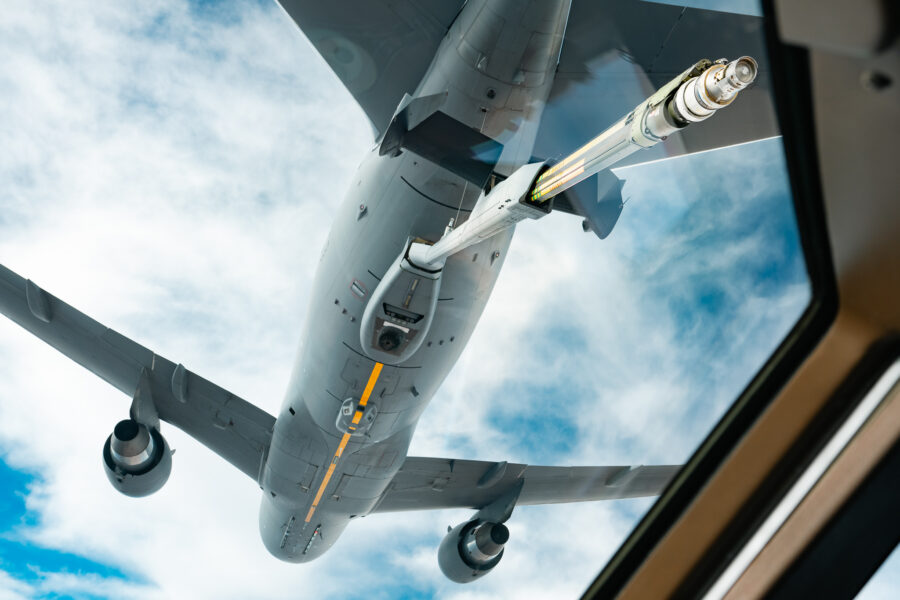
The Air Force Life Cycle Management Center wants a contractor to serve as integrator for all the software sustainment of current and future upgrades to the growing KC-46 Pegasus tanker fleet.
AFLCMC posted a notice in late October with a Dec. 11 deadline seeking industry proposals to manage a range of software updates, upgrades, and coordination across the tanker’s various systems, some of which are still under development.
The move comes as the Air Force fleet of KC-46s steadily grows past 100 aircraft, with plans to eventually buy up to 263 airframes.
The recent request for information has an eye on filling sustainment gaps in software management, testing, and modernization by creating a single integrator to be run out of the Depot System Integration Electronics/Software Laboratory at Tinker Air Force Base, Okla.
The Pegasus, a heavily modified Boeing 767-200ER, uses a probe/drogue refueling capability. A prototype first flew in 2014, and the KC-46 contract was eventually awarded to Boeing in 2016.
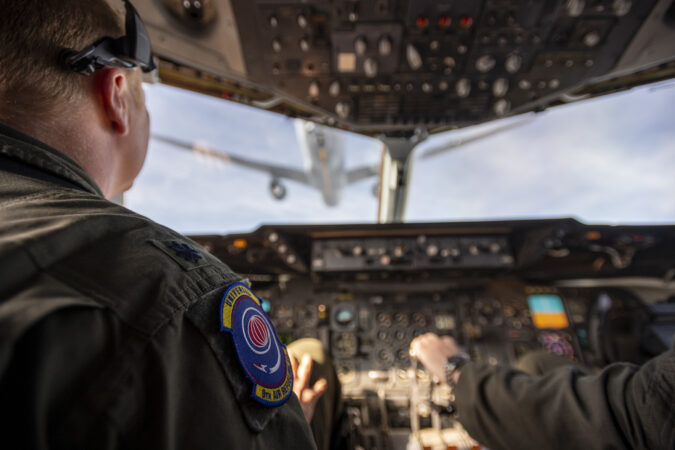
By integrating software management and future upgrades under one umbrella, AFLCMC aims to consolidate disparate work across various aspects of the aircraft, synchronize multiple software certification cycles, and keep cybersecurity across all systems up to date.
“As the fleet matures and software capabilities expand, the KC-46 Program Office is exploring the KC-46 Software Integration, Sustainment, and Support (K-SWISS) initiative to consolidate these workstreams under a comprehensive, long-term enterprise software strategy,” an AFLCMC spokesman told Air & Space Forces Magazine.
The initiative’s key objectives are to resolve software deficiency reports, adhere to the Department of the Air Force’s risk management framework cybersecurity protocols, and maintain continuous authority to operate across the fleet.
The spokesman said that the SIL at Tinker is already “scaled and postured” to support current fleet operations, upcoming aircraft deliveries, and future capability expansions.
To keep the authority-to-operate status clear, the request for information requires any industry offerings to include a comprehensive intellectual property and data rights framework, the spokesman said.
The spokesman stressed that there hasn’t been a software lapse for the plane.
“Since the conclusion of Interim Contracted Support in June 2022, KC-46A software requirements have been continuously sustained without operational lapse through dedicated modernization and sustainment efforts,” the spokesman said.
In addition to software upgrades, current modifications and upgrades on the KC-46 include a new Remote Vision System 2.0, which Boeing is hoping to start retrofitting onto aircraft in 2028. It’s essentially a complete overhaul of the plane’s electronic eyes, allowing the boom operator to sit at the front of the plane and use high-definition cameras to align the boom with the incoming aircraft for refueling, rather than sitting in the rear.
The legacy camera was plagued by poor lighting, depth perception issues, and image washout. The planned upgrade includes 4K Ultra HD cameras and a 3D display for a distortion-free view in any lighting scenario.
Other upgrades include various capability packages, software upgrades, and a redesign of the boom telescope actuator.
A Government Accountability Office report in June noted that the tanker did not meet its mission-capable rate goals from fiscal 2019-25, scoring a 62 percent rate in 2024.