


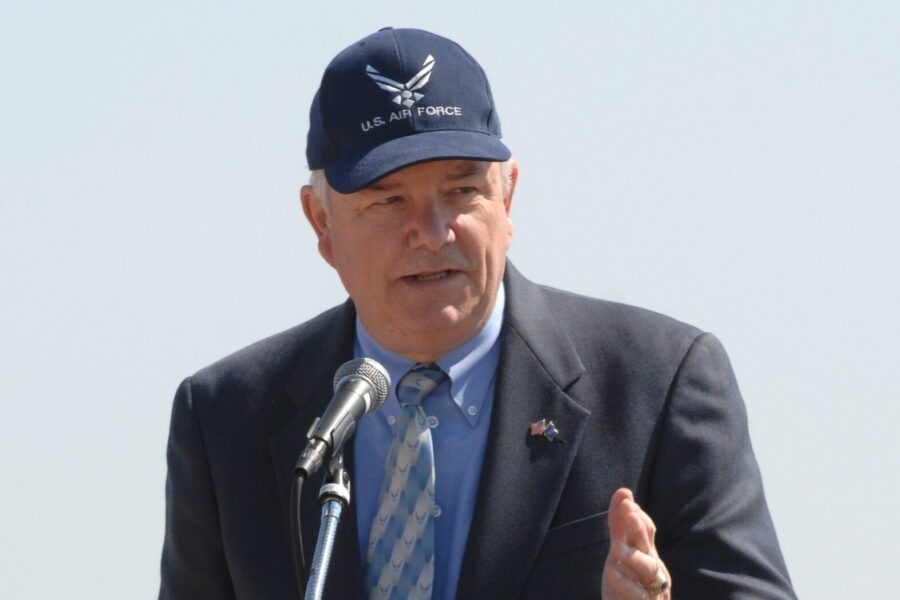
Michael Wynne, the 21st Secretary of the Air Force died Oct. 17. He was 82 years old.
Wynne was Secretary from 2005 to 2008, a stretch of time when the U.S. military was struggling to quell insurgencies in Iraq and Afghanistan and the Army was struggling to simultaneously man occupation forces in two theaters. Roadside bombs and insurgent attacks were killing U.S. troops, and the Air Force was under intense pressure to support its sister service with increased intelligence, surveillance and reconnaissance coverage and manpower and force cuts to ease the Army’s burden.
The Air Force was also fighting to protect its modernization efforts at the time, especially the F-22 Raptor program, which was less than halfway to its objective of 750 planes, new tankers (which would ultimately become the KC-46), and a future bomber (which would eventually yield the B-21).
In 2006, an Air Force B-52 took off from Minot Air Force Base, N.D., and flew to Barksdale Air Force Base, La., its crew unknowingly carrying nuclear weapons on board, a so-called “bent spear” incident. The discovery kicked off an investigation, recriminations, self-examination, and subsequent organizational, procedural, and cultural changes across the nuclear community.
The incident added to the tension between the Air Force and then-Secretary of Defense Robert Gates, who saw the service and particularly then-Chief of Staff Gen. T. Michael “Buzz” Moseley as recalcitrant in their pushback over budget, manning, and modernization. Seeing Wynne and Moseley as a close knit tandem, Gates fired both in June 2008, beheading the service—the first-ever simultaneous removal of a service chief and secretary.
Military Roots
Wynne hailed from a military family and followed his father’s footsteps to attend the U.S. Military Academy at West Point, graduating at the height of the Vietnam War. Among his 578 classmates, 30 died in Vietnam and about 100 others were wounded in fighting in Southeast Asia.
Instead of joining the Army, however, Wynne followed his older brother into the Air Force, reporting for Active Duty in August 1966.
“The day I reported for Active Duty, the report of my brother being shot down was announced,” Wynn recalled in a 2005 interview with the Washington Post. Maj. Patrick Wynne, a 1963 graduate of the U.S. Air Force Academy, had trained as a pilot, and was assigned to the 555th Tactical Fighter Squadron in Thailand. After only four months in country, his F-4C Phantom was shot down over Vietnam on Aug. 8, 1966. He was declared missing in action, and remained so until 1977, when his remains were identified and later returned to the United States. He is buried at the Air Force Academy.
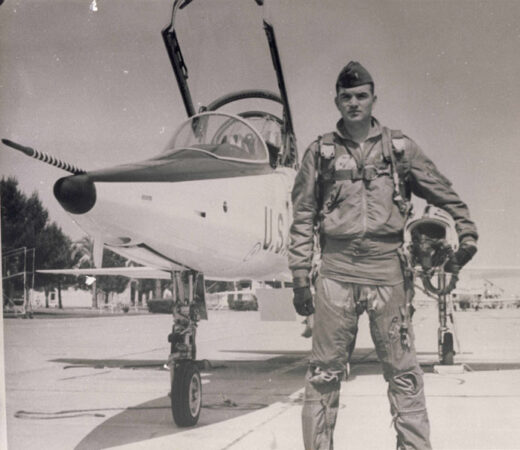
The younger Wynne served seven years in the Air Force, his final tour as an assistant professor of astronautics at the Air Force Academy.
Wynne then went to work for General Dynamics. For the next 26 years, he worked as an executive there, save for a three-year stint with Lockheed Martin after Lockheed acquired GD’s Space Systems Division. His work during in those years spanned General Dynamics’ F-16 and M1A2 tank divisions as well as space systems, including work on the Atlas, Titan, and Centaur launch vehicles.
In 2001, Wynne joined Defense Secretary Donald Rumsfeld’s Pentagon leadership team. Following the election of President George W. Bush, Wynne was confirmed as Principal Deputy Undersecretary of Defense for Acquisition, Technology, and Logistics, the start of a seven-year run in public service. In 2003, he was made Acting Undersecretary and he remained in that role until June 2005. Among his tasks at the time were leading the Pentagon’s preparations for the 2005 Base Realignment and Closure plan, which sought to “rationalize” the Defense Department’s far-flung bases and increase cross-service cooperation.
The 2005 BRAC results proved disappointing. Projected to save the Pentagon more than $25 billion annually by 2011, the plans failed to deliver due to higher-than anticipated construction costs, inflation, and incorrect assumptions. Instead of savings, the changes yielded a net cost increase, even when spread out over 20 years.
As Air Force Secretary, Wynne opposed efforts to consolidate and adopt joint basing, having come to embrace the Air Force’s explanation that many of its units operate and fight from their home bases rather than deploy to forward theaters.
“The Air Force has a very different concept of operations,” he would tell Air Force Magazine in 2008, weeks after his departure. Putting Air Force bases under the control of other services would undermine combat effectiveness, he said, adding, “I’d probably get fired again over my objection to the way the joint basing is happening.”
During his Air Force tenure, Wynne came under increasing pressure to cut the service’s budget, force structure, and modernization, and increasingly found himself in opposition to Gates, who took over as Secretary about a year after Wynne had been moved to the Air Force.
While he tried to justify force cuts in a 2006 interview, citing emerging technology like cell phones and more capable aircraft as supporting the case for downsizing by a planned 40,000 troops, “trimming in advance of new systems coming on and planning for the future right now,” he acknowledged that the current way the force was being utilized was unsustainable. At the time, 5,000 Airmen were doing Army jobs in Iraq, primarily jobs like convoy duty. “At some point in the future, it doesn’t work in the math—the Army has to pick up combat service support,” he said.
Wynne also butted heads with Gates over the F-22. While Gates suggested the Air Force could give up the “exquisite” F-22 because the then-fledgling F-35 was scheduled to join the fleet in 2014, Wynne disagreed.
“The notion of the F-22 [is] … similar to the F-35—we need to get rid of that,” Wynne said in his 2008 debrief with Air Force Magazine. The F-35, rather, “complements the F-22, but the F-22 is clearly an air superiority and air dominance weapon. The F-35 is a multinational, multirole, [air-to-ground] versatile airplane.”
The Air Force’s pursuit of a new tanker aircraft, a protracted and contentious effort that preceded him and would continue to drag on for years, was another challenge during Wynne’s tenure. As Secretary, he pressed for a single tanker aircraft rather than splitting the order between Boeing and Airbus platforms, as some urged. But after departing the Pentagon, he reconsidered, seeing value in it. He also came to regret not requiring that tankers become network nodes, an extra role for which they might have been well-suited.
And while many in the Pentagon failed to appreciate the Air Force’s contributions to the war in Iraq, Wynne became a strong advocate, noting that the 2007 “surge” of forces in Iraq was not merely an Army ground operation. “We surged 400 percent in the number of sorties and 1,000 percent in the pounds of ordnance dropped,” he said in a press conference on his final day in office. “What happened? I would tell you that what happened was the realization that we could get connectivity between the ground commanders and the air component—that there was true situational awareness available.”
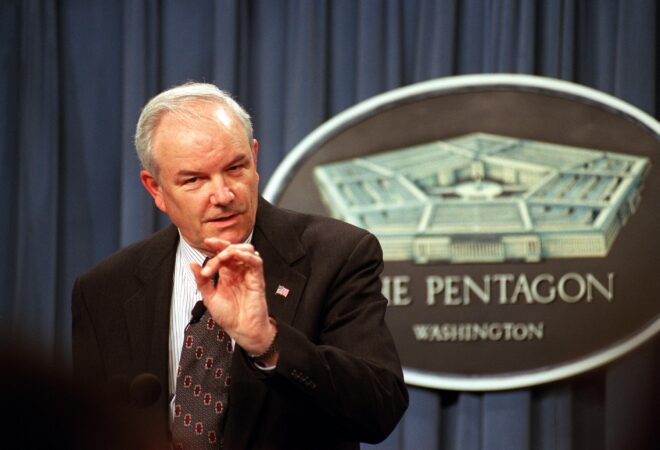
On June 5, 2008, Gates decided he’d had enough. Wynne and Moseley were en route to a Corona meeting of Air Force leaders at Wright-Patterson Air Force Base, Ohio, when Gates demanded their resignations.
The stated reason was the failures of Air Force leadership to safely steward the security of nuclear weapons. But by then it was generally well known that Gates and the Air Force were at odds on a number of issues, from the number of “orbits” flown by surveillance drones over Iraq and Afghanistan to support troops operating on the ground to what Gates termed “next-war-itis” in the Air Force’s conviction that it needed high-end stealth fighter jets to deter a rising China in the Pacific.
Moseley, in an interview, recalled his close working relationship with Wynne as “a privilege and a gift.” The two tried to meet daily and they shared a perspective both in terms of their duty and vision for the service. They also became friends.
“Mike Wynne and I had the best relationship of any that I’ve seen with 13-plus secretaries I worked with,” Moseley said. Wynne was well versed in the workings of the Pentagon hierarchy, the needs of each of the services, and how to get things done, the former chief said. “But he also understood the theater logistics, the technology to address the new world, and he understood the acquisition process better than anybody.”
Together, they worked to lay out and explain their priorities, the need for increased resources—estimated then to be $20 billion annually to modernize, in order:
- tankers
- search and rescue
- satellites that could be protected from cyber and maneuver attack
- F-35s to replace the F-16
- a new bomber
They laid out that plan shortly before the firing in a Pentagon meeting with Gates and other officials. Mosely recalled that afterward Wynne declared the presentation a success.
“I think that meeting went well,” Wynne told him, draping an arm around Moseley’s shoulder as they walked the Pentagon hallway. “But I think we’re both dead.”
Wynne may have been the only one who saw it coming.
When the decision came down to fire them, both were at Scott Air Force Base, en route to Dayton for a planned Corona meeting of Air Force leadership at Wright-Patterson Air Force Base, Ohio. Moseley was ordered back to Washington, where Chairman of the Joint Chiefs Adm. Mike Mullen delivered the news. In Dayton, Wynne was told to stand by for an unscheduled visit from Deputy Secretary of Defense Gordon England, who was flying in. No reason was given. Was England coming to discuss Moseley’s successor, someone wondered. “No,” Wynne said. “He’s coming for me.”
As the Corona meeting unfolded, Moseley called Wynne from Washington to say he was being relieved. Reporters began to call before England even arrived, adding to Wynne’s convictions. CNN might have been first to report the firings. Defense News Editor Vago Muradian, a rare press gallery guest at the Corona gathering, got his story out online on Defense News and Air Force Times. At the Pentagon, frustrated reporters gathered outside the press secretary’s office looking for answers; inside, staff was still trying to piece together what happened.
Two weeks later, Wynne departed the Pentagon at an official ceremony presided over by Gates, with Moseley at his side. What had been a very public firing was glossed over for public consumption as Gates pinned a medal on Wynne’s chest. Having Gates preside was Wynne’s idea, said retired Maj. Gen. Daryl Burke, Wynne’s military aide at the time. It was a challenge: Gates would either have to refuse or honor Wynne for his public service.
At the ceremony, Wynne expressed love for the service. “But it is the people of the Air Force that make the Air Force,” he added, “so in loving the Air Force, we love the people.”
Burke recalled how Wynne advised him to stand away as they awaited England’s arrival. Burke insisted he would stand with Wynne regardless, but Wynne was trying to ensure that Burke wouldn’t be damaged by association in the future by being seen as too closely associated with a politically unpopular boss. Wynne subsequently worked behind the scenes to find Burke a next assignment that would keep his career on track. In doing so, Wynne demonstrated both caring for his Airman and a savvy hand on the tiller for navigating Pentagon politics.
Lt. Gen. David Deptula, now dean of AFA’s Mitchell Institute for Aerospace Studies, was on the Air Staff at the time, recalling that Wynne kept working on the issues he believed in up to the very end—in particular, his opposition to joint basing.
“Secretary Wynne was a leader of uncommon integrity, genuine kindness, and extraordinary loyalty,” Deptula said. “He never confused holding a position of authority with the responsibility to do what was right. I witnessed his character firsthand when, even after learning he would be removed as Secretary of the Air Force, he continued working tirelessly to strengthen the service he loved. He put principle above position, loyalty above personal ambition, and the nation’s security above all else. In a famous action, when SECDEF Gates told Secretary Wynne to fire Chief of Staff, Buzz Moseley… Wynne refused. So, Gates fired both. The Air Force and our nation are better for his service, and I am better for having known him. He will be greatly missed.”
Robbin Laird, a military analyst and prolific writer who worked for Wynne during his Pentagon tenure, wrote admiringly of the former secretary in a remembrance, citing what he called the Wynne Doctrine: “If you are ever involved in a fair fight, it is the result of poor planning.”
“It is easy to hear it as swagger. It was the opposite,” Laird wrote. “A fair fight is one whose outcome is in doubt. When the outcome is in doubt, young Americans pay for that doubt with their lives. Mike believed a leader’s first duty was to make sure it never happens. That meant technology, organization, the unglamorous work of logistics and sustainment, and the discipline to think years ahead of the adversary.”
Michael Walter Wynne was born in Clearwater, Fla. He is survived by his wife Barbara and four married daughters.