


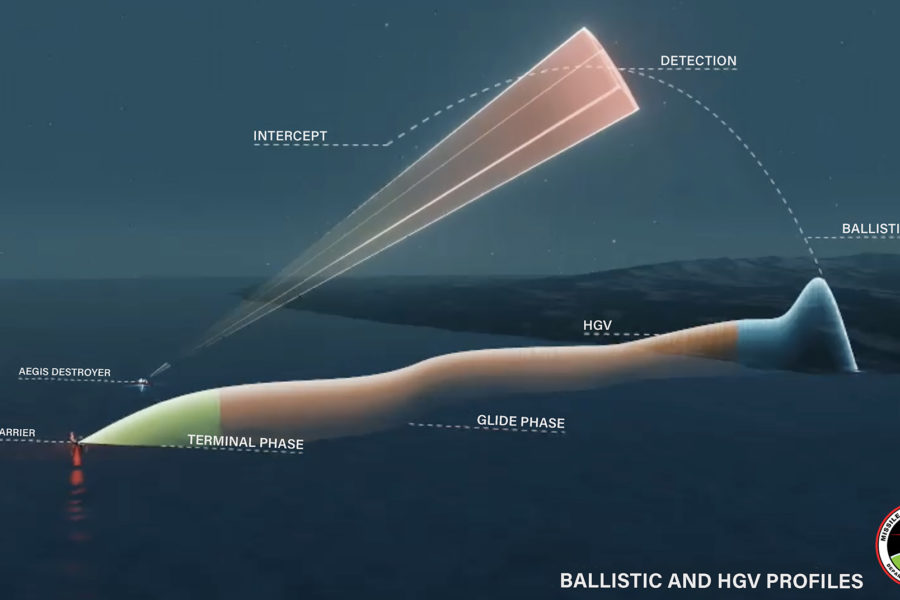
The Missile Defense Agency will test its ability to track and engage a hypersonic missile in fiscal 2027 with an event called “Project Maverick.”
The project, revealed in budget documents issued last month, could help the Pentagon develop some sort of near-term defense against hypersonic weapons while it works on the more advanced Glide Phase Interceptor, not expected to be delivered until 2031.
Budget documents state that for the test, a hypersonic glide vehicle will fly “up the East Coast,” and MDA will track it with “multi-phenomenology” elevated sensor data—likely air and space-based platforms equipped with advanced sensors.
From there, a tactical battle manager system will process and fuse the data, “enabling engage on remote,” per the budget documents—the ability to guide a weapon to its target using targeting data from an external sensor not physically with the shooter or the weapon.
The budget documents do not say if the test will involve a kinetic kill of the hypersonic vehicle or exactly which systems will be used, but MDA Director Heath Collins, an Air Force lieutenant general, said in written testimony to the House Armed Services Committee last month that the effort will “demonstrate capabilities across the kill chain.”
“Successfully demonstrated capabilities would supplement current and future defense architecture,” he added.
Hypersonic systems can travel and maneuver at speeds above Mach 5. China and Russia have developed and demonstrated multiple hypersonic weapons in recent years that could pose a threat to the U.S. The Glide Phase Interceptor is meant to counter some of those threats, but the program’s timeline has shifted multiple times. Even with an infusion of cash from the the 2025 reconciliation bill, GPI is still not expected for another half-decade.
In 2024, Collins said MDA was working to “think creatively and bring capability sooner” to defend against the hypersonic threat, adding that the capability would likely not be a new weapon but something that already exists and can be repurposed.
That work is likely feeding into a new initiative called Low-Cost Defeat, of which Project Maverick is a part along with another project called the Low-Cost Interceptor. LCI is in the rapid design, test, and demonstration phase, and MDA hopes to confirm the interceptor can be built in high numbers at a low cost in 2027, followed by a prototype test in 2028.
All told, MDA is requesting $460 million to pursue LCI, Project Maverick, and other advanced research efforts in fiscal ‘27.
The push to bolster hypersonic defenses fast is part of the Pentagon’s bigger effort to build an advanced missile shield, dubbed Golden Dome. The vision is for a layered network of sensors, missile interceptors, and command-and-control systems, with a projected cost of $185 billion.
The department’s fiscal ‘27 budget request includes $17.9 billion for Golden Dome. While the documents don’t specify funding for specific systems, they note that funds will be used to accelerate space-based sensors like the Hypersonic and Ballistic Tracking Space Sensor, develop a proliferated constellation of space-based interceptors, and conduct “rigorous, realistic testing and evaluation of all system components.”
The goals of Project Maverick are closely tied to those of Golden Dome—and MDA is the engineering, integration, and test lead for the missile shield architecture. Of note, Golden Dome Director Gen. Michael Guetlein has said his program will conduct a missile interceptor demonstration by next summer.
The cost of interceptors—whether engaging targets from the ground or in space—is of high interest to lawmakers. In the April 15 hearing with Collins, Guetlein and other Pentagon officials, Rep. Don Bacon (R-Neb.) highlighted depleted stocks of ground-based interceptors due to Operation Epic Fury in Iran, and noted that the Pentagon’s fiscal ‘27 budget request includes “tens of billions” to increase interceptor production.
In his written testimony, Collins said one of the goals of LCI is to “restore magazine depth” and lower the cost-per-kill by funding a “high-volume, affordable interceptor.”