


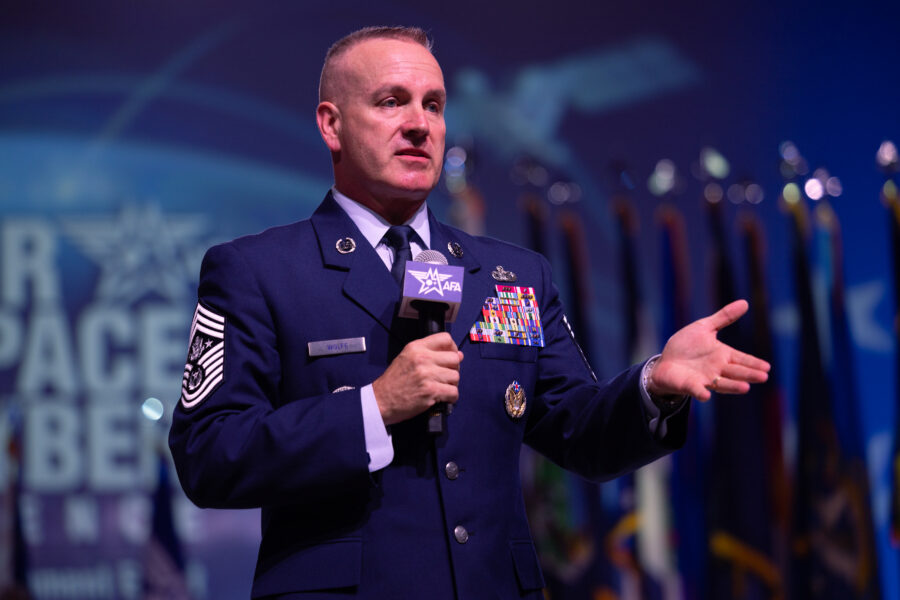
NATIONAL HARBOR, Md.—Today’s Airmen are going to have to embrace artificial intelligence the same way Chief Master Sergeant of the Air Force David R. Wolfe learned to love desktop computers and email in the 1990s, the senior enlisted Airman said Sept. 14 during AFA’s Air, Space & Cyber conference.
Wolfe has taken a strong stance on the advantages AI will offer the the Air Force and Airmen of all ranks at a time when much of society remains skeptical over how much control to give the rapidly advancing technology.
“We must overcome this fear if we’re going to fully realize the power of AI,” Wolfe said. “If you choose not to use AI, you are going to end up in everyone’s rearview mirror. … Artificial intelligence will not replace the judgment, discipline, or ingenuity of Airmen, but it can help us see farther down the track, anticipate problems sooner, and make better decisions at the speed the future will demand.”
Wolfe added that the creation of AI isn’t much different from the creation of personal computers and email, innovations he had to learn to adapt to more than 30 years ago.
“When I was given my first email address, honestly, I was skeptical,” Wolfe said, describing how he questioned, “where does this go when I hit send? How do I know who got to the right person? How do I know this is safe?”
“The questions felt pretty reasonable at the time,” he added. “I also thought my leadership was crazy when they told me every desk would soon have a computer on it, but I was wrong. Technology kept moving. We had to learn it, understand it, and figure out how to use it responsibly.”
Shortly after becoming CMSAF late last year, Wolfe stood up an AI Action Team that initially started with 40 members.
“Today we sit at over 200; we brought Airmen together from across the Air Force and asked them to take real problems they understood and see where AI could help,” Wolfe said, adding that the team is “completely rank agnostic” and that the most influential members are often junior Airmen.
Wolfe previously said in May that the service is developing a new training program to ensure every Airman is educated on how to use AI in their everyday job, just weeks after the Air Force released its artificial intelligence strategy.
Noting that he understands the general skepticism around AI, Wolfe said his goal is to reduce the fear many Airmen have of using AI, primarily broken down between two camps: those who worry that AI makes mistakes, and those that fear AI will replace them.
To the former, Wolfe said, “my response is ‘Well, sometimes, so are you.’”
To the latter, Wolfe said, “we’re in an age where that kind of learning is going to be taking place, and the machines are going to be able to make the decisions sometimes at a higher success rate than we will.”
But he stressed that “these capabilities are going to be additive at this point.”
Eventually, Wolfe said, AI may automate enough tasks that leaders can repurpose manpower “to do something else that only humans can do,’’ adding “Why wouldn’t we do that?”
“We’re going to have to make decisions like that sometime in the future,” he said. “But I think it’ll be it’ll be additive as we go on. Think of AI as an increase to the manpower in your units, folks.”
Wolfe encouraged Airmen to let AI allow them “to imagine solutions that were previously unavailable because of human limitations.”
“Technology will keep moving, just like it did when computers and email started showing up on our desks,” Wolfe said. “Our choice is whether we learn fast enough to move with it.”