
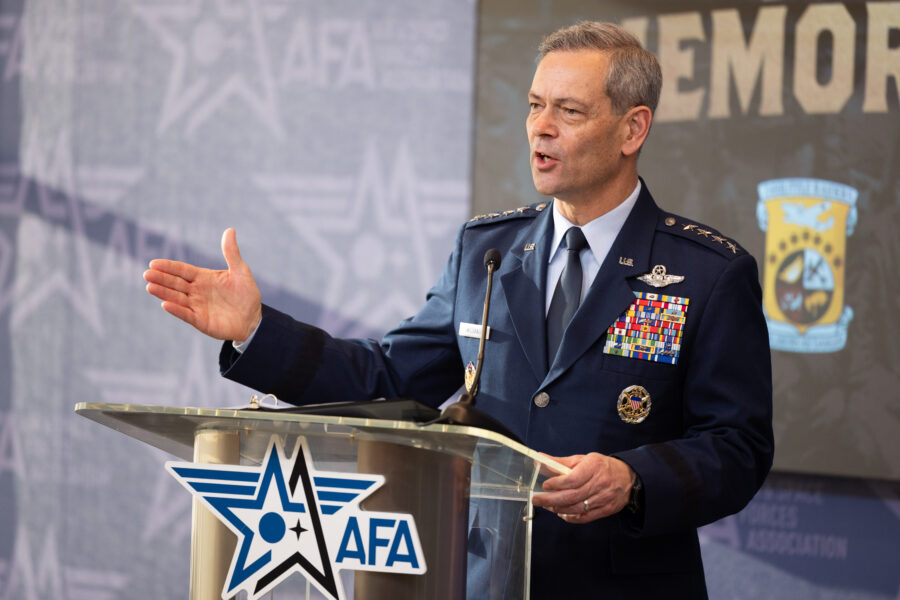
In a Nov. 23 letter to Airmen marking his first year as Air Force Chief of Staff, Gen. Kenneth S. Wilsbach reemphasized his focus on improving readiness, modernizing aircraft and other systems, and upholding high standards.
Since Wilsbach became the Air Force’s leader on Nov. 4, 2025, the service has been involved in large-scale combat operations in Venezuela and Iran, and the high ops tempo has pushed the force hard.
“You have shown the grit that makes our Air Force the most capable in the world,” Wilsbach said in his letter, which the Air Force released Nov. 24. “From Operations Absolute Resolve and Epic Fury to high-impact rescue and humanitarian missions around the world, I am proud to lead and serve alongside our dedicated Airmen.”
The nation’s adversaries continue to advance their capabilities, he said, and “our operating environment is becoming more demanding.”
“We must continue moving with urgency, removing obstacles, and aligning our resources to meet the demands of today’s environment while preparing for the challenges ahead,” Wilsbach wrote. “In doing so, our priorities remain unchanged, but how we execute them must evolve.”
Wilsbach underscored the importance of being able to generate airpower and other capabilities that can fight and win in a conflict, a theme he has made a hallmark of his tenure.
“Whether you fly, fix, support, or defend, you are part of the fight,” Wilsbach said. “Every mission matters and each Airman has a role in delivering the advantage our Nation expects.”
Airmen have shown what they are capable of over the past year, Wilsbach said, by carrying out combat operations in multiple theaters while continuing to train and prepare for a future conflict. But fighting against an advanced enemy military will test the Air Force’s readiness, he said—and the service has to be prepared to respond.
“A high-end fight against a capable adversary will demand speed, adaptability, and the ability to generate combat power under fire,” Wilsbach said. “Bureaucracy, unnecessary processes, and a culture of risk aversion have no place in that fight.”
That will include empowering unit-level commanders to make rapid decisions and respond “at the speed of combat,” Wilsbach said.
As for the broader Air Force, he said, the service will focus on continuing the process of moving combat formal training units to Air Combat Command—an initiative begun earlier in 2026 to streamline the training pipeline for fighter and drone units—as well as improving the absorption of new pilots, improving how maintenance is structured, and rolling out the new Air Expeditionary Wing 2.0 structure for deploying Airmen and units.
Wilsbach pointed to several modernization milestones this year, such as teaming an F-22 Raptor with the Air Force’s new Collaborative Combat Aircraft drone, beginning construction on the new Sentinel intercontinental ballistic missile’s infrastructure, and moving forward on the F-47 sixth-generation fighter, B-21 Raider stealth bomber, and VC-25B Air Force One presidential transport plane.
But, Wilsbach said, a “changing threat environment” led the Air Force to elevate its focus on point defense, another word for defending air bases against drones and other attacks. Iran’s targeting of bases used by U.S. forces this year, which seriously damaged or destroyed multiple aircraft, and Ukraine’s effective use of drones against Russian forces in 2025’s Operation Spider Web are some of the recent developments that renewed the Air Force’s focus on base defense.
The Air Force also needs to adapt to a world where advanced computing capabilities, autonomous technology, and low-cost mass “will increasingly shape the battlefield,” Wilsbach said, and the service will continue to pursue those technologies.
“We cannot ask tomorrow’s Airmen to fight with yesterday’s equipment, organizations, or procedures,” Wilsbach said.
Wilsbach also stressed the need to adhere to a “warrior culture” of standards, accountability, and lethality, to make sure Airmen can meet the challenges of combat. That includes adhering to physical fitness standards, mastering weapons systems, holding themselves and others accountable, sharpening tactics, and “developing the judgment required to make difficult decisions in a fight,” he said.
“Standards matter because lives and mission success depend on them,” Wilsbach said.
The Air Force also must take care of its Airmen and families, he said, and improve their quality of life. That includes improving reintegration programs for Airmen coming home after deployments, fixing medical care shortages, and improving housing and childcare at remote and high-tempo installations.
“Keep pushing and demanding excellence,” Wilsbach said in the conclusion to his letter. “Cut through the bureaucracy, master your craft, take care of your teammates, and stay focused on what matters most: delivering combat power and winning our nation’s wars. Stay ready to win.”