
A new Pentagon initiative could shrink the timelines for air and space commanders to gather and sort through the intelligence necessary to conduct operations.
The Defense Department announced the start of “Agent Network” for artificial intelligence-enabled battle management and targeting June 25. The new network is expected to build off the existing Palantir Maven Smart System and coordinated support by Lumbra, an agentic AI operating system.
The Maven Smart System, which grew from the department’s Project Maven more than half a decade ago, uses AI to sort through data streams and identify potential targets. It played a key role in the early stages of Operation Epic Fury against Iran, when, according to reports, operators used the system to craft strike packages for more than 1,000 targets. Commander demand for the system is growing.
Agent Network must undergo testing and development before fielding, but the Pentagon’s Chief Digital and AI Officer Cameron Stanley said in a release that the tool could deliver AI warfighting at “operational scale.”
The Pentagon Press Office declined to comment. Neither Palantir nor Lumbra responded to requests for comment on June 29.
The Agent Network is likely to enhance existing intelligence-gathering systems, which perform different functions depending on commander needs.
Those differences are key, said retired Air Force Col. George Dougherty who previously served as the director of innovation for the Department of the Air Force’s program acquisition executive for command, control, communications, and battle management.
Some of the intelligence feeds are going to come from public sources such as news articles and online posts to indicate activities by militia groups, as was common in the Global War on Terror, Dougherty told Air & Space Forces Magazine. But increasingly, for air and space combat needs, the systems must take in data from a variety of sensors.
Dougherty, who wrote “Beast in the Machine: How Robotics and AI Will Transform Warfare and the Future of Human Conflict,” said it is notable that officials did not give use case examples for the Agent Network in the Pentagon’s release.
“I think a better way to think about this is in the aggregate,” Dougherty said. “By automating the process of converting intelligence to actionable information such as targeting options, it makes it possible to do many more of these kinds of assessments in parallel in ways that would quickly saturate human analysts or even earlier forms of intelligence data workflow.”
For comparison, Dougherty explained, while a computer can do calculations faster than a standard calculator, the real benefit of the computer isn’t saving time but the scale of analysis it can do.
“Throughout development and fielding, Agent Network will be subject to rigorous testing, operational evaluation, and oversight to ensure it strengthens mission performance, while upholding U.S. legal and ethical obligations,” according to the release.
Dougherty said such networks and any AI orchestration systems need documented regulatory frameworks that provide the agents with unambiguous guidance.
“They also need guardrails or rules for decision making, including how and when to elevate situations for human guidance,” Dougherty said.

The Air Force has been working on integrating AI into its battle management networks even before Agent Network.
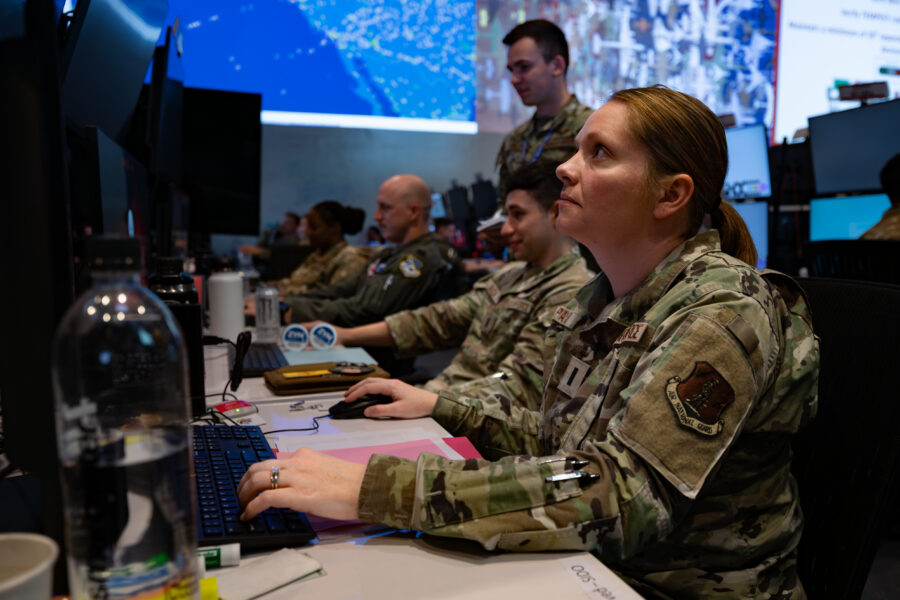
In December, the 805th Combat Training Squadron’s Shadow Operations Center at Nellis Air Force Base, Nev., conducted its capstone event following a year of experimentation for C2 modernization.
Event participants applied AI to C2 operations with human-machine teaming, kill chain automation, and multidomain operations.
The event included Army, Navy, and Marine Corps participants along with units from Canada and the United Kingdom, according to an Air Force release.
The shadow center worked on improving decision advantage using AI for workflows.
“We used these tools to react to changes before and during operations, increasing mission agility and FrOB [Friendly Order of Battle] awareness,” said Capt. Stephanie Albanese, experiment director.
Specifically, she said, participants used the Maven Smart System Joint Blue Asset Tool for tracking blue force assets, which helped with situational awareness and mission coordination.
Users tracked more than 500 assets to generate more than 300 solutions, according to the release.
The Agent Network is the Pentagon’s second of seven “Pace-Setting Projects” rolled out along with its AI Strategy in January. The first was the release of GenAI.mil, a department-wide access to frontier generative AI models for all DOD personnel. The website began offering wide access in December.
Other projects include:
- Swarm Forge: A competitive mechanism to iteratively discover, test, and scale new ways of fighting with and against AI-enabled capabilities
- Ender’s Foundry: Accelerating AI-enabled simulation capabilities
- Open Arsenal: Accelerating the technical intelligence-to-capability development pipeline
- Project Grant: Few details are known, besides “enabling transformation of deterrence from static postures and speculation to dynamic pressure with interpretable results.”
- Enterprise Agents: A playbook for rapid and secure AI agent development and deployment
