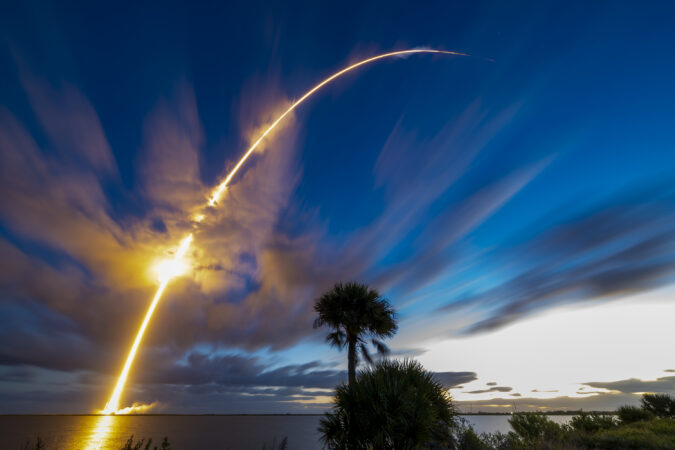

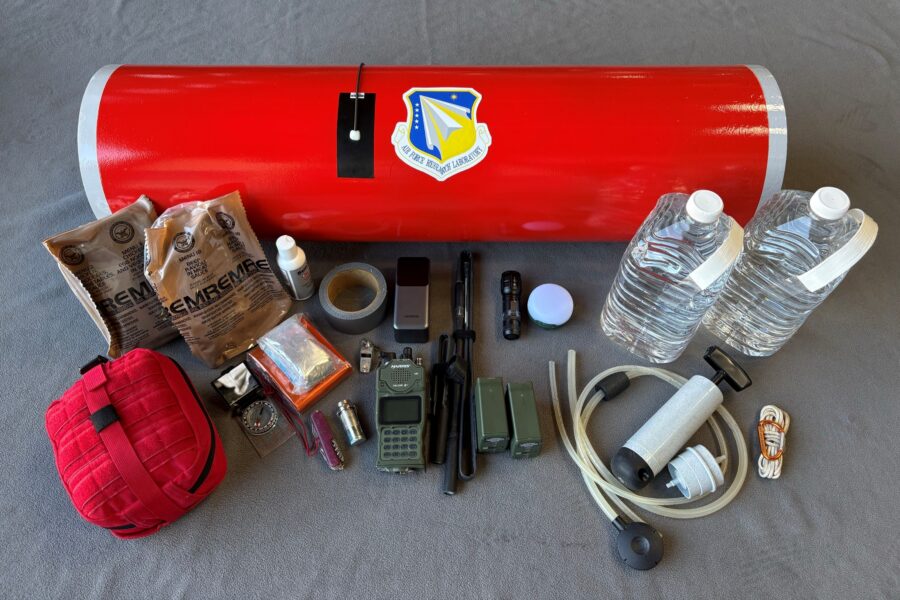
When a SpaceX Falcon 9 rocket took off from Cape Canaveral Space Force Station, Fla., on Oct. 20, it didn’t only carry the usual mix of micro-satellites and cubesats built by a wide range of companies. Also catching a ride into orbit was a capsule containing, among other things, a reverse osmosis desalinator, survival gear, and emergency medical equipment.
That capsule wasn’t bound for the only humans in space on the International Space Station; it was a test of a capability that could one day get critical supplies to U.S. forces around the globe.
The Air Force Research Laboratory launched its Rocket Cargo initiative in 2021 to explore the idea of moving large amounts of cargo through space, a process that would both be faster and allow the Pentagon to more easily reach remote or contested areas.
SpaceX, which has demonstrated the ability to return its rockets to Earth and safely land them, was the first company to get a contract under the program in 2022, when AFRL awarded the firm a five-year, $102 million contract.
Other companies, including Blue Origin, Sierra Space, and Rocket Lab, have since signed on as well, but AFRL never announced any experiments or tests for the project—until now.
In a release, AFRL said the Oct. 20 mission “used a SpaceX capsule with instrumentation to measure temperature, shock and vibration; it carried agile cargo pod designs built for various delivery loads.”
The lab did not specify how many pods or how much equipment were included in the test and did not immediately respond to a query, but its release said each pod had equipment and sensors to monitor the payload’s status as it launched and then reentered the atmosphere.
“Researchers paid special attention to the electronics equipment, including a satellite communication-enabled tracker, batteries, a reverse osmosis desalinator, survival gear and emergency medical equipment,” the release states.
The SpaceX capsule used in the test is called Starfall. Back in May, the Federal Aviation Administration released an environmental assessment for Starfall operations in the Pacific Ocean, describing it as a “cylindrical shaped capsule” with these dimensions:
- Approximately 0.75 meters (2.5 feet) tall
- A diameter of 3.1 meters (10.2 feet)
- A weight of 2,100 kilograms (4,600 pounds)
- Capable of carrying 1,000 kilograms (2,200 pounds) of payload
- Total weight of 3,100 kilograms (6,800 pounds)
In June, SpaceX launched what it called a “Starfall Demo Mission,” ending with the capsule splashing down into the Pacific.
It’s unclear if AFRL had any payload in the capsule for that May mission, or if the capsule from the Oct. 20 mission was recovered. But in a statement, AFRL’s Technology Transition Office director Adam Remaly touted the test as a success.
“This was a critical achievement to demonstrate the potential of Rocket Cargo delivery for point-to-point rapid global mobility for the future force,” Remaly said. “The cross-discipline collaborations and ability to unleash the speed of our defense industrial base are key to maximizing capability and winning the future.”
AFRL’s release noted that engineers also “measured the capsule to potentially include a life raft in future tests” on Oct. 20.
Rocket Cargo could one day deliver supplies “to contested environments and austere sites without access to runways and roads, including contested logistics, expeditionary operations, rescue operations, disaster relief and response to chemical, biological, radiological and nuclear hazards,” the release states.