
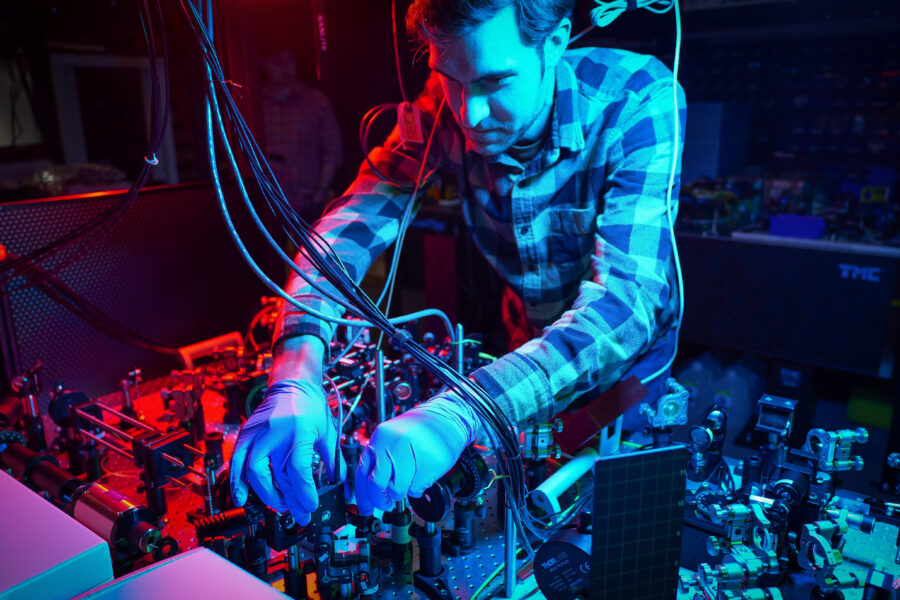
The Air Force Research Lab has awarded quantum computing firm IonQ a $7.5 million follow-on contract to bridge the gap between the lab and the field for the highly advanced technology.
The award, announced in late October, builds on the work the company has already done for AFRL at the the lab’s extreme computing facility in Rome, N.Y., as part of a total $21.1 million phased contract issued in January 2025
This new deal is for phase 2 and covers the development of optical, hardware, and software components that developers will use for an “operational, interoperable research platform,” according to a company release.
Donald A. Telesca Jr., chief of AFRL’s quantum information sciences and technology branch, told Air & Space Forces Magazine via email that integrating the full stack of quantum capabilities at the Rome location in phase 2 of the contract “serves as a critical steppingstone” for the lab’s broader roadmap toward a “multi-node quantum research platform.”
AFRL has worked on quantum networking and computing for the past decade, mostly in a laboratory context. Though the system being developed under the new deal isn’t meant to be fielded operationally, it’s moving toward that eventual goal.
“These incremental enhancements allow our researchers to validate foundational protocols now, setting the technical conditions required to build a fully interoperable, multi-node research environment in the future,” Telesca wrote.
The promise of a quantum network is in overcoming the bottlenecks common with traditional comms and data networks in modern-day warfighting, which produces tremendous amounts of data.
“Classical networks distribute readable information across global servers, whereas quantum networks distribute entanglement, a fragile physical correlation between endpoints that cannot be copied or broadcast,” Telesca wrote.
While traditional computing systems use bits to transmit information, quantum computing uses qubits, which can exist in any of three states: powered, off, or superposition, a combination. Entanglement is a “property that allows two qubits to be ‘linked’ together beyond what is possible in classical systems,” according to a report from consulting firm Ernst & Young.
That quantum link promises not faster computing, unbreakable encryption, and stronger communications links for the battlefield that overcome longstanding barriers.
“Rather than moving physical particles or transmitting traditional messages, quantum teleportation transfers fragile quantum states between distant nodes using shared entanglement alongside classical communication signals,” Telesca wrote.
In April, IonQ announced the first demonstration of connected, commercial quantum computers by photonically connecting two independent trapped-ion quantum systems: essentially, two quantum computers communicating via light instead of traditional electrical or other network cables.
This achievement could provide a way to build a quantum network, freed from the physical limits of by-wire networking.
Yet as Telesca noted, the link between qubits is fragile, and that fragility is a challenge when translating quantum tech from the field to the lab. Synchronization issues, signal loss, and a host of environmental noise challenges all make it harder to actually operationalize quantum.
“Moving entanglement distribution out of tightly controlled laboratory environments and onto existing, real-world telecom and open-air infrastructure is essential for proving practical viability,” Telesca wrote.
AFRL and IonQ are tackling that challenge in part by focusing on building quantum that can work on established networks and then scale to multi-nodal options in the future.
“Compatibility with established telecommunications wavelengths is important for integrating quantum technologies with existing optical networks. Supporting conversion to common telecom wavelengths provides greater flexibility to connect different types of quantum hardware,” Travis Pyne, IonQ’s director of technical program management, told Air & Space Forces Magazine in an email. “Improvements in network interfaces can also simplify integration across multiple nodes.
Connecting quantum technology using both standard telecom fiber optics cables and open-air links would allow the Pentagon to connect quantum processing units, Telesca wrote. That would then help synchronize atomic clocks for high-precision timing and link quantum sensors across broad geographic areas.
The new Phase 2 award for IonQ will fund the components needed to test how different quantum components interact outside the lab:
- Free-Space Optical Links: An advanced optical system with automatic pointing, acquisition, and tracking to establish entanglement distribution over secure, line-of-sight quantum channels within the C-band spectrum.
- Quantum Frequency Converters: Two quantum frequency converter modules that deliver interoperability across heterogeneous quantum and classical hardware utilizing standard telecom wavelength infrastructure.
- Automated Control Software: On-premises control-plane software upgrades supporting automated self-tests, real-time monitoring, failure handling, experiment execution, and automated results export.
- Upgraded Hardware Modules: O-band-compatible network hardware, enhanced polarization controls, and upgraded quantum network interface cards.
Source: IonQ
Company officials declined to share specific information about the components they are provided, citing proprietary protections.
However, Pyne said the company’s automated control software, which handles real-time monitoring, self-tests, and failure handling, is “essential” to potentially making quantum networks practical outside a lab setting.
“These capabilities help operators identify problems earlier and simplify routine maintenance. Ultimately, the goal is to make quantum networks easier to operate and more accessible to a broader range of users and organizations,” Pyne wrote.