


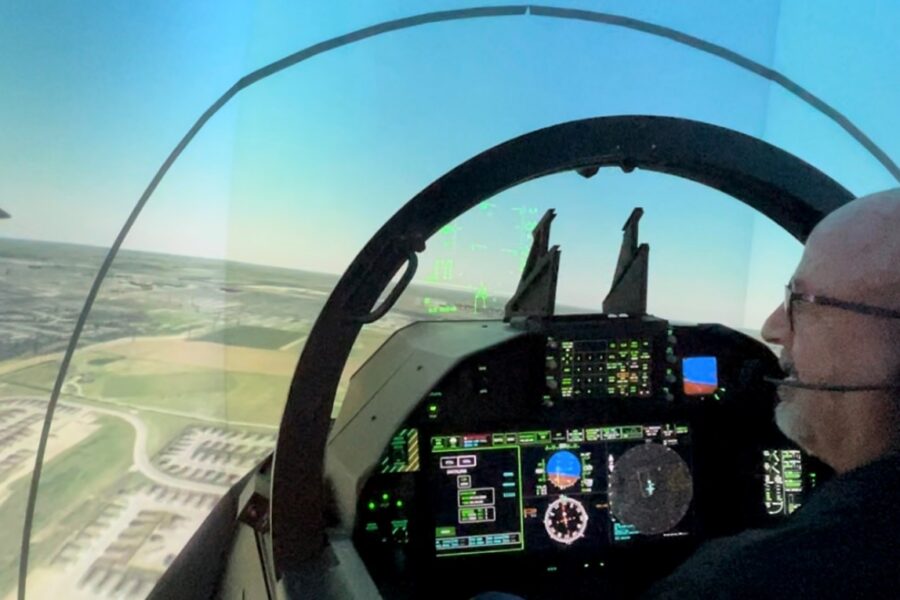
Three T-7A Red Hawks flew together at Joint Base San Antonio-Randolph, Texas, on Sept. 16—but only one was a real aircraft in the air. The other two jets were virtual, controlled from simulators on the ground. All three shared a single, common operating picture.
The demo marked the first time Air Education and Training Command has demonstrated live, virtual, and constructive simulation with its future jet trainer, the T-7 from Boeing. The demo inserted physical and digital assets into one synthetic environment, in which all three could communicate and work together.
“Think of it as a gaming area,” said Steven “Stein” Dobrinski, a Boeing flight simulator design engineer, in a January interview with Air & Space Forces Magazine. “If I’ve got everything programmed and I’m in the data link, now I’m able to have all the entities, the sims and the airplanes, that are all talking to each other in the same gaming area.”
Using LVC, the simulators and jets can fly as if equipped with missiles, bombs, or pods attached, and when employed by a pilot, others will “see” the effects play out on their displays. The simulators can also “inject” adversary aircraft or threats into a scenario, with threats appearing on everyone’s displays.
The Sept. 16 flight aimed to test and validate the “foundational digital architecture” for LVC to work with the T-7, according to a release from AETC.
The real T-7A was crewed by Col. Michael Trott and Lt. Col. Phillip Bourquin of the 99th Flying Training Squadron, while the simulators were controlled by civilian instructors with the 12th Training Squadron: Robb Erickson, a retired Air Force colonel, and Ryan Sparkman, a retired Air Force lieutenant colonel.
“Through secure, high-bandwidth tactical data links, ground-based flight simulators communicated directly with the airborne T-7A maneuvering across local military training airspace,” according to the release.
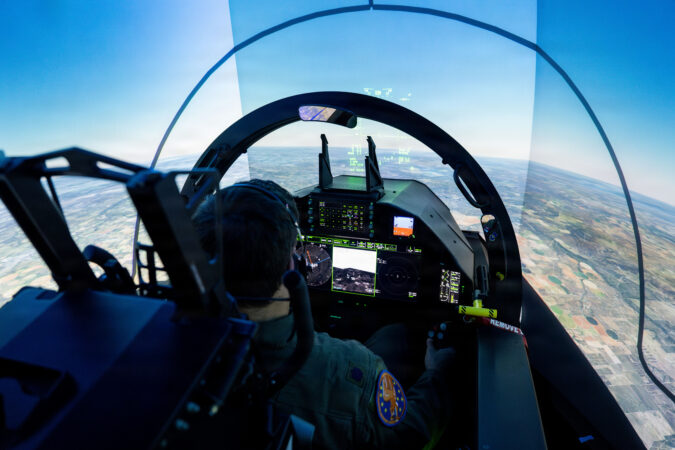
Boeing and the Air Force refer to the T-7 simulator as the Ground-Based Training System and see it as integral with the new trainer aircraft. The ability to pair simulators with real planes and inject virtual opponents into a scenario opens up a whole range of trainin capability that legacy T-38 Talon trainers could not support.
Officials envision future fighter pilots collaborating with manned and unmanned systems, along with automation, to manage enormous information streams, as they face off against high-level threats that will be difficult if not impossible to simulate in the physical world.
The most advanced versions of the T-7 GBTS simulator resemble an egg shell, with a 360-degree field of view, cockpit controls that mirror the real T-7 exactly, a seat that moves based on users’ inputs, and even an associated G-suit.
Trott, commander of the 99th and one of the first Airmen to be qualified as an instructor pilot on the T-7, praised the simulator to Air & Space Forces Magazine, calling it far more realistic than existing systems for the T-38 and F-15E, both of which he has used in the past.
The Sept. 16 flight is not the first time the T-7’s LVC capabilities have been tested—Dobrinski told Air & Space Forces Magazine in January that Boeing tried it out in a series of test flights last year. As one of the jets flew to Eglin Air Force Base, Fla., for climate testing, Boeing officials paired it with a simulator in St. Louis and inserted constructive entities.
“It worked like a champ on the way out,” Dobrinski said. “When it came back, we intercepted it again, and I was in one of [the simulators]. We had a four-ship, so we had four pilots in the sims, and we rejoined on the live aircraft and flew with them until they got sick of us, because we were talking on the radio. And we locked them with the radars, and that worked really, really well.”
More test flights followed, expanding up to a six-ship flight, Dobrinski said.
Training officials say live, virtual and constructive training is the future, not only for the T-7 but for other new aircraft, as well. The F-35 is starting to add elements of LVC through its highly advanced Joint Simulation Environment and new F-35 Emulated Non-Operational Flight Program Interoperability Experience, or FENIX, simulators. Air Force aviators used FENIX during Exercise Valiant Shield this summer to connect crews across the Pacific, according to a service release.