


NATIONAL HARBOR, Md.—The Air Force’s plans to field 1,000 semi-autonomous fighter and intelligence, surveillance, and reconnaissance drones within just a few years made headlines at AFA’s Air, Space & Cyber conference last month.
But beyond the service’s signature Collaborative Combat Aircraft and Massed Modular Aircraft programs, a half-dozen or so firms are pitching another kind of autonomous aircraft: cargo drones to solve some of the thorniest logistics problems.
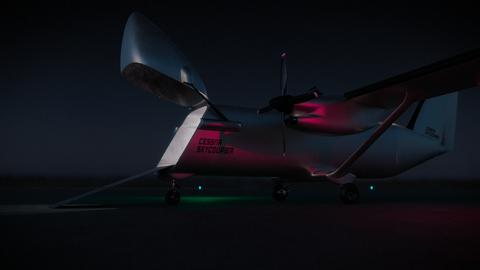
Textron Aviation and Merlin Labs unveiled a cockpit-less Cessna equipped with Merlin’s autonomy software and a nose hatch opening to a cavernous cargo bay.
“By pairing a proven aircraft platform with autonomy technology, we’re exploring new approaches to contested logistics operations while also examining how autonomy may enable more efficient cargo aircraft designs that increase usable volume, improve cargo accessibility and support mission sustainment requirements,” Bob Gibbs, Textron’s vice president for defense and special mission sales, said of the company’s Cessna SkyuCourier UX concept.
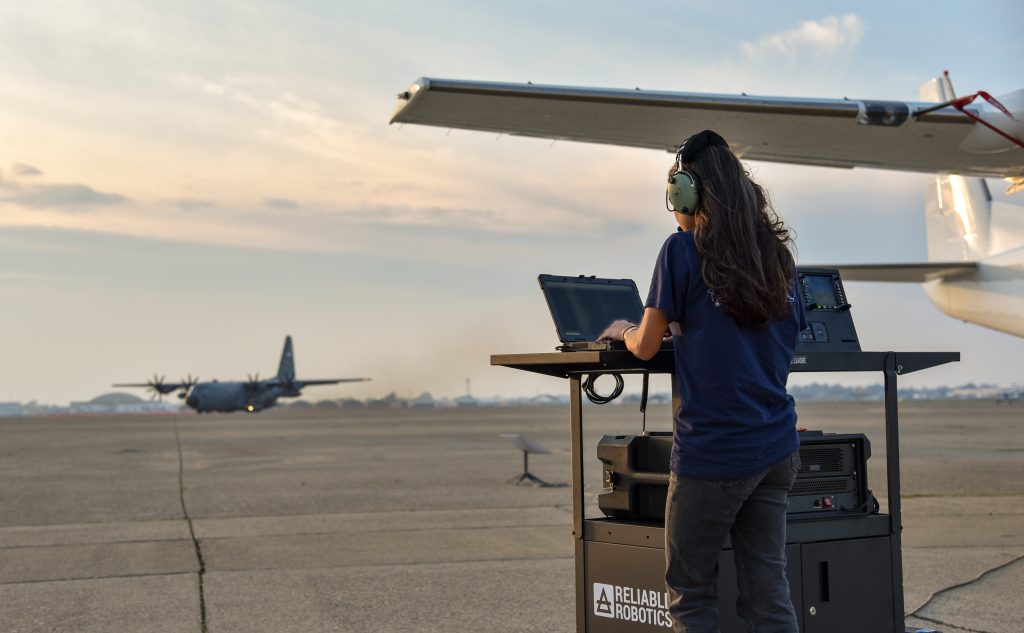
Reliable Robotics is offering its own modified Cessna 208B Caravan. Its aircraft flew in multiple Agile Flag exercises in 2024, installing actuators, sensors, and other gear in the cockpit and using a human pilot to command high-level direction from a ground station. Reliable announced a $17.4 million deal with the Air Force in 2025 to provide an aircraft for a yearlong test.
In a May blog post, Reliable’s certification flight test lead Chris Baughman wrote that the firm is targeting the start of fiscal 2027 to begin the test, which will focus on the Indo-Pacific region. The company is also seeking FAA certification for its autonomy software to operate in U.S. airspace, targeting 2028 for that certification.
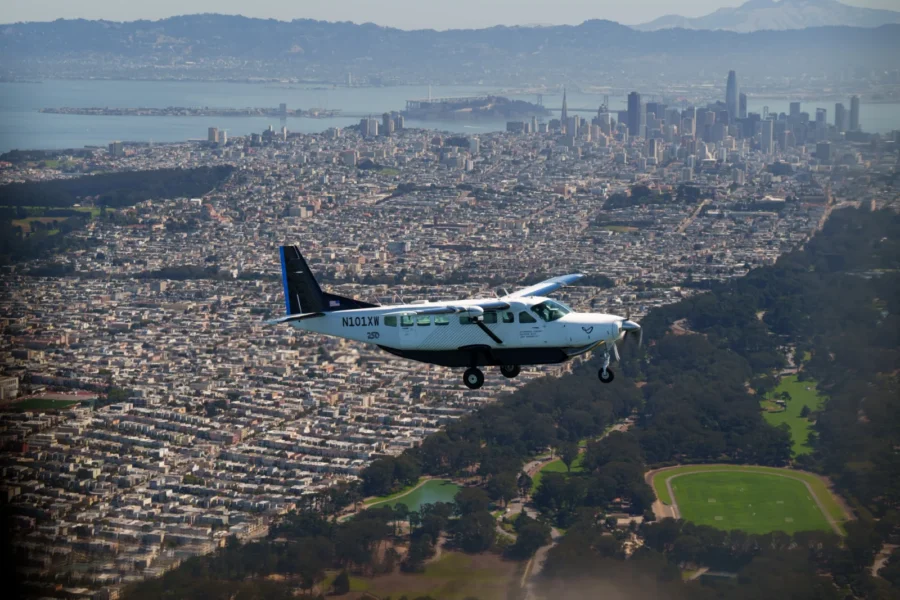
Joby Aviation, which previously acquired autonomy startup Xwing, is also flying a modified Cessna Caravan, racking up 40 hours and 7,000 miles during last summer’s Resolute Force Pacific. Joby did not exhibit at AFA’s Air, Space & Cyber, but sought to capitalize on the timing by announcing soon after that it completed 3,199 miles of autonomous flight across the U.S. this summer, including stops at Shaw Air Force Base, S.C., and near Washington D.C. At a press event Sept. 24, Joby’s Head of Defense Policy John Barranco told Air & Space Forces Magazine that the aircraft carried a safety pilot for those flights in case human intervention was needed, but the autonomy software never required a pilot intervention.
Coming at the same time that other vendors are developing autonomous fighters and reconnaissance aircraft with clean-sheet designs, the modified Cessnas might seem like minimalist efforts. But aviation firms see a gap they can fill in the Air Force’s logistics enterprise, a small airlifter that can do jobs that USAF’s workhorse C-130 cannot do as efficiently. The Hercules can haul 40,000 pounds of cargo, and the Air Force has only about 270. A Cessna could be ideal for shorter hops and smaller loads at a fraction of the cost.
“It’s a really robust, reliable existing cargo airframe that’s in the world, and there are many of them, and so we can retrofit a lot of those for the customers,” Barranco said.
USAF officials have spent years talking about Agile Combat Employment—the concept of dispersing small teams of Airmen and aircraft from large bases to operate from remote or austere locations and move quickly to counter adversary long-range missile attacks. But the ACE logistics is complex, especially in the vast and watery Indo-Pacific region.
Having small, unmanned aircraft to island-hop and resupply those forces so they can generate airpower—without taxing manned airlifters—could be a solution.
“Historically it’s about a logistics train where you’re trying to move a really big airframe and move a lot of stuff, and that takes time, and it takes Airmen, and it takes support, and that’s a really important mission,” said Barranco. “Sometimes you need to move a lot less really, really quickly, without standing up a mission, without 24 hours’ notice, without pulling folks together.”
Other concepts are also emerging to chase this possible market. DZYNE Technologies put its autonomous cargo drone, called Grasshopper, on display.
DZYNE and the Air Force Research Laboratory unveiled Grasshopper last May, as a self-guided glider capable of carrying up to 500 pounds after being dropped out the back of a C-130; from there, it could glide tens of miles to resupply troops in “high-risk environments.”
DZYNE has since offered a “Long-Range” powered variant with a turbine engine that can fly “10 times” further than Grasshopper and launched from “standoff” distances.
U.S. Special Operations Command has tested the concept, using the Long-Range Grasshopper in Exercise Trojan Footprint 26 in Romania and North Macedonia, where the drones were launched from a Romanian Air Force C-27J.
But the firms pursuing this niche want more than a narrow special ops use case, focusing on any mission where moving cargo quickly without risking crews could be attractive.
Grid Aero won $6 million in seed funding from the Air Force’s innovation arm, AFWERX, last August. CEO Arthur Dubois compared his company’s drone to a “flying pickup” truck at the time, saying it would be able to carry somewhere between 1,000 and 8,000 pounds from “Guam to Japan,” for example, a trek of some 1,500 miles.
Grid Aero’s Lifter Lite hasn’t made its first flight yet, but the firm was among seven selected in September to compete for the Air Force’s Massed Modular Aircraft program. It’s unclear if Lifter Lite or some other design is what the company envisions as its entry.
Dubois said last year that the idea for Lifter Lite sprang from asking military and commercial air cargo stakeholders about their pain points. For the military, that’s executing logistics in areas where U.S. assets could be attacked.
Lt. Gen. Kenyon K. Bell, deputy chief of staff for logistics, engineering, and force protection, noted as much during the conference: “The era of uncontested logistics is over,” Bell declared. “We will have to continue to fight our way in from a logistics standpoint and be able to sustain and regenerate ourselves while we’re in contact. … That is a concept that we certainly need to think through.”
Chief of Staff Gen. Kenneth S. Wilsbach endorsed the concept of autonomous cargo drones during a media roundtable at the conference, albeit without completely committing to it.
“We believe that there’s some value in that as well,” he said in response to a question. “It certainly could be valuable in the Pacific, with the ranges that we’re talking about. And so we’re looking at several different options and evaluating them, but I would say, no program of record just yet, but certainly taking a look at some demonstrators and the like to see what’s available to us.”
Congress and Pentagon officials are also tuning in. When Undersecretary of Defense for Research and Engineering Emil Michael culled the department’s list of “critical technology areas” from 14 to just six last November, “contested logistics technology” survived the cut.
The House Armed Services Committee directed the the Air Force to present a briefing on the topic in their version of the 2027 defense policy bill. Lawmakers also expect a proposed timeline for developing an acquisition strategy that could include rapid prototyping. They also want a strategy for the use of “low-cost and attritable Group 4 and 5 unmanned aircraft systems in contested logistics operations.”
Staff Writers Matthew Cox and Stephen Losey contributed reporting.