


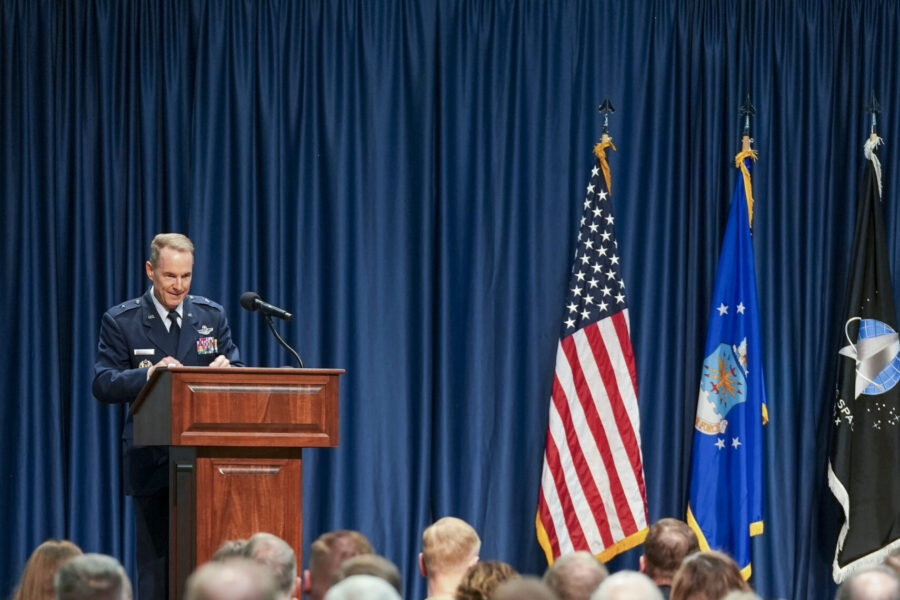
The Air Force Research Laboratory installed its newest commander, Brig. Gen. Douglas Wickert, in a June 3 ceremony at Wright-Patterson Air Force Base, Ohio.
Wickert most recently served as director of air, space, and cyber operations at Air Force Materiel Command, and before that, he led the 412th Test Wing at Edwards Air Force Base, Calif. An F-16 pilot earlier in his career, he spent several years as an instructor pilot at Eglin Air Force Base, Fla., and at Osan Air Base in South Korea.
Speaking at the change of command ceremony, Wickert emphasized AFRL’s role in helping shape the future of warfighting.
“The best way to predict the future is to invent it. The best way to win the future is to invent it. If we are to preserve the peace of the world in this pivotal decade, our science and technology enterprise must answer that same call again,” Wickert said. “It is our turn to discover, it is our turn to develop, it is our turn to deliver, and together our turn to win the future.”
He takes the helm amid a major AFRL reorganization, designed to position the lab to more quickly transition technology to Air Force and Space Force operators. Outgoing commander Brig. Gen. Jason Bartolomei led that organizational redesign, which consolidated 11 of its organizations into seven and aligned the remaining offices with the Department of the Air Force’s broader acquisition transformation.
As part of that effort, the services are reconfiguring siloed program offices into mission-centric portfolio acquisition executives, or PAEs. To more quickly funnel technology to those PAEs, the lab under Bartolomei’s leadership created four “integrating mechanisms” that cut across each of its organizations. Those include:
- Communities of practice, which will link researchers from different backgrounds with lab partners to share expertise
- Integrated planning teams, designed to spot technology gaps
- Innovation pipeline and advanced architecture cells, which create partnerships between AFRL and PAEs to align science and technology with acquisition requirements and timelines
- Campaigns focused on accelerating the transition of high-impact S&T projects
Bartolomei, who is retiring after 29 years in the Air Force and two years as AFRL commander, said this new structure positions AFRL well for the future.
“AFRL is the most important organization in the Department of the Air Force because it is the only organization not just thinking about the future, but committed to winning it,” Bartolomei said during the ceremony. “We are entering the next golden age of science and technology, and AFRL is well postured to bring the future faster for our nation.”