
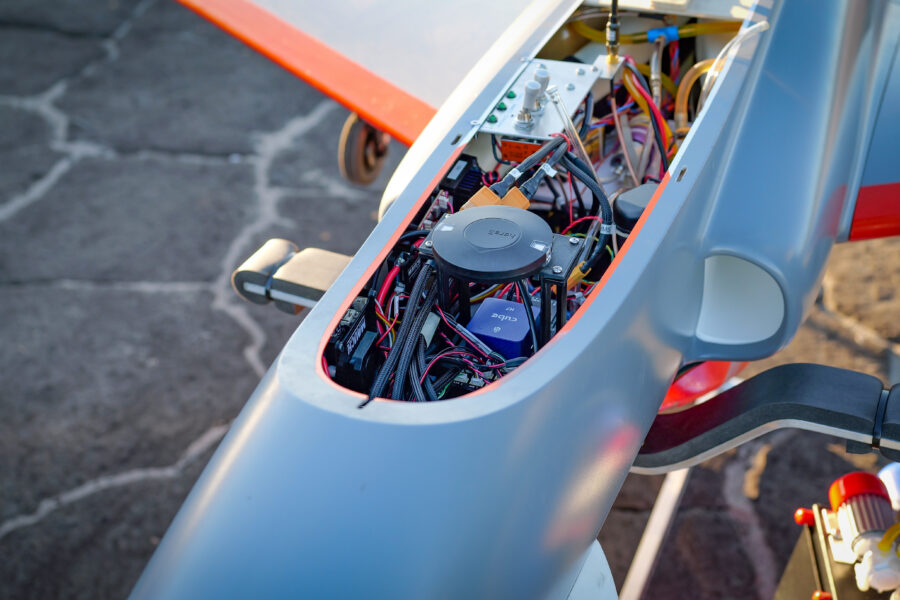
The Pentagon could have the option to create a new combatant command devoted to unmanned and autonomous systems if a provision in the Senate Armed Services Committee’s annual defense policy bill becomes law. The legislation is one of several moves lawmakers have proposed in recent weeks to both bound and bolster the department’s use of artificial intelligence and AI-enabled weapons.
The Senate committee released a summary of its proposed 2027 National Defense Authorization bill on June 11 revealing the potential new command, dubbed Robotic and Autonomous Systems Command. It would be the first new combatant command since U.S. Space Command was reestablished in 2019.
Lawmakers also included a section in the bill mandating a Defense Department review process for autonomous weapons systems and AI capabilities, according to the summary.
These proposals come on the heels of the House Armed Services Committee passing its own version of the NDAA last week, which also included a host of items involving AI and autonomous systems, including establishing an AI incident and vulnerabilities reporting program and an update on policy for AI and autonomous systems.
There’s a long way to go before any of these provisions become law, as both the full Senate and House must pass their bills and then resolve their differences. And notably, the SASC doesn’t want to mandate that the Pentagon create a new combatant command but instead just permit it.
But the efforts show a deep interest—and some concern—about how AI and autonomy are actively changing warfare.
At a June 11 background media briefing, congressional officials said the idea for a separate combatant command for robotic and autonomous systems was influenced in part by Ukraine establishing its Unmanned Systems Forces in 2024 and Russia starting its own Unmanned Systems Forces in 2025, as both countries rely more and more on such systems during the punishing war between them.
Still, it is far from settled that a combatant command—which commands and controls military forces either in a geographic region or with a specific function—is the right organizational construct. One official at the in-person media briefing said that within the committee, the decision involved a “very long, very spirited and very useful debate.”
Ultimately, committee members settled on a new combatant command, instead of setting up a new military service or leaving it up to the existing services and commands.
The potential command would be headed by a four-star officer tasked with quickly acquiring and integrating systems and transitioning the force to implement those systems, the official said.
Another official at the briefing said that idea is also based on lessons from the Pentagon’s Replicator initiative, which sought to field cheap, disposable autonomous systems in large numbers in under two years.
“How do you actually force generate and deliver those in a coherent way to combatant commanders?” the official said.
The committee’s reasoning, the official said, was that a new combatant command would give the DOD both guardrails and authorities, including for test and evaluation and limited acquisition authorities to experiment and buy items directly from the marketplace.
On the House side, an amendment seeks to update the Pentagon’s policy governing the use of autonomous systems and AI.
The update would establish or revise existing policy involving “artificial intelligence-enabled systems intended to support, recommend, or materially influence operational decisions associated with the employment of force, including systems used for operational planning, target development, weaponeering, or engagement recommendation.”
The move to both give more authority and put in safeguards is echoed in other areas of both the House and Senate bills.
The SASC summary, for example, included a provision that would create a review process for both autonomous systems and AI, specifically for “human judgment, validation and testing requirements, prohibited uses, and a centralized incident reporting repository.”
At a Center for a New American Security conference on June 11, retired Air Force Lt. Gen. Jack Shanahan, first director of the DOD’s Joint Artificial Intelligence Center, said that no matter how AI agents are used now or in the future, a human must remain the “final decider.”
Both he and fellow panelist Paul Scharre, CNAS executive vice president and author of “Four Battlegrounds: Power in the Age of Artificial Intelligence,” had overarching recommendations for AI policy.
Both agreed there must be law governing AI use, rather than DOD policy alone.
“I understand, at my very core, as somebody that spent 36 years in uniform, ‘leave us alone we know how to do this,’” Shanahan said. “But I now understand better than ever before, there is a legislative piece of that if you want to really take care of this at a high level, don’t just rely on an individual policy in the Pentagon.”
Scharre added that there are tradeoffs between Congress and the Pentagon. He advocated for a general framework of laws established by Congress that’s not overly constraining but that keeps the flexibility for the DOD to move quickly to rapidly changing technology.
Both the Senate and House Armed Services Committees want a way for Congress to be informed of incidents involving AI.
The HASC version would establish an AI incident and vulnerability reporting system, which Bryan Clark with the Hudson Institute told Air & Space Forces Magazine was one of the most “disruptive” of the House’s amendments, likely linked to recent attention Congress has paid to AI issues such as the Pentagon spat with Anthropic.
The Pentagon cancelled Anthropic contracts with the DOD earlier this year and is in the process of removing the company’s AI tools after Anthropic pushed back on the military’s insistence that it be allowed to use those tools for “all lawful purposes.” The company sought to restrict the use of its AI tools, such as Claude, with autonomous weapons systems.
The proposed vulnerability reporting system is an effort to try to make DOD leadership legally responsible to report to Congress when they have a model that operates in ways that are outside the legal bounds, Clark said.
“It’s sort of a push to get [DOD] to report things that it has made clear it doesn’t want to have a lot of oversight over,” Clark said.
Space Editor Courtney Albon contributed reporting.
