


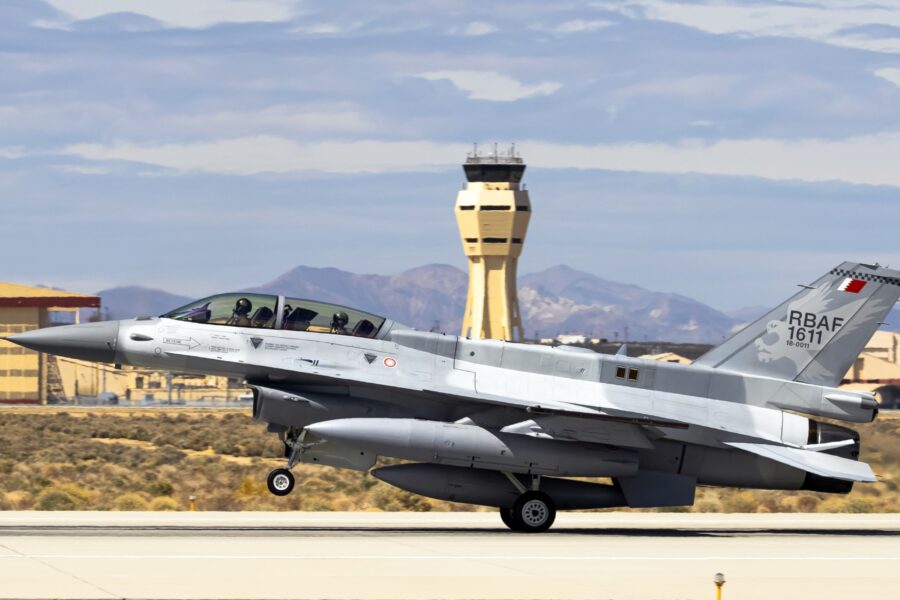
United States air forces are engaged in combat operations today, and not all the aircraft are modern stealthy platforms like the B-2, F-22, or F-35. The venerable Lockheed Martin F-16 Fighting Falcon remains the backbone of the U.S. Air Force fighter fleet and will be in service for two more decades, yet combat operations in Operation Urgent Fury prove it needs electromagnetic warfare (EW) upgrades to survive in modern threat environments.
Our knowledge of the frequencies and waveform characteristics across the Electromagnetic Spectrum (EMS) and our ability to manipulate them with hardware and software have grown tremendously. We harness our knowledge and capabilities continuously for tracking, intelligence, communication, jamming, radar, and many other applications. Unfortunately, so do our adversaries.
To survive and accomplish combat missions, F-16 pilots need to first detect enemy threat systems, like surface-to-air missiles or air-to-air radars, via a Radar Warning Receiver (RWR) and then counter the threat with Electronic Countermeasures (ECM) that manipulate radio signals to jam guidance systems outright or deceive them in such a way that makes them ineffective. If it were only that easy.
In 2023, Commander-in-Chief of the Ukraine Armed Forces, General Valerii Zaluzhnyi, wrote a paper listing five reasons why the war with Russia had ground into static trench warfare. He cited the critical importance and rapid adaptation of electromagnetic warfare along with air superiority, counter artillery battery fires, minefield clearing, and reserve forces.
The electromagnetic spectrum is the tissue that continuously connects all our systems together and allows us to coordinate our actions, detect adversaries, deceive threats, survive, and win. Acknowledging the EMS’s asymmetric impact, both Russia and China created separate branches of service and senior commands specifically focused on electromagnetic warfare.
While superiority in the EMS is critical across all warfighting domains: land, sea, space, and cyber, it is particularly important in air operations.
While the U.S. Air Force has re-prioritized EMS for a portion of the F-16 fleet, approximately 50% of the remaining F-16 aircraft fleet across the active duty, Air National Guard, and Reserves will not have EW protection with no clear plan going forward.
International partners have invested over $1B in procuring Viper Shield systems for their F-16s over the past seven years. The Air Force could add EW pods and leverage foreign investment to save taxpayer money. This foreign investment is funding development, lab testing, flight testing, and current production of operational Viper Shield systems, which presents the U.S. Air Force with a massive savings opportunity to avoid those upfront costs.
As the Air Force considers options to resolve the F-16 EW capability gap, a modest number of advanced EW pods would be a reasonable expense for near-term capability to mitigate against potential program delays, maximize flexibility across the F-16 fleet, and reduce invasive internal modifications.
Furthermore, the pod version of Viper Shield offers maximum flexibility to rotate systems across deploying squadrons, share them among operational units during training periods, and maintain them without taking an aircraft off the flying schedule.
F-16 pilots today – and for the next 20+ years – deserve the capability an EW pod like Viper Shield brings to the fight.
Lt. Gen. Lance Landrum, USAF (Ret.), served over 30 years as an F-16 Weapons Instructor and operational fighter pilot in several deployed locations developing firsthand combat experience on the importance of Electromagnetic Warfare. During his role as the Joint Staff J8 Deputy Director for Requirements and Capability Development, he stood up and led the interagency Electromagnetic Spectrum Operations Cross Functional Team that developed the current U.S. EMS Superiority Strategy and subsequent implementation plan. His insights are based on that experience and from his efforts to champion EMS capabilities as the U.S. European Command J3 and Deputy Chair of the NATO Military Committee.