
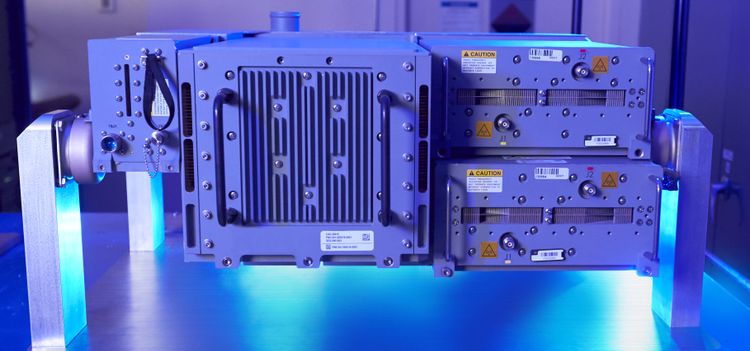
The Air Force has invested $87.4 million to upgrade the F-16 Fighting Falcon‘s electronic warfare capabilities, bolstering the fighter’s self-protection against increasingly advanced threats.
Bringing the total program value to $1.92 billion, the move is expected to jump-start fielding by funding low-rate initial production of the AN/ALQ-257 Integrated Viper Electronic Warfare Suite, or IVEWS, which is integrated into the fighter’s airframe.
This money is intended to produce an upgraded Viper for use in the Middle East, as part of an effort pushed by the U.S. military’s Central Command.
Work on the low-rate initial production batch at the company’s Illinois facility is expected to conclude by the end of 2029. The Air Force Lifecycle Management Center, Wright-Patterson, Ohio, oversees the contract.
The Need
The company says the new EW system is sorely needed for the F-16’s future fights.
“You cannot defeat what you cannot see,” said Shalini Gupta, vice president of electronic warfare and targeting at Northrop Grumman, in a statement to Air & Space Forces Magazine. “A modern EW suite is essential for operations in contested airspace. We are producing fully functional, flight-proven systems now. From day one, our customers gain the ability to geolocate threats with a single aircraft, and the confidence that comes with having a U.S. program of record system on board.”
The F-16 has seen a lot of action in Operation Epic Fury, and while its existing capabilities have handled Iranian air defenses and electronic warfare capabilities, peer adversaries such as the Chinese military have more sophisticated means to foil the jet fighter’s aims.
The Air Force issued an urgent operational need statement in 2025 that triggered a congressionally supplied $187 million in its fiscal 2026 reconciliation bill, which sped up system qualification and flight testing.
After CENTCOM’s operational need statement, Northrop and the Air Force made the effort a priority.
“This is one of many efforts to keep our fourth-gen platforms competitive as the adversary advances,” Lt. Gen. Derek France, then-commander of Air Forces Central, said in September 2025 about IVEWS. “That’s the bumper sticker, if you will.”
The recently announced additional $87.4 million LRIP modification fuels the initial production of the Viper suites. Full-rate production of the suites for the full 450-aircraft fleet is scheduled to follow this initial batch.
The initial production tranche for the Air Force was to outfit 72 Block 50 F-16s with IVEWS, with more likely to arrive as production ramps up, the company’s vice president of targeting and survivability Jim Conroy told Air & Space Forces Magazine in a 2025 interview.
Iran operates radar-guided and electro-optical/infrared (EO/IR) air defense systems. Non-traditional Houthi air defense systems proved a particular challenge for U.S. aircraft, including F-16s, during last year’s Operation Rough Rider against the group in Yemen.
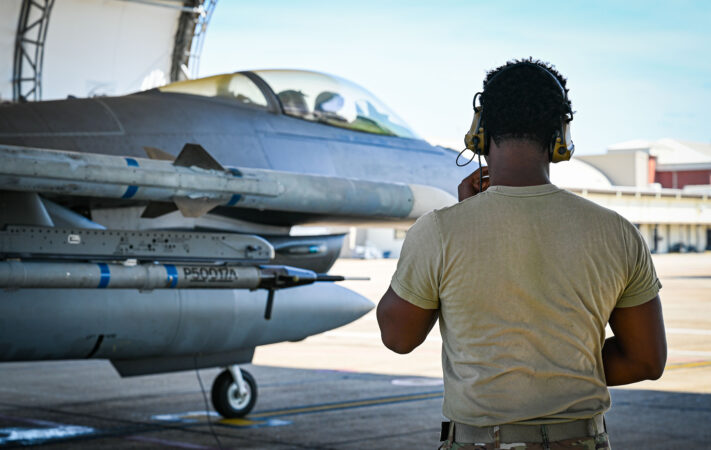
During Operation Epic Fury, the Air Force used its Block 50 F-16s in a suppression of enemy air defenses role and deployed most of its Wild Weasel SEAD F-16 units to support operations against Iran. Those units’ F-16s can carry AGM-88 anti-radiation missiles and are equipped with HARM Targeting System, or HTS, pods—a capability the Air Force’s other fourth-generation fighter, the F-15E Strike Eagle, lacks.
The System
IVEWS is an ultra-wideband, sophisticated EW system capable of radar warning, active jamming, and detecting, identifying, and locating threats, suited for fifth- and sixth-generation aircraft.
It can also conduct single-aircraft autonomous geolocation, meaning one aircraft can find an enemy radar and map a threat while actively using the aircraft’s jammer. Older systems required multiple aircraft to triangulate a radar location and required pilots to shut off jammers when mapping threats.
Under the USAF “Big Iron” software compliance standard, teams will be able to quickly update IVEWS system software files without hardware modifications or grounding the aircraft for days, weeks, or months.
IVEWS began flight tests in 2024 and has undergone more than 550 hours of effective testing across 300 sorties during operational assessments, Northrop Vice President for Mission Systems Mike Minahan said in a July call with reporters.
The system works in conjunction with the AN/AG-83 Scalable Agile Beam Radar. The radar uses an Active Electronically Scanned Array (AESA) to enable faster target tracking.
As of mid-May, Northrop had delivered 1,000 SABR radars to its F-16 customers. The new radar uses digital tracking as opposed to the legacy AN/APG-66 and AN-APG-68 radars that it is replacing.
IVEWS, the SABR, and the upgraded LITENING LA pod, which gives the aircraft a 50 percent increase in the range of its targeting system, are crucial to keeping the aging F-16 combat-worthy. The pod is also used on the F-15E Strike Eagle, A-10 Thunderbolt II, B-52 Stratofortress, and the Navy F/A-18 Super Hornet.
IVEWS would likely be equipped on possible future Air Force new-build “F-16G” purchases the service will consider, Air & Space Forces Magazine reported.
The LITENING LA, an upgrade from the current LITENING pod, entered flight testing in December, according to Northrop officials.