


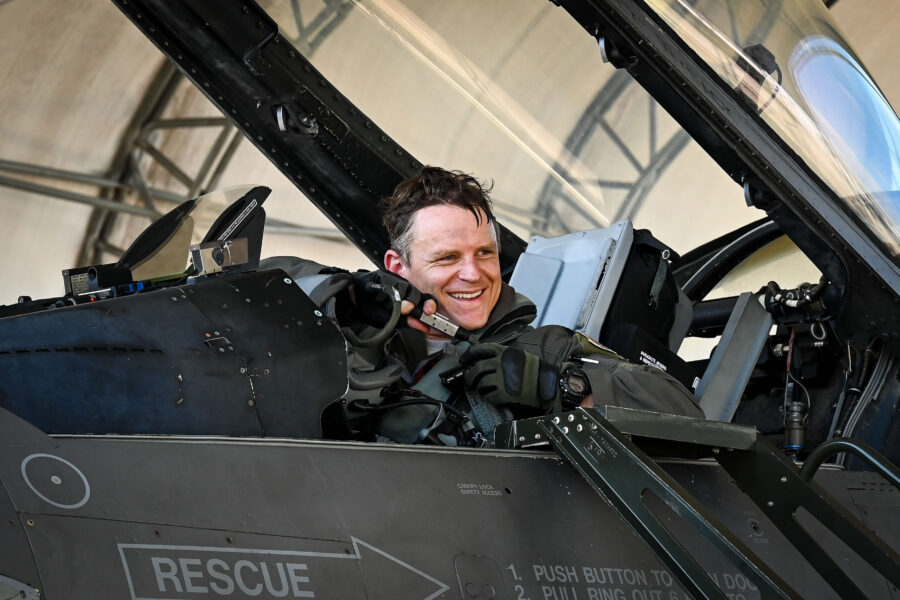
Northrop Grumman is deep into testing two upgrades for the F-16 as the Air Force looks to keep the fourth-generation fighter ready for the future fight, company officials told reporters this week.
The Integrated Viper Electronic Warfare Suite, or IVEWS, and the upgraded LITENING LA “large aperture” targeting pod have both been in the works for years now. Northrop’s vice president for mission systems Mike Minahan, a retired Air Force brigadier general, said in a July 13 call that both are nearing pivot points in their development.
IVEWS, officially designated the AN/ALQ-257, has been dubbed a fifth- or sixth-gen electronic warfare system, capable of radar warning, active jamming, and detecting, identifying, and locating threats.
The system entered flight tests back in 2024, and Minahan said it has now has undergone more than 550 hours of effective testing across 300 sorties during its operational assessment tests.
Northrop said last October that it was preparing to wrap up engineering and manufacturing development and move to production with the help of $187 million allocated in the “One Big Beautiful Bill Act” reconciliation package. In April, Minahan noted, the company got another $30 million contract for additional flight test releases as development continues.
Production is set to really ramp up in fiscal 2027, starting Oct. 1—the Air Force budget request includes $438 million for the program.
IVEWS is meant to work with Northrop’s AN/APG-83 Scalable Agile Beam Radar, which uses an Active Electronically Scanned Array to enable faster target tracking.
The company has delivered 1,000 SABR radars to F-16 customers, both U.S. and foreign, as of mid-May, according to a company release. The new radar replaces the fighter’s old AN/APG-66 and AN/APG-68 radars, which use mechanical scanning, a slower process that produces lag time when detecting threats.
The LITENING LA pod, meanwhile, is an upgraded version of the existing pod Northrop has built for decades. The firm previously upgraded the standard LITENING pods to digital color, and the large aperture version has improved resolution and image processing capabilities, according to a Northrop spokesperson. It also has six high-definition sensors that provide a 50 percent increase in range.
In late December, Northrop announced LITENING LA has entered flight testing. The company spokesperson said the pod is now in operational test flight.
Upgrades Needed
IVEWS, LITENING LA, and other upgrades are vital for the F-16 to keep pace with modern threats—especially as the stalwart fighter remains highly active.
“We’ve seen in Iran fourth-generation fighters, F-15s and F-16s have been playing a very important role,” retired Air Force Brig. Gen. Houston Cantwell told Air & Space Forces Magazine.
The modernization upgrades are aimed at giving the fourth-generation jet fifth-gen-like capabilities.
Cantwell prefers the term “4.5 generation” because, even with the required upgrades to keep the F-16 flying into the 2040s, the plane still won’t have the fifth-generation ability to ingest, process, and display all the information that the F-35 and F-22 Raptor can.
Still, the “Fighting Falcon” will have a role to play even against sophisticated adversaries such as Russia or China, said Cantwell, now a senior resident fellow at the Mitchell Institute for Aerospace Studies, said.
“I would imagine the way you would manage risk when it comes to that is your initial days would require fifth-generation, the most survivable aircraft, unmanned aircraft going in and knocking out a lot of the integrated air defense systems,” Cantwell said. “Once you’ve degraded those IADS, then that allows you to bring in more mass effects to allow fourth-generation fighters to bring in mass amounts of bombs and missiles to then further degrade and hit the strategic targets you want to hit.”
The F-16 makes up about 42 percent of the USAF fighter fleet, with 826 of them across the Active-Duty, Guard, and Reserve. As the service’s most common fighter, it is a linchpin of any near-term plans, Cantwell said.
“F-16 modernization, I believe, is absolutely critical because we are not purchasing enough new fighters to replace the older fighters at the rate that they’re being retired, and so we’re in this downward trend in terms of inventory numbers,” Cantwell said.
That’s important, Cantwell said, because of all the global commitments the U.S. military has on its plate. Even though the F-16’s eventual replacement, the F-35 Lightning II, can conduct more sophisticated missions and handle more tasks, there’s only so much that fleet can do while production is still ramping up.
“Even though we’d rather have F-35s go off and do everything around the world, there simply aren’t enough of them,” Cantwell said.
That’s especially true given that the F-35 has experienced delays with its new AN/APG-85 radar, resulting in some jets being sent to the Marine Corps without any radars whatsoever.