


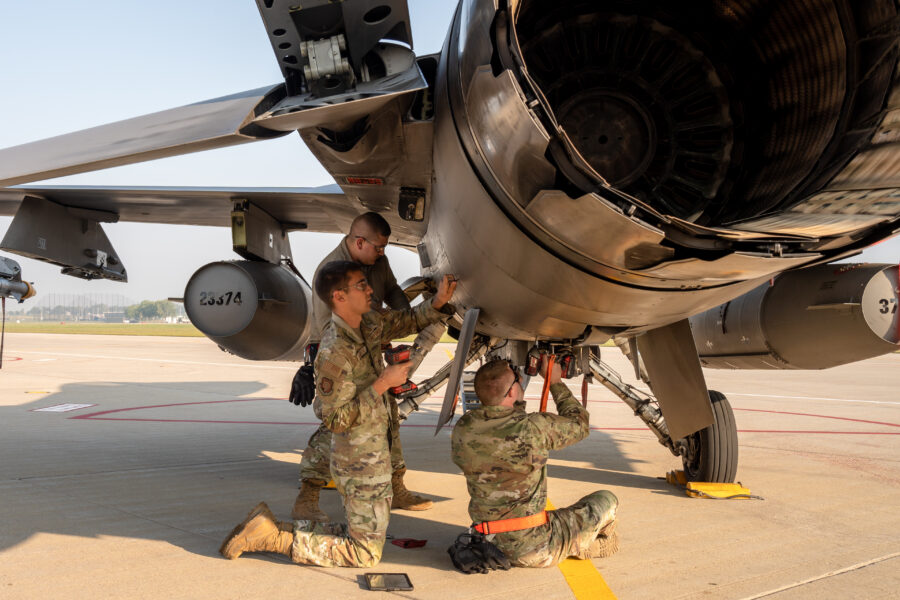
The Air Force Life Cycle Management Center is moving forward with a program to upgrade a quarter-century-old computing system for some F-16 fighter jets.
AFLCMC posted a notice seeking sources for what it calls the F-16 Next-Generation Mission Compute program in May, and it will meet with interested vendors at an Industry Day event Oct. 20-21 at Wright-Patterson Air Force Base, Ohio.
The project seeks to give the older F-16 an open systems architecture to process the troves of data now available via radar that are necessary for electronic warfare and networking with other systems, especially fifthgeneration fighters such as the F-22 Raptor and F-35 Lightning II.
“The team is especially interested in mature, open-system, modular solutions that can integrate efficiently into the existing aircraft while providing substantial growth capacity at speed,” an AFLCMC spokesperson told Air & Space Forces Magazine in an email. “The response from industry confirmed that a robust and highly capable industrial base with significant technical expertise is ready to deliver.”
The center wants to “maintain and strengthen the F-16’s operational relevance and dominance in an increasingly data-intensive combat environment.”
The upgrade is vital for the Viper to keep flying the combat missions the Air Force needs, retired Maj. Heather Penney, director of studies and research at the Mitchell Institute for Aerospace Studies, told Air & Space Forces Magazine.
“That’s the heart of the F-16’s ability to manage, integrate and present information to the pilot,” Penney, a former F-16 pilot, said. “That’s what really is bringing together all of the mission systems on the F-16. Whenever that computer was last updated, that’s your line in the sand for what the compute capabilities of that processor provide.”
Though not an exact analogy, Penney likened the current computing power on the F-16 to trying to use a 1990s-era Pentium 256 processor to run a modern GPU graphics project.
With the extra processing power, the mission compute upgrade also gives future technicians and F-16 teams ways to quickly add software capabilities and swap out components with the open mission systems approach, she said.
Not all F-16s are slated to get the update—the program is focused on the Block 40/42 and 50/52, or “post block” variants, not the older Block 30/32 types.
The Block 40/42/50/52 aircraft all have the Common Configuration Implementation Program software, which used the Modular Mission Computer from 2000 to 2010. The Raytheon-built MMC worked as a single processing hub, replacing the previous subsystems on the legacy aircraft.
The MMC had three hardware generations, with its chips evolving from 32-bit and 4MB of memory to 64-bit and 10MB of memory.
“This upgrade will combine the latest in open systems architecture, processing performance, reliability, and opportunities for growth to support rapid modernization while retaining compatibility with the F-16’s existing infrastructure,” the AFLCMC spokesperson wrote.
The jets being upgraded have been flying for 21 to 38 years. The Air Force wants to keep them going into the 2040s through a program it calls the Post Block Integration Team, or PoBIT.
It is “one of the largest modernization efforts in Air Force history,” according to a 2022 AFLCMC release. The total package, in addition to the mission compute upgrade, includes 22 modifications to the decadesold aircraft.
“You need to refresh your fleet when it’s out of life, and we know the F-16s have been rode hard and put away wet,” Penney said.
Stepping Up
The switch from the existing, closed computing system to an open compute system is similar to the shift from hardware-defined radios to software-defined radios, Penney said.
“That’s what this open compute is going to be able to do because it is actually … using a graphic processing unit, and that’s going to be the core of the new computer,” Penney said.
If a pilot is flying an F-16 into combat today, they don’t have the speed, RAM, or processing ability to integrate with the advanced battlespace networks their fifth-generation counterparts are tapping, Penney said.
So much of what’s happening in the airspace in modern combat is data- and processing-intensive.
“We need to have the new mission compute in order to make the most of the combat assets we have,” she said.
A Numbers Game
While the Air Force’s new fourth-gen jet, the F-15EX, has much of the capability the upgraded F-16s will have, the new Eagle II is nowhere near as plentiful as the Fighting Falcon fleet—USAF has 120 F-15EXs under contract and a total of about 267 planned, but the service flies more than 600 post-block F-16s.
The Air Force’s long-term plan dedicates a total of $6.3 billion for PoBIT F-16 fleet upgrades involving active electronically scanned array radar integration, Link 16, EW upgrades, structural upgrades, and thenew mission compute.
There’s also the possibility that the Air Force may decide to buy new F-16s, built off Block 70/72 tech, to build out its combat fleet’s capacity and supplement the F-22, F-35, and eventually the sixth-gen F-47.
While all these new fighters are necessary, Penney said upgraded F-16s are also a must-have for the service.
“If the F-16 fleet doesn’t receive this new mission computer, you’re essentially creating two tiers of your force, you’ve got the A team and the B team,” Penney said. “So, of all the things that the Air Force is working hard to move, you’re leaving the bulk of your fighter force behind. And I think that’s not going to serve combatant commanders if they are limited to using these aircraft in a different operational architecture.”