


NATIONAL HARBOR, Md.—BAE Systems is building a new slate of compact electronic warfare tools for small airborne platforms that could coordinate with fighters, work with helicopters, or augment legacy aircraft with outdated, hard-to-update EW suites.
The “Shadow EW” family will be produced out of the company’s Cedar Rapids, Iowa, facility, said Josh Niedzwiecki, vice president and general manager of electronic combat solutions for BAE.
The company announced the new systems here Sept. 15 at AFA’s Air, Space & Cyber conference.
Niedzwiecki couldn’t share details on specific platforms that Shadow might work with, but he did say the devices can perform standalone EW functions and can both complement and augment existing EW systems.
“If you’re on a platform and now you have another sensor or networked set of sensors in the environment that are providing spatially differentiated information about the battlespace that can be communicated back to, say, a manned platform, then it allows you to have a better picture, and then make better decisions,” Niedzwiecki said.
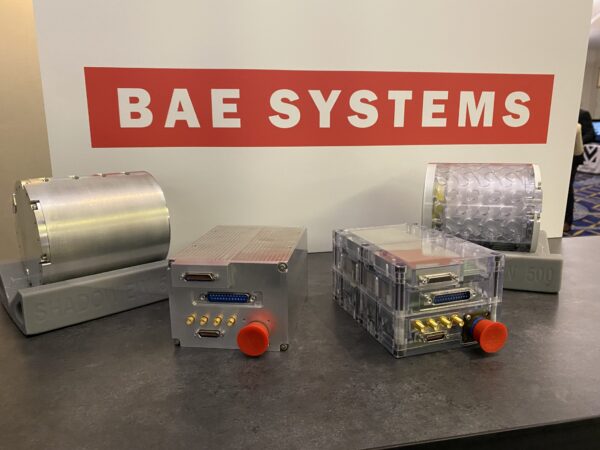
The “family” of Shadow systems include the 100, 120, and 500.
The Shadow EW 100 is designed for smaller platforms, mostly drones or attritable systems. It operates in the wideband radio frequency range of 70 MHz–6.0 GHz.
The Shadow EW 120 specializes in radar EW while also conducting signals and communications intelligence. It works in
5 MHz–6.0 GHz RF coverage.
The Shadow EW 500 can do edge processing and is built for Weapons Open System Architecture platforms. It works in the 10 MHz-18 GHz RF coverage.
While much has been made of the Air Force’s push to boost production of kinetic munitions—from the cheap Family of Affordable Mass Missiles program to existing air-to-air systems to new hypersonic weapons—the service is also looking for cheaper ways to deliver nonkinetic effects, such as electronic warfare.
Small Package
With the Shadow EW systems, BAE is looking to be “ahead of need” for the Air Force, anticipating that the service will want readily available EW tools.
David “Kooler” Krumm, BAE’s VP of business development and a retired USAF three-star, said the service will likely need such systems particularly for systems that require more work and funding to upgrade.
“Some of our legacy systems are just older and a take longer time [to upgrade]. Having something that you can carry now, use it to have the effect of an electromagnetic spectrum that you want, allows you to expand your capabilities across the board,” Krumm said. “So, it’s a very quick way to respond to emerging threats.”
BAE decided to take a “low-cost … high volume” approach to Shadow to respond to what Krumm said is an operational need for more EW arrows in the quiver.
The company is “working through” the price point for the EW packages, but while many sophisticated EW suites on board U.S. Air Force aircraft can cost several million dollars each, Niedzwiecki said Shadow will cost between thousands and tens to hundreds of dollars, depending on the features provided.
Without sharing specifics, Niedzwiecki said BAE is targeting active Pentagon programs with Shadow EW.
“The short answer is in the electronic warfare segment of our business, building ahead of need is usually very aligned to a very specific contract where we know something’s coming and we’re going to get ahead to make sure we buy material ahead of time to a contract,” Niedzwiecki said.
The smaller, cheaper option also lets operators deploy EW effects without giving away their position.
“Every time you communicate and radiate in the battle space, you’re also vulnerable. And so, if you can not have to rely on other assets to tell you where things are, then you have a much better chance of getting a target,” Niedzwiecki said.
The devices are also field programmable, which bypasses lengthy installation-level software updates or upgrade work.