
From missile warning to satellite communications for drones, the Space Force has played a key, if often unseen, role in the U.S. conflict with Iran, the head of the service’s Combat Forces Command said July 17. And one area in particular has seen Guardians be especially active: the electromagnetic spectrum.
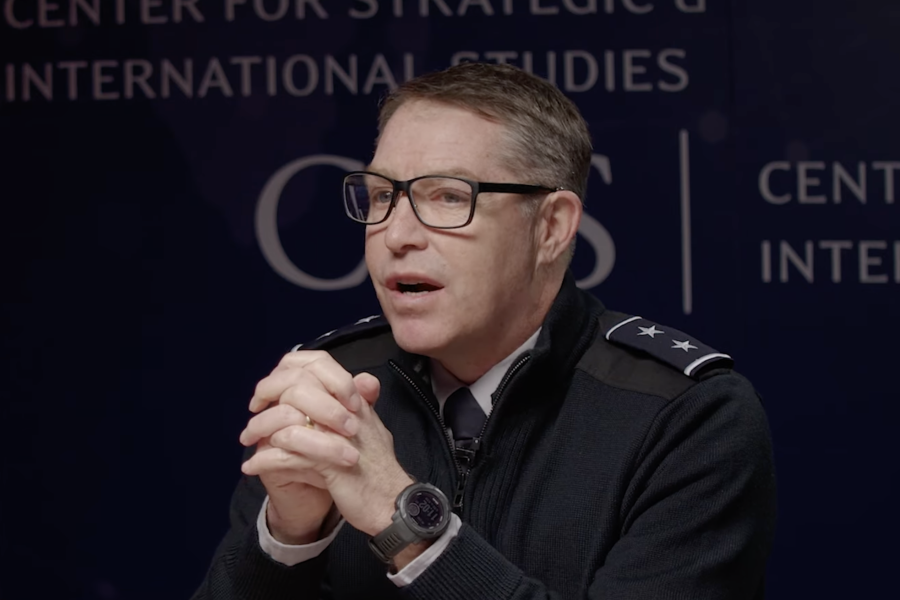
“What you are seeing in these operations isn’t just extremely proficient space operations. What you’re seeing from U.S. forces is extremely proficient joint operations,” Lt. Gen. Gregory J. Gagnon said at a virtual event with AFA’s Mitchell Institute for Aerospace Studies.
The Space Force’s combat contributions are often hidden behind a veil of classification, but officials have offered more and more hints about those efforts in recent months. Chairman of the Joint Chiefs Gen. Dan Caine identified space forces as among the “first movers” in Operation Epic Fury, U.S. Central Command boss Adm. Brad Cooper said the U.S. achieved “space superiority” in the conflict, and Chief of Space Operations Gen. B. Chance Saltzman said Guardians are providing “continuous application of space effects into the joint force.”
Gagnon provided some of the most details yet, noting that “there’s more that we can say than people properly appreciate.”
“Whether it’s missile warning or precision to long-range weapons, or [satellite communications] to the rapidly expanding drone warfare—because think about this: if you have a drone that needs controlling and it goes beyond line of sight, it obviously uses SATCOM,” Gagnon said. “If you’re using SATCOM to change the way warfare is today, you’re using the United States Space Force.”
Missile warning, position, navigation, and timing, and SATCOM are well-known Space Force missions. But the role of satellite communications specifically for drone warfare is a new wrinkle and particularly important given that the U.S. has deployed drones like never before during the conflict, including new one-way aerial and naval attack drones.
It was the mission of spectrum warfare, however, that Gagnon highlighted the most.
“What you are seeing in Central Command today, and in U.S. joint operations, is a return to U.S. spectrum dominance,” Gagnon told the moderator, retired Gen. Kevin P. Chilton.
When Chilton was on Active-Duty, Gagnon noted, the U.S. focused on spectrum warfare as a necessity to counter the Soviet Union. But during the Global War on Terror, that focus wavered because the adversary had no real spectrum capabilities.
The pendulum, Gagnon said, is swinging back.
“What I am seeing in this conflict is the space forces are delivering not just on the need for space superiority, because they have checked that block,” Gagnon said. “They are also delivering effects inside the joint formation, in a contested electromagnetic environment. And the Space Force, more than just being the space officer, is also the senior officer who’s extremely astute at [radio frequency], counter-command and control warfare, and spectrum dominance, and that’s a return for the U.S. military.”
Resiliency
In addition to the conflict in Iran, Gagnon also stressed the Space Force’s massive budget boost planned for 2027—the service’s request is more than double what it got it 2026.
Some of that extra money, Gagnon said, will go toward added resiliency for the service’s satellite constellations. The need for resiliency has been a major focus for the Space Force over the last five or so years, as the service tries to move away from large, exquisite satellites vulnerable to attack with few backup options.
That focus has paid off, Gagnon said.
“That type of thinking about adding resiliency into core capabilities the joint force needs—that was an uphill argument four years ago,” Gagnon said. “We don’t have to make that argument anymore. Everyone’s like, you tell them the bill, and then they say, ‘Is that resilient?’ You’re like, ‘Yes, we designed that.’ … So the climate’s changed quite a bit inside the resource world.”
For many, resiliency in space often means larger numbers of small satellites so that the constellation can withstand losses. But Gagnon said in some cases it will also entail keeping satellites in storage, ready to go up on short notice. That means paying for extra spacecraft, something the Space Force typically hasn’t done but is starting to do, he said.
“I assume losses, because that’s war,” Gagnon said.
“We do that with airplanes,” Chilton noted.
“We do it with everything except space. So we’re fixing that. It’s going to take time, but that is part of those budget numbers.”
