
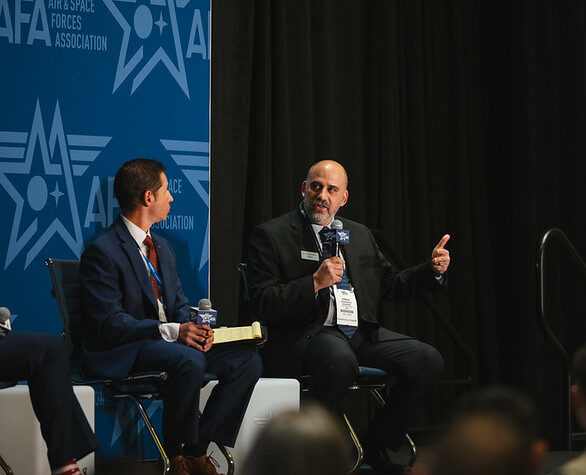
The Trump administration on April 21 nominated retired Col. Erich Hernandez-Baquero, an executive at Raytheon, to become assistant secretary of the Air Force for space acquisition and integration.
Hernandez-Baquero’s most recent position is vice president of space intelligence, surveillance, and reconnaissance at Raytheon. If confirmed, he will oversee the Space Force’s acquisition enterprise, filling a role that’s been vacant since January 2025.
Retired from the Air Force after 27 years of service, Hernandez-Baquero held a number of space-related positions within the intelligence community before joining Raytheon in 2021. He was the principal deputy director of the ground enterprise directorate at the National Reconnaissance Office for four years and prior to that, from 2012 to 2017, he was in NRO’s Geospatial Intelligence Division, where he was payload division chief and later deputy director.
His intelligence community experience is similar to the only individual to previously occupy the Space Force acquisition executive role, Frank Calvelli, who was principal deputy director of the National Reconnaissance Office for eight years prior to taking the Space Force role.
Calvelli was known throughout his tenure from 2022 to 2025 for his “acquisition tenets,” which called on acquisition personnel to be “demanding customers,” write realistic and executable contracts, and avoid overclassification. He led a push toward smaller, more proliferated satellites and ground systems with simplified designs that could be produced in larger quantities.
“The traditional ways of doing space acquisition must be reformed in order to add speed to our acquisitions to meet our priorities,” Calvelli said in an October 2022 memo to his workforce. “Former approaches of developing a small among of large satellites along with large, monolithic ground systems that took many years to develop on cost plus contracts can no longer be the norm.”
Calvelli’s focus on streamlining and reforming space acquisition laid the groundwork for a broader service-wide push to buy more off-the-shelf systems. It also helped position the service to respond to Defense Secretary Pete Hegseth’s current acquisition transformation remit, which calls on the military services to deliver capabilities faster and in larger quantities and to rethink the way they manage acquisition efforts—moving away from individual program lines toward capability portfolios.
Hernandez-Baquero, if confirmed, will oversee a growing portfolio of satellites and ground systems and most likely a growing budget for both procurement and research and development. The Space Force’s fiscal 2027 budget request asks for $19 billion in procurement funding, up from $3.6 billion in ‘26, and $40.6 billion in R&D funding, up from $30 billion this year.
He will also inherit a depleted acquisition workforce, which suffered steep losses of civilian talent as a result of the Trump administration’s Deferred Resignation Program, which sought to shrink the size of the federal government by offering civilian staff months off with pay while they sought private sector employment. Space Systems Command, the Space Force’s largest acquisition organization, is working to rebuild that workforce. SSC Commander Lt. Gen. Philip Garrant said April 14 he’s been asked to hire 100 new personnel per month to fill close to 1,000 positions, 200 of them new.
