
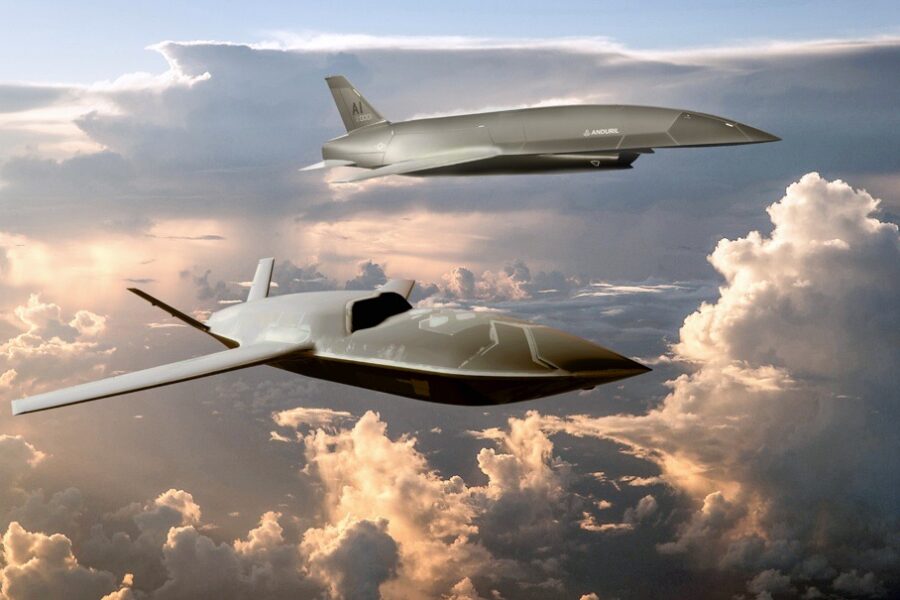
The fiscal 2027 defense budget request comes at a crucial time for a game-changing new military capability: The Air Force’s plan to develop a whole new kind of combat aircraft, the autonomous Collaborative Combat Aircraft.
The Air Force wants about $1 billion to move the CCA program into production in fiscal 2027 and accelerate the introduction of this game-changing technology. Congress should support that objective.
Here’s why: With today’s U.S. Air Force inventory both too old and too small for the myriad missions it faces, CCA can be the key to ensuring U.S. fighting capacity in the future.
These uncrewed jets have the potential to radically change air warfare. Because they are autonomous, CCA can act as force multipliers operating in partnership with crewed combat aircraft. The combination would be more lethal while reducing risk to human pilots and the mission. Just as remotely piloted aircraft like the MQ-9 transformed and even created new types of missions like persistent overwatch, CCA will change air combat and inaugurate new types of missions, increasing effectiveness and lethality—but only if Congress funds their development at this key juncture.
As threats to the U.S. radiate from the Pacific to Europe and the Middle East to our homeland, demand for airpower from combatant commanders is growing. But because the nation has not meaningfully recapitalized the U.S. Air Force for over 30 years, the force is stretched thin. Despite the magnificent performance of our combat Airmen, the age and lack of capacity is driving operational risk to unacceptable levels.
The U.S. Air Force shrunk from well over 4,000 fighters and 400 bombers at the end of the Cold War in 1990 to just over 2,000 fighters and less than 150 bombers today. Yet demand for combat airpower in only increasing.
Deterring Chinese aggression and a nuclear-armed North Korea, defeating Iran, blocking Russian hostilities in Europe from expanding across the continent, and ensuring the U.S. homeland remains a sanctuary from foreign military interference are all vital, ongoing missions; leaders can’t choose one or another. All require full-time attention.
The CCA program is a key part of the answer. Designed around the need for mass, CCA have the potential to augment sensing and firepower at the scale and scope future combat will demand. Recent wargames point to novel uses of the jets, increasing USAF’s ability to surprise adversaries, decrease their battlespace awareness, deliver kinetic and nonkinetic effects, and draw forces away from manned force packages.
Real-world combat results from Operation Epic Fury bear this out: Remotely piloted MQ-9 were specifically tasked in ways far different than their manned counterparts. Commanders harnessed the MQ-9’s endurance, powerful sensors, and on-board weapons to take outsized risks and successfully find and destroy mobile missiles, attack drones, and air defense systems. While a number of MQ-9s were lost in those missions, no Airmen were—demonstrating the value of uncrewed platforms as stand-in weapons. Hardware can always be replaced, but people are a different story.
Like the MQ-9, CCA can be employed to execute the most dangerous missions and increase total force effectiveness. But the Air Force will need the funding to develop the CCA autonomy—the mission-oriented “brains” of the aircraft.
Competing priorities and visions are also at play, and protecting the programs that have the greatest transformational potential will be crucial. This year’s congressional budget cycle is a big one for the Air Force, with a record $1.5 trillion Department of War budget proposal in play.
President Trump and a bipartisan selection of lawmakers are poised to invest to revitalize America’s military. The fact is that programs move at the speed of resourcing. CCA software and hardware can stay in the lab, growing more costly as delays mount, or they can move into development, get fielded, and benefit from real-world operational flight time.
The faster Airmen get their hands on this technology and put it to work in operational environments, the sooner warfighters will gain from the technology. Likewise, those reps and sets will also pay off for the mission commanders operating with CCA, who must develop the tactics, techniques, and procedures needed to effectively integrate, employ, and sustain CCA. Everything remains theory until it’s put into practice, and it’s only through practice one can learn to be effective.
Still, for all the value and promise of CCA, manned aircraft still have a role in modern warfare. Nothing yet can replace the power of human cognition, real-time judgment, and improvisation in warfare. Pairing crewed and uncrewed aircraft as collaborative teammates can yield a more potent force combining the respective advantages affordable combat mass of CCAs with the creativity of human warfighters. That combo can better penetrate enemy airspace, survive threats, and deliver lethal effects, maximizing combat flexibility.
As the budget bill moves through Congress, some might be tempted to pump the brakes on emerging technologies like CCA. But doing so now would have long-lasting repercussions, costing the Air Force time to turn these emerging capabilities into operational airpower now, so that USAF is fully equipped to employ those new weapons when called upon later. The time is now to fund CCA to get these important teammates into the hands of the warfighters who will need them.
Heather Penney, a former F-16 fighter pilot, is Director of Studies and Research at AFA’s Mitchell Institute for Aerospace Studies.
