


The Air Force has awarded contracts to General Electric Aerospace and Rolls-Royce to further hone their designs for engines to power medium-thrust autonomous drones.
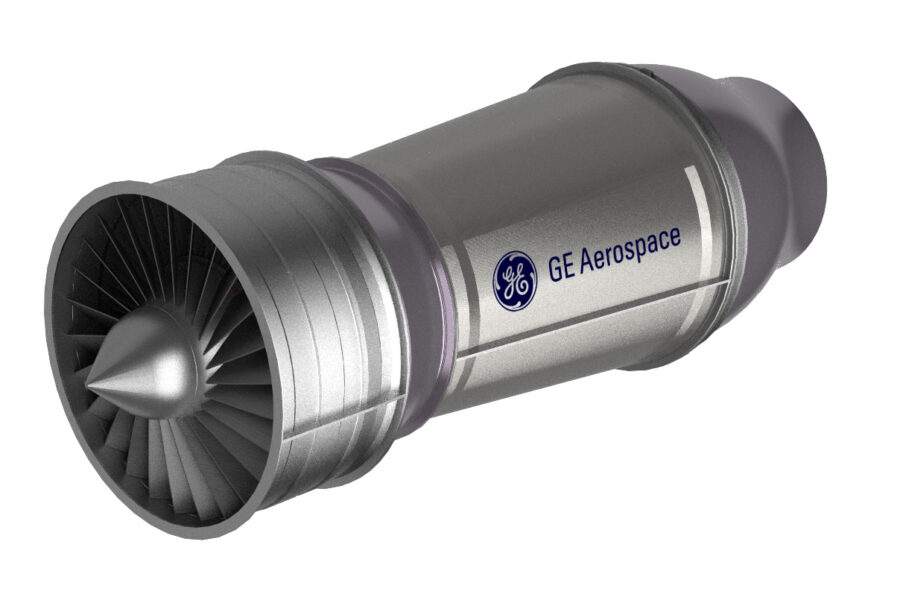
GE announced in a May 19 release that it received a contract to complete a preliminary design review for its GE426 engine, supporting the Air Force’s medium thrust class Autonomous Collaborative Platform, or ACP, project.
An Air Force spokesperson also confirmed in a statement to Air & Space Forces Magazine that Rolls-Royce Liberty Works—the company’s Indianapolis-based advanced research and development arm that focuses on military and government projects—had received a contract as part of the same solicitation.
The Air Force said GE received a firm-fixed-price award that leveraged an Other Transaction Authority through the service’s Propulsion Consortium Initiative 2.0, and that Rolls-Royce’s contract was awarded under the same solicitation.
The contracts and Rolls-Royce’s selection were first reported by Breaking Defense.
ACP drones are autonomous drones that would operate alongside more expensive, piloted aircraft, the Air Force spokesperson said.
ACPs “will be designed with modular open systems architecture, digital engineering, rapid software development, and new manufacturing techniques that will offer the potential for a new genus of smart, risk-tolerant, teamed aircraft that can increase capacity in a highly contested environment,” the Air Force spokesperson said.
The Air Force spokesperson said Collaborative Combat Aircraft, such as the General Atomics YFQ-42A and Anduril YFQ-44A, are types of ACPs.
The Air Force is now concentrating on the ACP effort, the spokesperson said, but other platforms could also use Rolls-Royce or GE’s engines.
Candice Binyard, Rolls-Royce’s director of business development and future programs for defense, said in a statement to Air & Space Forces Magazine that the company’s AE engines could be chosen for the ACP drones.
“Autonomous aircraft represent a fundamental shift in how the U.S. Air Force will project combat airpower,” Binyard said. “By leveraging our advanced AE engine family, we can move quickly to deliver the performance, electrical power and reliability our warfighters need for operational advantage in contested environments.”
The Navy’s MQ-25 Stingray refueling drone uses Rolls-Royce’s AE 3007, the company said, and the RQ-4 Global Hawk and MQ-4C Triton use the military variant of that engine, the F137.
GE Aerospace said its GE426 engine is a new propulsion system that was built specifically for medium-thrust ACPs. The company said in a May 19 release it successfully finished the engine’s concept design review in August 2025, which confirmed its architecture would work and moving the design forward.
GE Aerospace now plans to keep maturing the GE426 prototype through a preliminary design review and further refine its capability, producibility and cost.
“We’ve proven we can rapidly move from concept to engine demonstration with the GEK800, and our focus now is on applying that process to the GE426 to ensure it provides the performance, affordability and readiness the warfighter needs,” Steve “Doogie” Russell, the vice president and general manager of GE Aerospace’s Edison Works, said in the company’s own statement.